
 Facebook
 Google
 GitHub
 Linkedin
Discrete Semiconductor Devices and Circuits
Oscillator Circuits
49 questions By Tony R. Kuphaldt
-
Question 7 of 49
Explain the principle of operation in this astable multivibrator circuit:
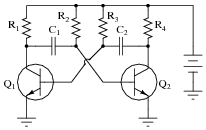
Also, identify where you would connect to this circuit to obtain an output signal. What type of signal would it be (sine wave, square wave, ramp or triangle wave, etc.)?
Reveal answerA square-wave output signal may be obtained at the collector of either transistor. I’ll let you research this circuit’s principle of operation.
Notes:Ask your students to explain how the frequency of this circuit could be altered. After that, ask them what they would have to do to alter the duty cycle of this circuit’s oscillation.
-
Question 8 of 49
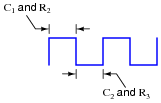
This astable multivibrator circuit will oscillate with a 50% duty cycle if the components are symmetrically sized:

Determine which component(s) would have to be re-sized to produce a duty cycle other than 50%.
Reveal answerI won’t answer this question directly, but I will give a large hint: C1 and R2 determine the pulse width of one-half of the square wave, while C2 and R3 control the pulse width of the other half:
Challenge question: re-draw the schematic diagram to show how a potentiometer could be used to make the duty cycle adjustable over a wide range.
Notes:Astable multivibrator circuits are simple and versatile, making them good subjects of study and discussion for your students.
-
Question 9 of 49
If you have ever used a public address (“PA”) amplifier, where sounds detected by a microphone are amplified and reproduced by speakers, you know how these systems can create “screeching” or “howling” sounds if the microphone is held too close to one of the speakers.
The noise created by a system like this is an example of oscillation: where the amplifier circuit spontaneously outputs an AC voltage, with no external source of AC signal to “drive” it. Explain what necessary condition(s) allow an amplifier to act as an oscillator, using a “howling” PA system as the example. In other words, what exactly is going on in this scenario, that makes an amplifier generate its own AC output signal?
Reveal answerThe amplifier receives positive feedback from the output (speaker) to the input (microphone).
Notes:Ask your students to define what “positive feedback” is. In what way is the feedback in this system “positive,” and how does this feedback differ from the “negative” variety commonly seen within amplifier circuitry?


