Facebook
 Google
 GitHub
 Linkedin
Basic Electricity
Performance-Based Assessments for Basic Electricity Competencies
29 questions By Tony R. Kuphaldt
-
Question 10 of 29
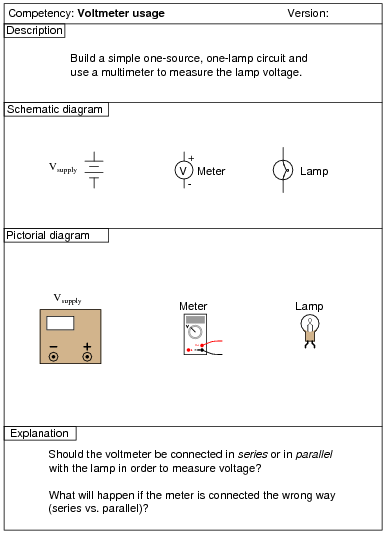
Reveal answerConnect the voltmeter in parallel with the component whose voltage is to be measured.
Notes:The purpose of this exercise is to make absolutely sure students can safely measure voltage with a multimeter.
A good extension of this assessment is to have students demonstrate competency using both digital and analog multimeters!
-
Question 11 of 29
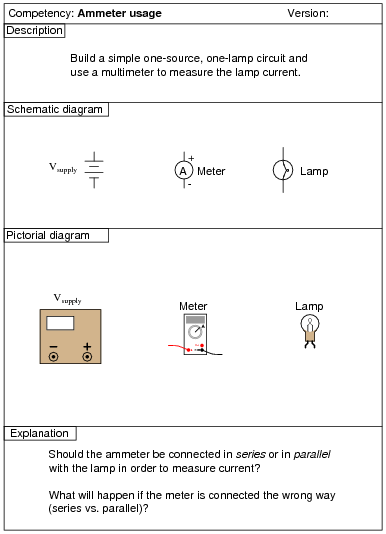
IMPORTANT NOTE: do not actually try to connect the ammeter improperly in the circuit, as the meter may be damaged in the process!
Reveal answerConnect the ammeter in series with the component whose current is to be measured.
Notes:The purpose of this exercise is to make absolutely sure students can safely measure current with a multimeter.
A good extension of this assessment is to have students demonstrate competency using both digital and analog multimeters!
-
Question 12 of 29
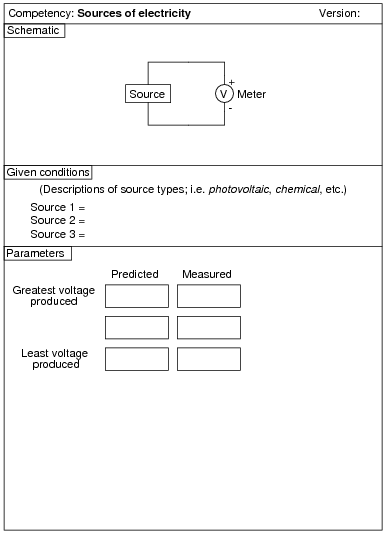
Reveal answerThe real-life measurements you take constitute the “final word” on which sources generate the most significant voltages.
Notes:In this performance assessment, different electricity sources are suggested by way of conversion phenomena. In other words, the instructor will list such things as photovoltaic and piezoelectric, and students will have to choose the correct components to demonstrate conversion of energy into electrical form. Then, students will demonstrate each conversion for the instructor, ranking them in order of the voltage magnitude generated by each demonstration.
The purpose of this exercise is not only for students to obtain a practical understanding of electricity sources, but also to understand the relative magnitudes of each one. It is important for students to know, for instance, that thermoelectricity is a rather weak effect compared to piezoelectricity. This will help them understand the relative sensitivity of sensors and other electrical devices in the future.
Possible sources to list for student demonstration are:
- • Photovoltaic
- • Piezoelectric
- • Electromagnetic
- • Chemical
- • Thermoelectric
Of course, your selection of sources for student demonstration depends on the parts and equipment available to them.