Facebook
 Google
 GitHub
 Linkedin
Basic Electricity
Performance-Based Assessments for Basic Electricity Competencies
29 questions By Tony R. Kuphaldt
-
Question 13 of 29
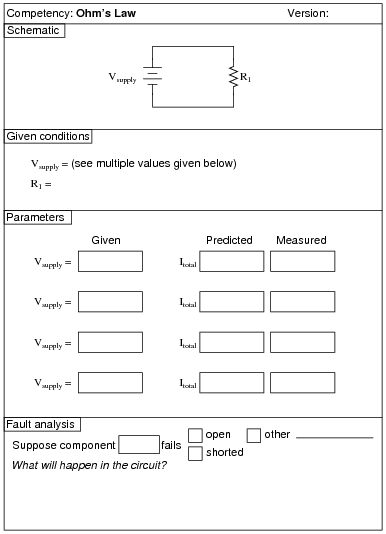
Reveal answerUse circuit simulation software to verify your predicted and measured parameter values.
Notes:Use a variable-voltage, regulated power supply to supply any amount of DC voltage below 30 volts. Specify a standard resistor value, somewhere between 1 kΩ and 100 kΩ (1k5, 2k2, 2k7, 3k3, 4k7, 5k1, 6k8, 10k, 22k, 33k, 39k 47k, 68k, etc.).
-
Question 14 of 29

Reveal answerUse circuit simulation software to verify your predicted and measured parameter values.
Notes:Use a variable-voltage, regulated power supply to supply any amount of DC voltage below 30 volts. Specify a standard resistor value, somewhere between 1 kΩ and 100 kΩ (1k5, 2k2, 2k7, 3k3, 4k7, 5k1, 6k8, 10k, 22k, 33k, 39k 47k, 68k, etc.).
-
Question 15 of 29

Reveal answerUse circuit simulation software to verify your predicted and measured parameter values.
Notes:Use a variable-voltage, regulated power supply to supply any amount of DC voltage below 30 volts. If using this question as a lab exercise rather than an assessment, I recommend specifying a voltage that is standard for batteries, so students don’t necessarily have to have an adjustable power supply available to do this lab.
In this exercise, the student must both quantitatively and qualitatively analyze the circuit, because the ideal resistor value probably does not exist. As the instructor, it is you task to choose voltage and current specifications that preclude exact solutions with common resistor values.