Facebook
 Google
 GitHub
 Linkedin
DC Electric Circuits
Performance-Based Assessments for DC Circuit Competencies
31 questions By Tony R. Kuphaldt
-
Question 10 of 31

Reveal answerUse circuit simulation software to verify your predicted and measured parameter values.
Notes:Use a variable-voltage, regulated power supply to supply any amount of DC voltage below 30 volts. Specify standard resistor values, all between 1 kΩ and 100 kΩ (1k5, 2k2, 2k7, 3k3, 4k7, 5k1, 6k8, 8k2, 10k, 22k, 33k, 39k 47k, 68k, 82k, etc.).
An extension of this exercise is to incorporate troubleshooting questions. Whether using this exercise as a performance assessment or simply as a concept-building lab, you might want to follow up your students’ results by asking them to predict the consequences of certain circuit faults.
-
Question 11 of 31

Reveal answerUse circuit simulation software to verify your predicted and measured parameter values.
Notes:Be sure to remind your students that resistances R1 and R2 may need to be series-parallel networks in themselves, to achieve the necessary values. An alternative you may wish to permit is the use of 10-turn (precision) potentiometers connected as rheostats for R1 and R2. This way the circuit’s minimum and maximum values may be precisely calibrated. The main potentiometer, Rpot1, should be a 3/4 turn unit, to allow fast checking of minimum and maximum total resistance, and it should be some common value such as 1 kΩ or 10 kΩ.
-
Question 12 of 31
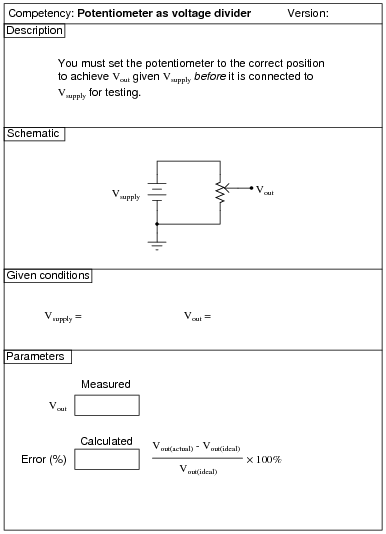
Reveal answerUse circuit simulation software to verify your predicted and measured parameter values.
Notes:Students need not measure potentiometer shaft angles in order to do this exercise. Rather, all they need to do is measure resistance between the wiper and the two outer terminals to set the potentiometer to a position where it will produce the specified division of voltage.
An extension of this exercise is to incorporate troubleshooting questions. Whether using this exercise as a performance assessment or simply as a concept-building lab, you might want to follow up your students’ results by asking them to predict the consequences of certain circuit faults.