Facebook
 Google
 GitHub
 Linkedin
DC Electric Circuits
Performance-Based Assessments for DC Circuit Competencies
31 questions By Tony R. Kuphaldt
-
Question 13 of 31
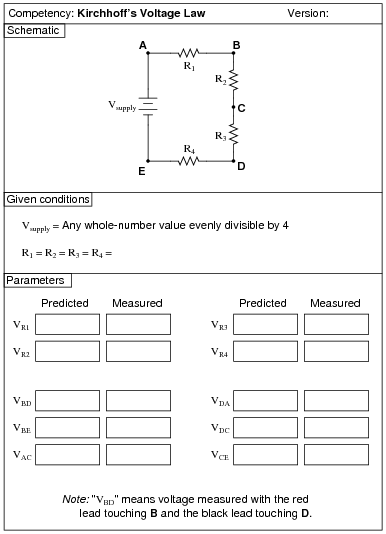
Reveal answerUse circuit simulation software to verify your predicted and measured parameter values.
Notes:An extension of this exercise is to incorporate troubleshooting questions. Whether using this exercise as a performance assessment or simply as a concept-building lab, you might want to follow up your students’ results by asking them to predict the consequences of certain circuit faults.
-
Question 14 of 31

Reveal answerUse circuit simulation software to verify your predicted and measured parameter values.
Notes:I recommend students use a normal regulated (voltage) power supply, adjusting the output voltage until the output current is at 4 mA. 1 kΩ resistors work well for this circuit, requiring only 6.4 volts from the power supply to achieve 4 mA total current.
An extension of this exercise is to incorporate troubleshooting questions. Whether using this exercise as a performance assessment or simply as a concept-building lab, you might want to follow up your students’ results by asking them to predict the consequences of certain circuit faults.
-
Question 15 of 31
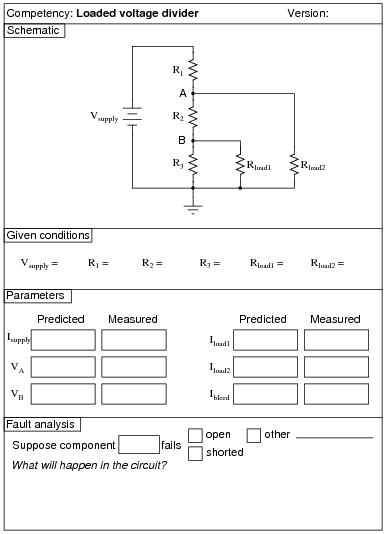
Reveal answerUse circuit simulation software to verify your predicted and measured parameter values.
Notes:Use a variable-voltage, regulated power supply to supply any amount of DC voltage below 30 volts. Specify standard resistor values, all between 1 kΩ and 100 kΩ (1k5, 2k2, 2k7, 3k3, 4k7, 5k1, 6k8, 8k2, 10k, 22k, 33k, 39k 47k, 68k, 82k, etc.).
I have used this circuit as both a “quick” lab exercise and a troubleshooting exercise, using values of 10 kΩ for R1, R2, and R3; 15 kΩ for R(load1); 22 kΩ for R(load2); and 6 volts for the power supply. Of course, these component values are not critical, but they do provide easy-to measure voltages and currents without incurring excessive impedances that would cause significant voltmeter loading problems.
An extension of this exercise is to incorporate troubleshooting questions. Whether using this exercise as a performance assessment or simply as a concept-building lab, you might want to follow up your students’ results by asking them to predict the consequences of certain circuit faults.