Facebook
 Google
 GitHub
 Linkedin
DC Electric Circuits
Performance-Based Assessments for DC Circuit Competencies
31 questions By Tony R. Kuphaldt
-
Question 16 of 31
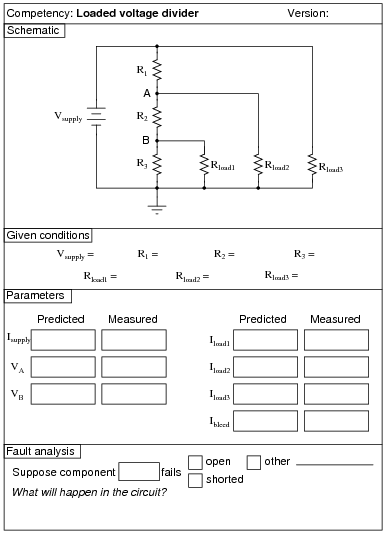
Reveal answerUse circuit simulation software to verify your predicted and measured parameter values.
Notes:Use a variable-voltage, regulated power supply to supply any amount of DC voltage below 30 volts. Specify standard resistor values, all between 1 kΩ and 100 kΩ (1k5, 2k2, 2k7, 3k3, 4k7, 5k1, 6k8, 10k, 22k, 33k, 39k 47k, 68k, etc.).
An extension of this exercise is to incorporate troubleshooting questions. Whether using this exercise as a performance assessment or simply as a concept-building lab, you might want to follow up your students’ results by asking them to predict the consequences of certain circuit faults.
-
Question 17 of 31
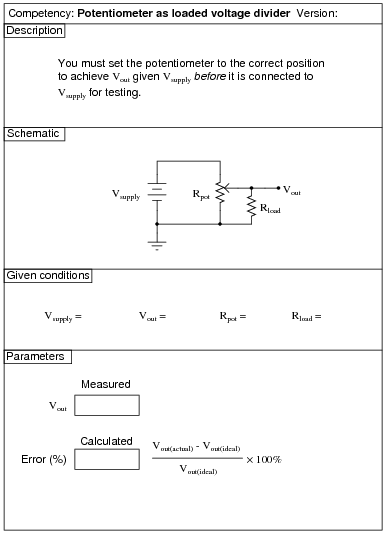
Reveal answerUse circuit simulation software to verify your predicted and measured parameter values.
Notes:Students need not measure potentiometer shaft angles in order to do this exercise. Rather, all they need to do is measure resistance between the wiper and the two outer terminals to set the potentiometer to a position where it will produce the specified division of voltage.
Rpot refers to the potentiometer’s nominal full-range value (for example, 1 kΩ or 5 kΩ), and not to its particular setting. The setting is what the student must figure out to achieve Vout.
An extension of this exercise is to incorporate troubleshooting questions. Whether using this exercise as a performance assessment or simply as a concept-building lab, you might want to follow up your students’ results by asking them to predict the consequences of certain circuit faults.
-
Question 18 of 31
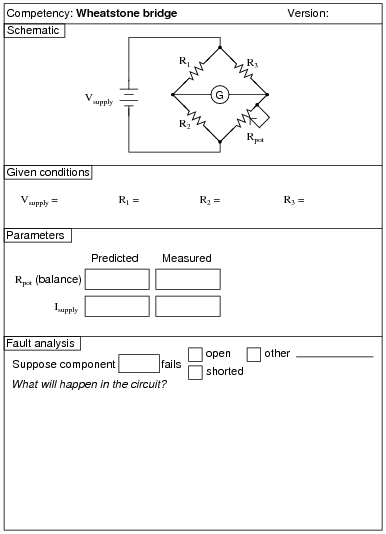
Reveal answerUse circuit simulation software to verify your predicted and measured parameter values.
Notes:Use a variable-voltage, regulated power supply to supply any amount of DC voltage below 30 volts. Specify standard resistor values, all between 1 kΩ and 100 kΩ (1k5, 2k2, 2k7, 3k3, 4k7, 5k1, 6k8, 10k, 22k, 33k, 39k 47k, 68k, etc.), and be sure to specify a potentiometer value in excess of the amount required to balance the bridge.
An extension of this exercise is to incorporate troubleshooting questions. Whether using this exercise as a performance assessment or simply as a concept-building lab, you might want to follow up your students’ results by asking them to predict the consequences of certain circuit faults.