Facebook
 Google
 GitHub
 Linkedin
DC Electric Circuits
Performance-Based Assessments for DC Circuit Competencies
31 questions By Tony R. Kuphaldt
-
Question 19 of 31
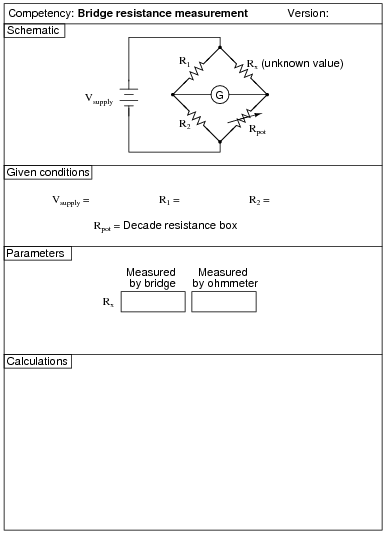
Reveal answerThe ohmmeter’s indication is the “final word” on resistance.
Notes:Use a variable-voltage, regulated power supply to supply any amount of DC voltage below 30 volts. Use precision resistors for R1 and R2, and use any standard resistor value for Rx between 1 kΩ and 100 kΩ.
An extension of this exercise is to incorporate troubleshooting questions. Whether using this exercise as a performance assessment or simply as a concept-building lab, you might want to follow up your students’ results by asking them to predict the consequences of certain circuit faults.
-
Question 20 of 31

Reveal answerUse circuit simulation software to verify your predicted and measured parameter values.
Notes:Students may use potentiometers in their range resistance networks to achieve precise values. However, they are not allowed to adjust those potentiometers after connecting them to the meter movement - they must set their potentiometer(s) during the “prediction” step of the assessment before the circuit is completely built.
An extension of this exercise is to incorporate troubleshooting questions. Whether using this exercise as a performance assessment or simply as a concept-building lab, you might want to follow up your students’ results by asking them to predict the consequences of certain circuit faults.
-
Question 21 of 31
Reveal answerUse circuit simulation software to verify your predicted and measured parameter values.
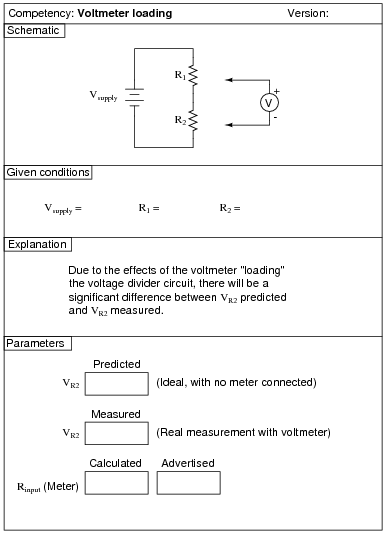
Notes:Be sure to specify resistor values for the voltage divider that will show a marked impact when measured with the type of voltmeter you expect your students to use. If you size the resistors for a modest impact measured with an analog voltmeter (20,000 Ω/Volt), your students may not see much of an impact when using a modern digital voltmeter (Zin > 10 MΩ).
New students often have a difficult time grasping the main idea of this activity, due to the assumption of the voltmeter’s indication always being taken as true. The purpose of this activity is to shatter that assumption: to teach students that electrical measurements are never truly passive - rather, they invariably impact the circuit being measured in some way. Usually, the impact is so small it may be safely ignored. Here, due to the large resistor values used in the divider circuit, the impact of voltmeter usage on the circuit is non-trivial.
Another aspect of this activity that escapes some students’ attention is that the circuit must be analyzed twice: once with the meter connected and once without. The point here is that the meter becomes a component of the circuit when it is connected across R2, and thus changes all the voltages and currents.