Facebook
 Google
 GitHub
 Linkedin
AC Electric Circuits
Resonance
26 questions By Tony R. Kuphaldt
-
Question 4 of 26
Calculate the resonant frequency of this parallel LC circuit, and qualitatively describe its total impedance (Ztotal) when operating at resonance:

Reveal answerfr = 6.195 kHz
Ztotal @ fr = ∞
Notes:Nothing special to note here, just an application of the resonance formula and a review of parallel LC resonance.
-
Question 5 of 26
If a metal bar is struck against a hard surface, the bar will “ring” with a characteristic frequency. This is the fundamental principle upon which tuning forks work:
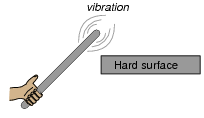
The ability of any physical object to “ring” like this after being struck is dependent upon two complementary properties: mass and elasticity. An object must possess both mass and a certain amount of “springiness” in order to physically resonate.
Describe what would happen to the resonant frequency of a metal bar if it were made of a more elastic (less “stiff”) metal? What would happen to the resonant frequency if an extra amount of mass were added to the end being struck?
Reveal answerIn either case, the resonant frequency of the bar would decrease.
Notes:Electrical resonance is so closely related to physical resonance, that I believe questions like this help students grasp the concept better. Everyone knows what resonance is in the context of a vibrating object (tuning fork, bell, wind chime, guitar string, cymbal head), even if they have never heard of the term “resonance” before. Getting them to understand that mechanical resonance depends on the complementary qualities of mass and elasticity primes their minds for understanding that electrical resonance depends on the complementary qualities of inductance and capacitance.
-
Question 6 of 26
This simple electric circuit is capable of resonance, whereby voltage and current oscillate at a frequency characteristic to the circuit:

In a mechanical resonant system - such as a tuning fork, a bell, or a guitar string - resonance occurs because the complementary properties of mass and elasticity exchange energy back and forth between each other in kinetic and potential forms, respectively. Explain how energy is stored and transferred back and forth between the capacitor and inductor in the resonant circuit shown in the illustration, and identify which of these components stores energy in kinetic form, and which stores energy in potential form.
Reveal answerCapacitors store energy in potential form, while inductors store energy in kinetic form.
Notes:Ask your students to define “potential” and “kinetic” energy. These terms, of course, are central to the question, and I have not bothered to define them. This omission is purposeful, and it is the students’ responsibility to research the definitions of these words in the process of answering the question. If a substantial number of your students stopped trying to answer the question when they encountered new words (instead of taking initiative to find out what the words mean), then it indicates a need to focus on independent learning skills (and attitudes!).
Discuss a typical “cycle” of energy exchange between kinetic and potential forms in a vibrating object, and then relate this exchange process to the oscillations of a tank circuit (capacitor and inductor).