Facebook
 Google
 GitHub
 Linkedin
AC Electric Circuits
Resonance
26 questions By Tony R. Kuphaldt
-
Question 7 of 26
Resonant electric circuits are analogous to resonant mechanical systems. They both oscillate, and their oscillation is founded on an exchange of energy between two different forms.
Mechanical engineers studying vibrations in machinery sometimes use capacitors and inductors to model the physical characteristics of mechanical systems. Specifically, capacitors model elasticity, while inductors model mass.
Explain what mechanical quantities in a resonant system are analogous to voltage and current in a resonant circuit.
Reveal answerMechanical force and velocity are analogous to electrical voltage and current, respectively.
Challenge question: specifically relate voltage and current for an inductor to force and velocity for a mass, and voltage and current for a capacitor to force and velocity for a spring. Illustrate the similarities mathematically, where possible!
Notes:This is a challenging question, and it is one I would reserve for students destined to become engineers. However, once answered, it brings deep insight to the phenomenon of resonance both mechanical and electrical.
-
Question 8 of 26
If an oscilloscope is set up for “single-sweep” triggering and connected to a DC-excited resonant circuit such as the one shown in the following schematic, the resulting oscillation will last just a short time (after momentarily pressing and releasing the pushbutton switch):
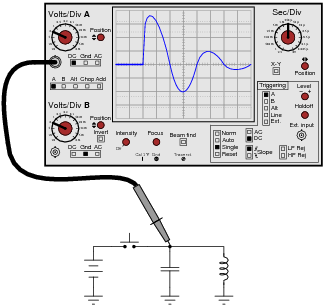
Explain why the oscillations die out, rather than go on forever. Hint: the answer is fundamentally the same as why a swinging pendulum eventually comes to a stop.
Reveal answerNo resonant circuit is completely free of dissipative elements, whether resistive or radiative, and so some energy is lost each cycle.
Notes:A circuit such as this is easy to build and demonstrate, but you will need a digital storage oscilloscope to successfully capture the damped oscillations. Also, the results may be tainted by switch “bounce,” so be prepared to address that concept if you plan to demonstrate this to a live audience.
You might want to ask your students how they would suggest building a “tank circuit” that is as free from energy losses as possible. If a perfect tank circuit could be built, how would it act if momentarily energized by a DC source such as in this setup?
-
Question 9 of 26
How may the resonant frequency of this tank circuit be increased?

Reveal answerThe resonant frequency of this tank circuit may be increased by substituting a smaller-value capacitor in for the capacitor value it presently has.
Note: this is not the only way to increase this circuit’s resonant frequency!
Notes:Challenge your students to explain another method for increasing the resonant frequency of this tank circuit, besides decreasing the value of the capacitor. Discuss how any of these alterations to the circuit affect the typical energy “cycle” between kinetic and potential forms, and why they lead to an increased frequency.