Facebook
 Google
 GitHub
 Linkedin
AC Electric Circuits
Resonance
26 questions By Tony R. Kuphaldt
-
Question 16 of 26
Calculate all voltages and currents in this circuit, at a power supply frequency near resonance:
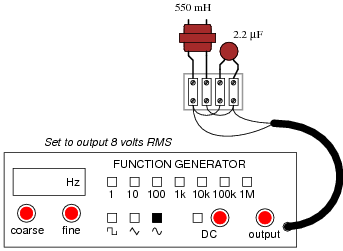
Based on your calculations, what general predictions can you make about parallel-resonant circuits, in terms of their total impedance, their total current, and their individual component currents?
Reveal answerIn a parallel LC circuit near resonance, Ztotal is nearly infinite, Itotal is small, and both IL and IC are large as well.
Follow-up question: suppose the inductor were to fail open. Identify how this failure would alter the circuit’s current and voltage drops.
Notes:This question is given without a specified source frequency for a very important reason: to encourage students to “experiment” with numbers and explore concepts on their own. Sure, I could have given a power supply frequency as well, but I chose not to because I wanted students to set up part of the problem themselves.
In my experience teaching, students will often choose to remain passive with regard to a concept they do not understand, rather than aggressively pursue an understanding of it. They would rather wait and see if the instructor happens to cover that concept during class time than take initiative to explore it on their own. Passivity is a recipe for failure in life, and this includes intellectual endeavors as much as anything else. The fundamental trait of autonomous learning is the habit of pursuing the answer to a question, without being led to do so. Questions like this, which purposefully omit information, and thus force the student to think creatively and independently, teach them to develop this trait.
-
Question 17 of 26
Does a series LC circuit “appear” capacitive or inductive (from the perspective of the AC source powering it) when the source frequency is greater than the circuit’s resonant frequency? What about a parallel resonant circuit? In each case, explain why.
Reveal answerA series LC circuit will appear inductive when the source frequency exceeds the resonant frequency. A parallel LC circuit will appear capacitive in the same condition.
Notes:Ask your students to explain their answers mathematically.
-
Question 18 of 26
A paradoxical property of resonant circuits is that they have the ability to produce quantities of voltage or current (in series and parallel circuits, respectively) exceeding that output by the power source itself. This is due to the cancellation of inductive and capacitive reactances at resonance.
Not all resonant circuits are equally effective in this regard. One way to quantify the performance of resonant circuits is to assign them a quality factor, or Q rating. This rating is very similar to the one given inductors as a measure of their reactive “purity.”
Suppose we have a resonant circuit operating at its resonant frequency. How may we calculate the Q of this operating circuit, based on empirical measurements of voltage or current? There are two answers to this question: one for series circuits and one for parallel circuits.
Reveal answerQseries = EC Esource= EL EsourceQparallel = IC Isource= IL IsourceFollow-up question: what unique safety hazards may high-Q resonant circuits pose?
Notes:Ask your students to determine which type of danger(s) are posed by high-Q series and parallel resonant circuits, respectively. The answer to this question may seem paradoxical at first: that series resonant circuits whose overall impedance is nearly zero can manifest large voltage drops, while parallel resonant circuits whose overall impedance is nearly infinite can manifest large currents.