Facebook
 Google
 GitHub
 Linkedin
AC Electric Circuits
Resonance
26 questions By Tony R. Kuphaldt
-
Question 13 of 26
Suppose we were to build a series “LC” circuit and connect it to a function generator, where we could vary the frequency of the AC voltage powering it:

Calculate the amount of current in the circuit, given the following figures:
- Power supply voltage = 3 volts RMS
- Power supply frequency = 100 Hz
- Capacitor = 4.7 μF
- Inductor = 100 mH
Then, describe what happens to the circuit current as the frequency is gradually increased.
Reveal answerCircuit current = 10.88 mA RMS. As the frequency is gradually increased, the circuit current increases as well.
Follow-up question: what do you suppose might happen to the circuit current if the frequency is increased to the point that the reactances of the inductor and capacitor completely cancel each other? What safety concerns might arise from this possibility?
Notes:In order for your students to arrive at the answer of circuit current increasing with frequency, they must perform a few calculations at different frequencies. Do this together, as a group, and note how the circuit’s impedance changes with frequency.
-
Question 14 of 26
Calculate the power supply frequency at which the reactances of a 33 μF and a 75 mH inductor are exactly equal to each other. Derive a mathematical equation from the individual reactance equations \((X_{L}=2 \pi fL\ and\ {X}_{C}=\frac{1}{2 \pi fC}\), solving for frequency (f) in terms of L and C in this condition.
Calculate the total impedance of these two components, if they were connected in series, at that frequency.
Reveal answerfresonant = 101.17 Hz. At this frequency, Zseries = 0 Ω.
Notes:The answer gives away the meaning of this question: the determination of an LC circuit’s resonant frequency. Students may be surprised at the total impedance figure of 0 Ω, but this is really nothing more than an extension of the “impedance cancellation” concept they’ve seen before in other series LC circuit questions. In this case, the cancellation concept has merely been taken to the ultimate level of total cancellation between the two impedances.
-
Question 15 of 26
Calculate all voltages and currents in this circuit, at a power supply frequency near resonance:
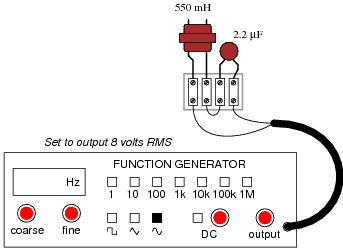
Based on your calculations, what general predictions can you make about series-resonant circuits, in terms of their total impedance, their total current, and their individual component voltage drops?
Reveal answerIn a series LC circuit near resonance, Ztotal is nearly zero, Itotal is large, and both EL and EC are large as well.
Follow-up question: suppose the capacitor were to fail shorted. Identify how this failure would alter the circuit’s current and voltage drops.
Notes:This question is given without a specified source frequency for a very important reason: to encourage students to “experiment” with numbers and explore concepts on their own. Sure, I could have given a power supply frequency as well, but I chose not to because I wanted students to set up part of the problem themselves.
In my experience teaching, students will often choose to remain passive with regard to a concept they do not understand, rather than aggressively pursue an understanding of it. They would rather wait and see if the instructor happens to cover that concept during class time than take initiative to explore it on their own. Passivity is a recipe for failure in life, and this includes intellectual endeavors as much as anything else. The fundamental trait of autonomous learning is the habit of pursuing the answer to a question, without being led to do so. Questions like this, which purposefully omit information, and thus force the student to think creatively and independently, teach them to develop this trait.