
 Facebook
 Google
 GitHub
 Linkedin
Basic Electricity
Series DC Circuits Practice Worksheet with Answers
27 questions By Tony R. Kuphaldt
-
Question 19 of 27
Suppose that an electric heater, which is nothing more than a large resistor, dissipates 500 watts of power when directly connected to a 110 volt source:

Now suppose that exact same heater is connected to one end of a long two-wire cable, which is then connected to the same 110 volt source. Assuming that each conductor within the cable has an end-to-end resistance of 3 ohms, how much power will the heater dissipate?

Reveal answerP = 321.1 watts
Notes:The purpose of this question, besides providing a good problem-solving exercise for students, is to get them to realize one of the practical implications of power-line resistance.
-
Question 20 of 27
The circuit shown here is commonly referred to as a voltage divider. Calculate the voltage dropped across the following pairs of terminals, the current through each resistor, and the total amount of electrical resistance ßeen” by the 9-volt battery:
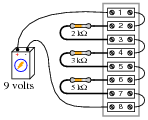
- • Voltage between terminals 2 and 3 =
- • Voltage between terminals 4 and 5 =
- • Voltage between terminals 6 and 7 =
- • Voltage between terminals 6 and 8 =
- • Voltage between terminals 4 and 8 =
- • Voltage between terminals 2 and 8 =
- • Current through each resistor =
- • Rtotal =
Can you think of any practical applications for a circuit such as this?
Reveal answer- • Voltage between terminals 2 and 3 = 1.8 volts
- • Voltage between terminals 4 and 5 = 2.7 volts
- • Voltage between terminals 6 and 7 = 4.5 volts
- • Voltage between terminals 6 and 8 = 4.5 volts
- • Voltage between terminals 4 and 8 = 7.2 volts
- • Voltage between terminals 2 and 8 = 9 volts
- • Current through each resistor = 0.9 mA
- • Rtotal = 10 kΩ
Note how all the voltage drops are a certain proportion of the total voltage. What do you think would happen to these voltage drops if the source voltage (9 volts from the battery) were doubled?
Notes:Some students may find the diagram hard to follow, and so they will find the task of analysis helped by drawing an equivalent schematic diagram for this circuit, with all terminal points labeled. I recommend you not suggest this solution immediately, but rather challenge your students to think of problem-solving techniques on their own. Surely, someone in the class will have thought of doing this, and the impact of such a suggestion coming from a peer is greater than if it came from you, the instructor.
Be sure to ask your students this question: “Why is this type of circuit commonly called a voltage divider?”
-
Question 21 of 27
What will happen in this circuit as the switches are sequentially turned on, starting with switch number 1 and ending with switch number 3?

Describe how the successive closure of these three switches will impact:
- • The total amount of circuit resistance “seen” by the battery
- • The total amount of current drawn from the battery
- • The current through each resistor
- • The voltage drop across each resistor
Also, provide a safety-related reason for the existence of the fourth resistor in this circuit, on the left-hand side of the circuit (not bypassed by any switch).
Reveal answerI won’t explain what happens when each of the switches is closed, but I will describe the effects of the first switch closing:
As the first switch (SW1) is closed, the voltage across resistor R1 will decrease to zero, while the voltages across the remaining resistors will increase. The current through resistor R1 will also decrease to zero, and the current through the remaining resistors will also increase. Each of the resistors will experience the same amount of current as the others, and this amount of current will also be experienced by the battery. Overall, the battery “sees” less total resistance than before.
The fourth resistor is there to prevent a short-circuit from developing if all switches are simultaneously closed.
Notes:One problem I’ve encountered while teaching the “laws” of series circuits is that some students mistakenly think the rule of äll currents in a series circuit being the same” means that the amount of current in a series circuit is fixed over time and cannot change. The root of this misunderstanding is memorization rather than comprehension: students memorize the rule “all currents are the same” and think this means the currents must remain the same before and after any change is made to the circuit. I’ve actually had students complain to me, saying, “But you told us all currents are the same in a series circuit!”, as though it were my job to decree perfect and universal Laws which would require no critical thinking on the part of the student. But I digress . . .
This question challenges students’ comprehension of series circuit behavior by asking what happens after a change is made to the circuit. The purpose of the switches is to “remove” resistors from the circuit, one at a time, without actually having to remove components.






llaboutcircuits.com/worksheets/series-dc-circuits/. In question 5, total series resistance is sum of each resistor, not product. Correct both question and answer
Hello Everybody and thanks for your fantastic articles!
I’m having troubles solving Excercise 19 of your Series circuits problems (https://www.allaboutcircuits.com/worksheets/series-dc-circuits/): For this excercise I’m getting a power dissipation for the heater of 403 W instead of 321.1 W.
Since I’m learning electronics I’m surely doing something wrong… Here how I’m reasoning:
1. With 110 V and a power dissipated of 500 W, I can calculate the current in the circuit, that should be I=P/V 500/110 = 4.545 A
2. Knowing that the current in the circuit is 4.545 A I can use Ohm’s law to calculate the resistance of the heater: R=V/I 110/4.545 = 24 Ohm
3. Now, longing the wires it’s the same as adding 6 Ohm of resistance, for a total resistance of 30 Ohm (24 + 6) so the current in the circuit will change accordingly. To find the new amount of current I use Ohm’s law once again: I=V/R 110/30 = 3.666 A
4. Having a new current value of 3.666 A, I can now calculate power dissipation P=V*I 110*3.666 = 403 W
Could you please help me understand where I’m wrong?
Thank you so much!
Stefano.