
 Facebook
 Google
 GitHub
 Linkedin
Basic Electricity
Series DC Circuits Practice Worksheet with Answers
27 questions By Tony R. Kuphaldt
-
Question 16 of 27
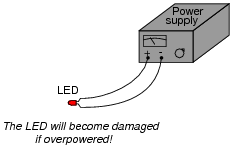
Light-emitting diodes, or LEDs, are rugged and highly efficient sources of light. They are far more rugged and efficient than incandescent lamps, and they also have the ability to switch on and off much faster because there is no filament inside needing to heat or cool:

LEDs are low voltage devices, typically rated in the range of 1.5 to 2 volts DC maximum. Single diodes generally draw low currents as well, about 20 milliamps each. The problem is, how do you operate an LED from a typical electronic power source, which may output 24 volts DC or more?
The answer is to use a series dropping resistor:
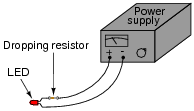
Calculate the necessary resistance value and minimum power rating of a series dropping resistor for an LED rated at 1.7 volts and 20 mA, and a power supply voltage of 24 volts.
Reveal answerRdropping = 1115 Ω, with a power rating of at least 0.446 watts (1/2 watt would be ideal).
Follow-up question: if there were no 1115 Ω resistors to choose from (which there most likely will not be!), would it be safer to choose a higher-value resistor or a lower-value resistor for this application? For example, if your only choices in 1/2 watt resistors were a 1 kΩ and a 1.2 kΩ, which one would you choose? Explain your answer.
Notes:The follow-up question is a very practical one, for it is seldom that you have the exact components on-hand to match the requirements of a circuit you are building. It is important to understand which way is safer to err (too large or too small) when doing “as-built” design work.
-
Question 17 of 27
Calculate the necessary series “dropping” resistor value to operate a 1.6 volt, 20 mA LED from a 15 volt DC power source. Also, calculate the power dissipated by the resistor while operating.
R = PR =
Reveal answerR = 670 Ω PR = 0.268 W
Notes:Ask your students to explain how they calculated the correct answer for this question.
-
Question 18 of 27
Calculate the necessary series “dropping” resistor value to operate a 1.8 volt, 20 mA LED from a 34 volt DC power source. Also, calculate the power dissipated by the resistor while operating.
R = PR =
Reveal answerR = 1.61 kΩ PR = 0.644 W
Notes:Ask your students to explain how they calculated the correct answer for this question.






llaboutcircuits.com/worksheets/series-dc-circuits/. In question 5, total series resistance is sum of each resistor, not product. Correct both question and answer
Hello Everybody and thanks for your fantastic articles!
I’m having troubles solving Excercise 19 of your Series circuits problems (https://www.allaboutcircuits.com/worksheets/series-dc-circuits/): For this excercise I’m getting a power dissipation for the heater of 403 W instead of 321.1 W.
Since I’m learning electronics I’m surely doing something wrong… Here how I’m reasoning:
1. With 110 V and a power dissipated of 500 W, I can calculate the current in the circuit, that should be I=P/V 500/110 = 4.545 A
2. Knowing that the current in the circuit is 4.545 A I can use Ohm’s law to calculate the resistance of the heater: R=V/I 110/4.545 = 24 Ohm
3. Now, longing the wires it’s the same as adding 6 Ohm of resistance, for a total resistance of 30 Ohm (24 + 6) so the current in the circuit will change accordingly. To find the new amount of current I use Ohm’s law once again: I=V/R 110/30 = 3.666 A
4. Having a new current value of 3.666 A, I can now calculate power dissipation P=V*I 110*3.666 = 403 W
Could you please help me understand where I’m wrong?
Thank you so much!
Stefano.