
 Facebook
 Google
 GitHub
 Linkedin
Basic Electricity
Series DC Circuits Practice Worksheet with Answers
27 questions By Tony R. Kuphaldt
-
Question 13 of 27
What would happen if three 6-volt light bulbs were connected as shown to a 6-volt battery? How would their brightnesses compare to just having a single 6-volt light bulb connected to a 6-volt battery?
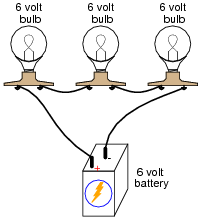
Reveal answerThe three light bulbs would glow dimly.
Notes:Here, the important principle of voltage “drops” in a series circuit is highlighted. This question serves to further define, in practical ways, what the term “series” really means.
-
Question 14 of 27
Qualitatively compare the voltage and current for each of the three light bulbs in this circuit (assume the three light bulbs are absolutely identical):
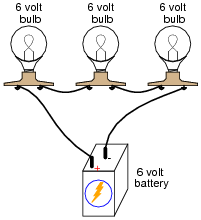
Reveal answerThe current through each of the lights bulbs is guaranteed to be equal. The voltage across each of the light bulbs, in this particular case (with identical bulbs), happens to be equal.
Notes:Here, the important principles of voltage and current in a series circuit are highlighted. This question serves to further define, in practical ways, what the term “series” really means.
An important lesson of this question is the distinction between measurements which are guaranteed to be equal versus measurements which just happen to be equal for a given selection of components.
-
Question 15 of 27
Explain, step by step, how to calculate the amount of current (I) that will go through each resistor in this series circuit, and also the voltage (V) dropped by each resistor:

Reveal answer- IR1 = 2.22 mA ; VR1 = 3.33 V
- IR2 = 2.22 mA ; VR2 = 22.2 V
- IR3 = 2.22 mA ; VR3 = 10.4 V
Notes:Students often just want to memorize a procedure for determining answers to questions like these. Challenge your students to not only understand the procedure, but to also explain why it must be followed.
Something your students will come to realize in discussion is that there is more than one way to arrive at all the answers! While some of the steps will be common to all calculation strategies, other steps (near the end) leave room for creativity.
Note to your students that European symbols are used throughout this schematic diagram.






llaboutcircuits.com/worksheets/series-dc-circuits/. In question 5, total series resistance is sum of each resistor, not product. Correct both question and answer
Hello Everybody and thanks for your fantastic articles!
I’m having troubles solving Excercise 19 of your Series circuits problems (https://www.allaboutcircuits.com/worksheets/series-dc-circuits/): For this excercise I’m getting a power dissipation for the heater of 403 W instead of 321.1 W.
Since I’m learning electronics I’m surely doing something wrong… Here how I’m reasoning:
1. With 110 V and a power dissipated of 500 W, I can calculate the current in the circuit, that should be I=P/V 500/110 = 4.545 A
2. Knowing that the current in the circuit is 4.545 A I can use Ohm’s law to calculate the resistance of the heater: R=V/I 110/4.545 = 24 Ohm
3. Now, longing the wires it’s the same as adding 6 Ohm of resistance, for a total resistance of 30 Ohm (24 + 6) so the current in the circuit will change accordingly. To find the new amount of current I use Ohm’s law once again: I=V/R 110/30 = 3.666 A
4. Having a new current value of 3.666 A, I can now calculate power dissipation P=V*I 110*3.666 = 403 W
Could you please help me understand where I’m wrong?
Thank you so much!
Stefano.