Facebook
 Google
 GitHub
 Linkedin
Basic Electricity
Specific Resistance of Conductors
15 questions By Tony R. Kuphaldt
-
Question 10 of 15
Calculate the amount of power delivered to the load resistor in this circuit:
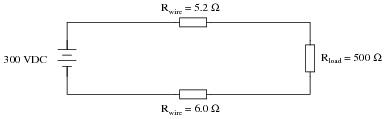
Also, calculate the amount of power that would be delivered to the load resistor if the wires were superconducting (Rwire = 0.0 Ω).
Reveal answerPload ≈ 170 Watts (with resistive wire)
Pload = 180 Watts (with superconducting wire)
Follow-up question: Compare the direction of current through all components in this circuit with the polarities of their respective voltage drops. What do you notice about the relationship between current direction and voltage polarity for the battery, versus for all the resistors? How does this relate to the identification of these components as either sources or loads?
Notes:Not only is this question good practice for series circuit calculations (Ohm’s and Joule’s Laws), but it also introduces superconductors in a practical context.
-
Question 11 of 15
Suppose a power system were delivering AC power to a resistive load drawing 150 amps:

Calculate the load voltage, load power dissipation, the power dissipated by the wire resistance (Rwire), and the overall power efficiency, indicated by the Greek letter “eta” (η = [(Pload)/(Psource)]).
- Eload =
- Pload =
- Plines =
- η =
Now, suppose we were to re-design both the generator and the load to operate at 2400 volts instead of 240 volts. This ten-fold increase in voltage allows just one-tenth the current to convey the same amount of power. Rather than replace all the wire with different wire, we decide to use the exact same wire as before, having the exact same resistance (0.1 Ω per length) as before. Re-calculate load voltage, load power, wasted power, and overall efficiency of this (higher voltage) system:

- Eload =
- Pload =
- Plines =
- η =
Reveal answer240 volt system:
- Eload = 210 volts
- Pload = 31.5 kW
- Plines = 4.5 kW
- η = 87.5 %
2400 volt system:
- Eload = 2397 volts
- Pload = 35.96 kW
- Plines = 45 W
- η = 99.88 %
Notes:An example like this usually does a good job clarifying the benefits of using high voltage over low voltage for transmission of large amounts of electrical power over substantial distances.
-
Question 12 of 15
The efficiency (η) of a simple power system with losses occurring over the wires is a function of circuit current, wire resistance, and total source power:

A simple formula for calculating efficiency is given here:
η = Psource − I2R PsourceWhere,
Psource = the power output by the voltage source, in watts (W)
I = the circuit current, in amperes (A)
R = the total wire resistance (Rwire1 Rwire2), in ohms (Ω)
Algebraically manipulate this equation to solve for wire resistance (R) in terms of all the other variables, and then calculate the maximum amount of allowable wire resistance for a power system where a source outputting 200 kW operates at a circuit current of 48 amps, at a minimum efficiency of 90%.
Reveal answerR = Psource − ηPsource I2The maximum allowable (total) wire resistance is 8.681 Ω.
Notes:A common mistake for students to make here is entering 90% as “90” rather than as “0.9” in their calculators.