Facebook
 Google
 GitHub
 Linkedin
Basic Electricity
Specific Resistance of Conductors
15 questions By Tony R. Kuphaldt
-
Question 7 of 15
A spool holds an unknown length of aluminum wire. The size of the wire is 4 AWG. Fortunately, both ends of the wire are available for contact with an ohmmeter, to measure the resistance of the entire spool. When measured, the wire’s total resistance is 0.135 Ω. How much wire is on the spool (assuming the spool is at room temperature)?
Reveal answer353.51 feet
Notes:This question illustrates another practical application of specific resistance calculations: how to determine the length of wire on a spool. The amount of resistance in this example is quite low, being a mere fraction of an ohm. Ask your students what kinds of problems they might encounter trying to measure such a low resistance with accuracy. Would the typical errors incurred in such a low-resistance measurement tend to make their calculation of length be excessive, or too low? Why?
-
Question 8 of 15
The cross-sectional dimensions of a copper “busbar” measure 8 cm by 2.5 cm. How much resistance would this busbar have, measured end-to-end, if its length is 10 meters? Assume a temperature of 20o Celsius.
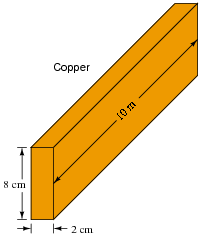
Reveal answer83.9 μΩ
Notes:This question is a good review of the metric system, relating centimeters to meters, and such. It may also be a good review of unit conversions, if students choose to do their resistance calculations using English units (cmils, or square inches) rather than metric.
Students may be surprised at the low resistance figure, but remind them that they are dealing with a solid bar of copper, over 3 square inches in cross-sectional area. This is one big conductor!
-
Question 9 of 15
Calculate the end-to-end resistance of a 20 meter length of copper wire with a diameter of 0.05 cm. Use 1.678 ×10⁻⁶ Ω·cm for the specific resistance of copper.
Reveal answer1.709 Ω
Notes:Nothing to comment on here - just a straight-forward calculation of resistance. Students need to be careful of the centimeter dimension, though!