
 Facebook
 Google
 GitHub
 Linkedin
DC Electric Circuits
Time Constant Calculations
52 questions By Tony R. Kuphaldt
-
Question 34 of 52
At a party, you happen to notice a mathematician taking notes while looking over the food table where several pizzas are set. Walking up to her, you ask what she is doing. Ï‘m mathematically modeling the consumption of pizza,” she tells you. Before you have the chance to ask another question, she sets her notepad down on the table and excuses herself to go use the bathroom.
Looking at the notepad, you see the following equation:
Percentage = (1 − e−[t/5.8]) ×100% Where,
t = Time in minutes since arrival of pizza.
The problem is, you don’t know whether the equation she wrote describes the percentage of pizza eaten or the percentage of pizza remaining on the table. Explain how you would determine which percentage this equation describes. How, exactly, can you tell if this equation describes the amount of pizza already eaten or the amount of pizza that remains to be eaten?
Reveal answerThis equation models the percentage of pizza eaten at time t, not how much remains on the table.
Notes:While some may wonder what this question has to do with electronics, it is an exercise in qualitative analysis. This skill is very important for students to master if they are to be able to distinguish between the equations e−[t/(τ)] and 1 − e−[t/(τ)], both used in time-constant circuit analysis.
The actual procedure for determining the nature of the equation is simple: consider what happens as t begins at 0 and as it increases to some arbitrary positive value. Some students may rely on their calculators, performing actual calculations to see whether the percentage increases or decreases with increasing t. Encourage them to analyze the equation qualitatively rather than quantitatively, though. They should be able to tell which way the percentage changes with time without having to consider a single numerical value!
-
Question 35 of 52
The following expression is frequently used to calculate values of changing variables (voltage and current) in RC and LR timing circuits:
e−[t/(τ)] or 1 e[t/(τ)]If we evaluate this expression for a time of t = 0, we find that it is equal to 1 (100%). If we evaluate this expression for increasingly larger values of time (t → ∞), we find that it approaches 0 (0%).
Based on this simple analysis, would you say that the expression e−[t/(τ)] describes the percentage that a variable has changed from its initial value in a timing circuit, or the percentage that it has left to change before it reaches its final value? To frame this question in graphical terms . . .
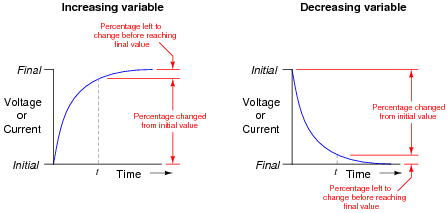
Which percentage does the expression e−[t/(τ)] represent in each case? Explain your answer.
Reveal answerWhether the variable in question is increasing or decreasing over time, the expression e−[t/(τ)] describes the percentage that a variable has left to change before it reaches its final value.
Follow-up question: what could you add to or modify about the expression to make it describe the percentage that a variable has already changed from its initial value? In other words, alter the expression so that it is equal to 0% at t = 0 and approaches 100% as t grows larger (t → ∞).
Notes:It is very important for students to understand what this expression means and how it works, lest they rely solely on memorization to use it in their calculations. As I always tell my students, rote memorization will fail you! If a student does not comprehend why the expression works as it does, they will be helpless to retain it as an effective “tool” for performing calculations in the future.
A good way to suggest students approach a problem such as this is to imagine t increasing in value. As t grows larger, what happens to the expression’s overall value? Then, compare which of the two percentages (percentage traversed, or percentage remaining) follow the same trend. One not need touch a calculator to figure this out!
-
Question 36 of 52
Determine the capacitor voltage and capacitor current at the specified times (time t = 0 milliseconds being the exact moment the switch contacts close). Assume the capacitor begins in a fully discharged state:

Time VC (volts) IC (mA)
0 ms
30 ms
60 ms
90 ms
120 ms
150 ms
Reveal answer
Time VC (volts) IC (mA)
0 ms 0 4.255
30 ms 6.932 2.781
60 ms 11.46 1.817
90 ms 14.42 1.187
120 ms 16.35 0.7757
150 ms 17.62 0.5069
Notes:Be sure to have your students share their problem-solving techniques (how they determined which equation to use, etc.) in class.




Maybe this will help someone else. The general formulas for V(t) and I(t) in question 25 (and the x(t) versions in question s 23 and 14) contain typos (or maybe hypertext coding glitches). They should actually be V(t) = (Vf-Vo)(1-e^(-t/𝛕)) + Vo, I(t) = (If-Io)(1-e^(-t/𝛕)) + Io in question 25. Those are correct in the PDF download version. In questions 23 and 24 the equations are x = xinitial + ( xfinal − xinitial ) ( 1 − e[(−t)/(τ)] ).