
 Facebook
 Google
 GitHub
 Linkedin
DC Electric Circuits
Time Constant Calculations
52 questions By Tony R. Kuphaldt
-
Question 49 of 52
∫f(x) dx Calculus alert!
Differential equations may be used to model the charging behavior of an L/R circuit. Take, for instance, this simple L/R circuit: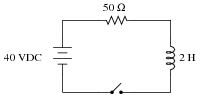
We may develop a loop equation based on Kirchhoff’s Voltage Law, knowing that the voltage of the power source is constant (40 volts), and that the voltage drops across the inductor and resistor are VL = L[dI/dt] and VR = IR, respectively:
40 − IR − L dI dt= 0 Show that the specific solution to this differential equation, assuming an initial condition of I = 0 at t = 0, is as follows:
I = 0.8(1 − e−25t) Reveal answer40 − IR − L dI dt= 0 40 − IR = L dI dt40 − IR L= dI dtdt L= dI 40 − IR⌠ ⌡ 1 Ldt = ⌠ ⌡ 1 40 − IRdI Substitution: u = 40 − IR ; du dI= −R ; dI = − 1 Rdu 1 L⌠ ⌡ dt = − 1 R⌠ ⌡ 1 udu t LK1 = − 1 R| lnu | − tR LK2 = | lnu | e−[tR/L] K2 = | u | K3e−[tR/L] = u K3e−[tR/L] = 40 − IR IR = 40 − K3e−[tR/L] I = 40 R− K4e−[tR/L] Given the initial condition of zero current (I = 0) at time zero (t = 0), the constant of integration must be equal to [40/R] in our specific solution:
I = 40 R− 40 Re−[tR/L] I = 40 R(1 − e−[tR/L]) Substituting the given component values into this specific solution gives us the final equation:
I = 0.8(1 − e−25t) Notes:L/R time constant circuits are an excellent example of how to apply simple differential equations. In this case, we see that the differential equation is first-order, with separable variables, making it comparatively easy to solve.
It should also be evident to students that any initial condition for current may be set into the general solution (by changing the value of the constant).
-
Question 50 of 52
Assume that the switch in this circuit is toggled (switched positions) once every 5 seconds, beginning in the “up” (charge) position at time t = 0, and that the capacitor begins in a fully discharged state at that time. Determine the capacitor voltage at each switch toggle:

Time Switch motion VC (volts)
0 s discharge → charge 0 volts
5 s charge → discharge
10 s discharge → charge
15 s charge → discharge
20 s discharge → charge
25 s charge → discharge
Reveal answer
Time Switch motion VC (volts)
0 s discharge → charge 0 volts
5 s charge → discharge 6.549 volts
10 s discharge → charge 2.260 volts
15 s charge → discharge 7.329 volts
20 s discharge → charge 2.529 volts
25 s charge → discharge 7.422 volts
Notes:Be sure to have your students share their problem-solving techniques (how they determined which equation to use, etc.) in class. See how many of them notice that the exponential portion of the equation (e[t/(τ)]) is the same for each calculation, and if they find an easy way to manage the calculations by storing charge/discharge percentages in their calculator memories!
-
Question 51 of 52
This passive integrator circuit is powered by a square-wave voltage source (oscillating between 0 volts and 5 volts at a frequency of 2 kHz). Determine the output voltage (vout) of the integrator at each instant in time where the square wave transitions (goes from 0 to 5 volts, or from 5 to 0 volts), assuming that the capacitor begins in a fully discharged state at the first transition (from 0 volts to 5 volts):
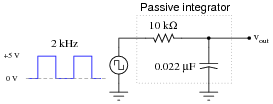
Transition vout
#1 (0 → 5 volts) 0 volts
#2 (5 → 0 volts)
#3 (0 → 5 volts)
#4 (5 → 0 volts)
#5 (0 → 5 volts)
#6 (5 → 0 volts)
#7 (0 → 5 volts)
#8 (5 → 0 volts)
Reveal answer
Transition vout
#1 (0 → 5 volts) 0 volts
#2 (5 → 0 volts) 3.395 volts
#3 (0 → 5 volts) 1.090 volts
#4 (5 → 0 volts) 3.745 volts
#5 (0 → 5 volts) 1.202 volts
#6 (5 → 0 volts) 3.781 volts
#7 (0 → 5 volts) 1.214 volts
#8 (5 → 0 volts) 3.785 volts
Challenge question: what are the final (ultimate) values for the integrator output’s sawtooth-wave peak voltages?Notes:Be sure to have your students share their problem-solving techniques (how they determined which equation to use, etc.) in class. See how many of them notice that the exponential portion of the equation (e[t/(τ)]) is the same for each calculation, and if they find an easy way to manage the calculations by storing charge/discharge percentages in their calculator memories!






Maybe this will help someone else. The general formulas for V(t) and I(t) in question 25 (and the x(t) versions in question s 23 and 14) contain typos (or maybe hypertext coding glitches). They should actually be V(t) = (Vf-Vo)(1-e^(-t/𝛕)) + Vo, I(t) = (If-Io)(1-e^(-t/𝛕)) + Io in question 25. Those are correct in the PDF download version. In questions 23 and 24 the equations are x = xinitial + ( xfinal − xinitial ) ( 1 − e[(−t)/(τ)] ).