
 Facebook
 Google
 GitHub
 Linkedin
DC Electric Circuits
Time Constant Calculations
52 questions By Tony R. Kuphaldt
-
Question 46 of 52
Calculate the rate of change of voltage ([dv/dt]) for the capacitor at the exact instant in time where the switch moves to the “charge” position. Assume that prior to this motion the switch had been left in the “discharge” position for some time:
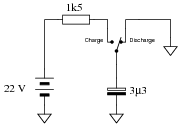
Reveal answer[dv/dt] = 4.44 kV/s or 4.44 V/ms
Notes:Some students may think that a rate of change of 4.44 kilovolts per second harbors shock hazard, because, well, 4.44 thousand volts is a lot of voltage! Remind them that this is a rate of change and not an actual voltage figure. This number simply tells us how fast the voltage is changing, not how far it will rise to. It is the difference between saying that a car travels at 75 miles per hour and that a car will travel 75 miles.
-
Question 47 of 52
Calculate the rate of change of current ([di/dt]) for the inductor at the exact instant in time where the switch moves to the “charge” position.

Reveal answer[di/dt] = 280 A/s or 0.28 A/ms
Follow-up question: does the resistor value have any effect on this initial [di/dt]? Explain why or why not.
Notes:Some students may think that a rate of change of 280 amps per second might burn up the wiring, because 280 amps seems like a lot of current. Remind them that this is a rate of change and not an actual current figure. This number simply tells us how fast the current is changing, not how far it will rise to. It is the difference between saying that a car travels at 75 miles per hour and that a car will travel 75 miles.
-
Question 48 of 52
∫f(x) dx Calculus alert!
Differential equations may be used to model the charging behavior of an RC circuit. Take, for instance, this simple RC circuit:
We may develop a loop equation based on Kirchhoff’s Voltage Law, knowing that the voltage of the power source is constant (30 volts), and that the voltage drops across the capacitor and resistor are VC = Q/C and VR = IR, respectively:
30 − IR − Q C= 0 To turn this into a true differential equation, we must express one of the variables as the derivative of the other. In this case, it makes sense to define I as the time-derivative of Q:
30 − dQ dtR − Q C= 0 Show that the specific solution to this differential equation, assuming an initial condition of Q = 0 at t = 0, is as follows:
Q = 0.0003(1 − e−50t) Also, show this solution in a form where it solves for capacitor voltage (VC) instead of capacitor charge (Q).
Reveal answer30 − dQ dtR − Q C= 0 30 − Q C= dQ dtR 30 − Q CR
=
dQ
dt
30C C− Q CR
=
dQ
dt
30C − Q RC= dQ dtdt RC= dQ 30C − Q⌠ ⌡ 1 RCdt = ⌠ ⌡ 1 30C − QdQ Substitution: u = 30C − Q ; du dQ= −1 ; dQ = −du 1 RC⌠ ⌡ dt = − ⌠ ⌡ 1 udu t RCK1 = − | lnu | − t RC− K1 = | lnu | e−[t/RC] − K1 = | u | K2e−[t/RC] = u K2e−[t/RC] = 30C − Q General solution: Q = 30C − K2e−[t/RC] Given the initial condition that the charge stored in the capacitor is zero (Q = 0) at time zero (t = 0), the constant of integration must be equal to 30C in our specific solution:
Q = 30C − 30Ce−[t/RC] Q = 30C (1 − e−[t/RC]) Substituting the given component values into this specific solution gives us the final equation:
Q = 0.0003(1 − e−50t) Showing a final equation in terms of capacitor voltage instead of capacitor charge:
Q C= 30C C(1 − e−[t/RC]) VC = 30(1 − e−50t) Notes:RC time constant circuits are an excellent example of how to apply simple differential equations. In this case, we see that the differential equation is first-order, with separable variables, making it comparatively easy to solve.
It should also be evident to students that any initial condition of capacitor charge may be set into the general solution (by changing the value of the constant).





Maybe this will help someone else. The general formulas for V(t) and I(t) in question 25 (and the x(t) versions in question s 23 and 14) contain typos (or maybe hypertext coding glitches). They should actually be V(t) = (Vf-Vo)(1-e^(-t/𝛕)) + Vo, I(t) = (If-Io)(1-e^(-t/𝛕)) + Io in question 25. Those are correct in the PDF download version. In questions 23 and 24 the equations are x = xinitial + ( xfinal − xinitial ) ( 1 − e[(−t)/(τ)] ).