Facebook
 Google
 GitHub
 Linkedin
DC Electric Circuits
Time Constant Circuits
23 questions By Tony R. Kuphaldt
-
Question 10 of 23
There are many, many processes in the natural sciences where variables either grow (become larger) or decay (become smaller) over time. Often, the rate at which these processes grow or decay is directly proportional to the growing or decaying quantity. Radioactive decay is one example, where the rate of decay of a radioactive substance is proportional to the quantity of that substance remaining. The growth of small bacterial cultures is another example, where the growth rate is proportional to the number of live cells.
In processes where the rate of decay is proportional to the decaying quantity (such as in radioactive decay), a convenient way of expressing this decay rate is in terms of time: how long it takes for a certain percentage of decay to occur. With radioactive substances, the decay rate is commonly expressed as half-life: the time it takes for exactly half of the substance to decay:
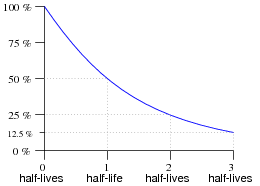
In RC and LR circuits, decay time is expressed in a slightly different way. Instead of measuring decay rate in units of half-lives, we measure decay rate in units of time constants, symbolized by the Greek letter “tau” (τ).
What is the percentage of decay that takes place in an RC or LR circuit after one “time constant’s” worth of time, and how is this percentage value calculated? Note: it is not 50%, as it is for “half life,” but rather a different percentage figure.
Graph the curve of this decay, plotting points at 0, 1, 2, and 3 time constants:
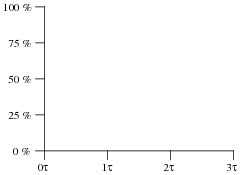
Reveal answerThe percentage is 63.2% for each time constant.

Notes:I like to use the example of radioactive decay to introduce time constants, because it seems most people have at least heard of something called “half-life,” even if they don’t know exactly what it is.
Incidentally, the choice to measure decay in either “half lives” or “time constants” is arbitrary. The curve for radioactive decay is the exact same curve as that of an RC or LR discharge process, and is characterized by the same differential equation:
dQ dt= −kQ Where,
Q = Decaying variable (grams of substance, volts, amps, whatever)
k = Relative decay rate
t = Time
By solving this separable differential equation, we naturally arrive at an equation expressing Q in terms of an exponential function of e:
Q = Q0 e−kt Thus, it makes more sense to work with units of “time constants” based on e than with “half lives,” although admittedly “half-life” is a concept that makes more intuitive sense. Incidentally, 1 half-life is equal to 0.693 time constants, and 1 time constant is equal to 1.443 half-lives.
-
Question 11 of 23
∫f(x) dx Calculus alert!
Suppose a capacitor is charged by a voltage source, and then switched to a resistor for discharging:
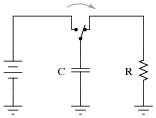
Would a larger capacitance value result in a slower discharge, or a faster discharge? How about a larger resistance value? You may find the Öhm’s Law” equation for capacitance helpful in answering both these questions:
i = C dv dtNow consider an inductor, “charged” by a current source and then switched to a resistor for discharging:
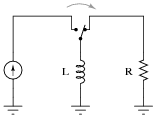
Would a larger inductance value result in a slower discharge, or a faster discharge? How about a larger resistance value? You may find the Öhm’s Law” equation for inductance helpful in answering both these questions:
v = L di dtReveal answerFor the RC circuit:
- •
- Larger capacitance = slower discharge
- •
- Larger resistance = slower discharge
For the LR circuit:
- •
- Larger inductance = slower discharge
- •
- Larger resistance = faster discharge
Notes:Students usually want to just use the τ = RC and τ = \(\frac{L}{R}\) formulae to answer questions like this, but unfortunately this does not lend itself to a firm conceptual understanding of time-constant circuit behavior.
If students need hints on how to answer the capacitance and inductance questions, ask them what the fundamental definitions of “capacitance” and ïnductance” are (the ability to store energy . . .). Then ask them what takes longer to discharge (given the same power, or rate of energy release per unit time), a large reservoir of energy or a small reservoir of energy.
If students need hints on how to answer the resistance questions, ask them what each type of reactive component resists change in (voltage for capacitors and current for inductors). Then ask them what condition(s) are necessary to cause the most rapid change in those variables (high current for capacitors and high voltage for inductors). This is most evident by inspection of the differential equations i = C\(\frac{dv}{dt}\) and v = L \(\frac{di}{dt}\).
-
Question 12 of 23
Capacitors tend to oppose change in voltage, and so they may be considered “temporary voltage sources.” That is, they tend to hold a constant voltage over time, but they cannot do so indefinitely. Any motion of charge (current) will change the voltage of a capacitor.
Likewise, inductors may be considered “temporary current sources” because while they tend to hold current constant over time, they cannot do so indefinitely. Any application of voltage across a (perfect) inductor will alter the amount of current going through it.
Given the above characterizations, determine what resistance levels will result in the fastest discharge of energy for both the capacitive circuit and the inductive circuit. Considering each of the reactive components (C and L, respectively) as “temporary” power sources whose store of energy will drain over time, determine what value of R in each circuit will result in the quickest depletion of energy by making each source “work hardest:”
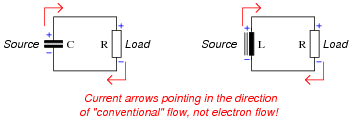
Based on your answer to this question, explain how circuit resistance (R) affects the time constants (τ) of RC and of LR circuits.
Reveal answerI will answer this question with another question: what value of R in each of these circuits will result in the greatest power dissipation at the load, large R or small R?

Large R values slow down RC circuits and speed up LR circuits, while small R values speed up RC circuits and slow down LR circuits.
Notes:The leap I expect students to make here is to think about the exchange of energy for both capacitors and inductors as they deliver power to a resistive load. Which ever values of R make the respective sources work the hardest (dissipate the most power at the load) will be the values that make the reactive components discharge quickest.