Facebook
 Google
 GitHub
 Linkedin
DC Electric Circuits
Time Constant Circuits
23 questions By Tony R. Kuphaldt
-
Question 13 of 23
While many students find it easy to understand how the value of R affects the time constant of a resistor-capacitor charging circuit (more R means slower charging; less R means faster charging), the opposite behavior of resistor-inductor circuits (less R means slower charging; more R means faster charging) seems incomprehensible:

Resistor-capacitor circuit charging behavior probably makes more sense to students because they realize resistance controls charging current, which in turn directly effects how quickly the capacitor’s voltage may rise:
i = C dv dtCurrent (i) is proportional to the rate of change of voltage \(\frac{dv}{dt}\). Since current is inversely proportional to resistance in a circuit powered by a voltage source, so must be the capacitor charging rate.
One way to help make the inductor charging circuit more sensible is to replace the series voltage-source/resistor combination with its Norton equivalent, a parallel current-source/resistor combination:
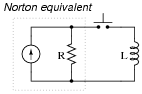
Re-analyze the circuit in this form, and try to explain why more resistance makes the inductor charging time faster and less resistance makes the inductor charging time slower.
Reveal answerThe answer relates to this equation (of course!):
v = L di dtThe inductor’s “charge” is a direct function of current, the change of which (rate of charge) is directly proportional to the amount of voltage impressed across the inductor. In a Norton equivalent circuit, the output voltage is directly proportional to the internal resistance. So, a greater resistance results in a faster charging time.
Notes:My answer could stand to be a little more detailed, but the main idea here is to have students piece together their own argument explaining why inductor charging rate is directly proportional to resistance. Of course, this is yet another example of the usefulness of Thévenin/Norton equivalent circuits. Sometimes a simple source conversion from one form to the other is all that is needed to achieve a conceptual breakthrough!
-
Question 14 of 23
What value of resistor would need to be connected in series with a 33 μF capacitor in order to provide a time constant (τ) of 10 seconds? Express your answer in the form of a five-band precision resistor color code (with a tolerance of /- 0.1%).
Reveal answerOrg, Blk, Org, Org, Vio
Notes:In order for students to answer this question, they must research the RC time constant equation and review the 5-band resistor color code.
-
Question 15 of 23
What value of resistor would need to be connected in series with a 75 mH inductor in order to provide a time constant (τ) of 20 microseconds? Express your answer in the form of a five-band precision resistor color code (with a tolerance of /- 0.25%).
Reveal answerOrg, Vio, Grn, Brn, Blu
Notes:In order for students to answer this question, they must research the LR time constant equation and review the 5-band resistor color code.