
 Facebook
 Google
 GitHub
 Linkedin
DC Electric Circuits
Voltmeter Design
18 questions By Tony R. Kuphaldt
-
Question 10 of 18
Calculate the necessary resistance values to give this multi-range voltmeter the ranges indicated by the selector switch positions:
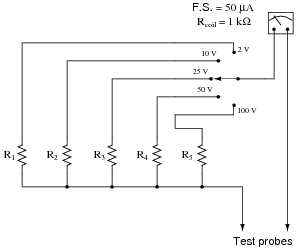
Reveal answer- R1 = 39 k Ω
- R2 = 199 k Ω
- R3 = 499 k Ω
- R4 = 999 k Ω
- R5 = 1.999 M Ω
Notes:This is really nothing more than a set of simple series circuit problems, although the context of it being a voltmeter seems to confuse some students. If you find a large percentage of your class not understanding where to begin in a problem such as this, it means they really don’t understand series circuits - all they learned to do when studying series resistor circuits before is to follow an easy sequence of steps to find voltages and currents in series resistor circuits. They did not learn the concepts well enough to abstract to something that looks just a little bit different.
-
Question 11 of 18
Calculate the necessary resistance values to give this multi-range voltmeter the ranges indicated by the selector switch positions:
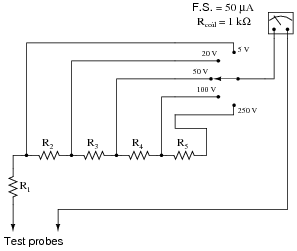
Reveal answer- R1 = 99 k Ω
- R2 = 300 k Ω
- R3 = 600 k Ω
- R4 = 1 M Ω
- R5 = 3 M Ω
Hint: if you need help getting started in this problem, begin with calculating the value of R1.
Notes:This is really nothing more than a set of simple series circuit problems, although the context of it being a voltmeter seems to confuse some students. If you find a large percentage of your class not understanding where to begin in a problem such as this, it means they really don’t understand series circuits - all they learned to do when studying series resistor circuits before is to follow an easy sequence of steps to find voltages and currents in series resistor circuits. They did not learn the concepts well enough to abstract to something that looks just a little bit different.
You should point out to your students how the series arrangement of the range resistors lends itself to more common resistance values, as opposed to having a separate range resistor for each range. There is a downside to this design, however: reliability. Discuss with your students the consequences of “open” resistor faults in both types of voltmeter designs.
-
Question 12 of 18
Ideally, should a voltmeter have a very low input resistance, or a very high input resistance? (Input resistance being the amount of electrical resistance intrinsic to the meter, as measured between its test leads.) Explain your answer.
Reveal answerIdeally, a voltmeter should have the greatest amount of input resistance possible. This is important when using it to measure voltage sources and voltage drops in circuits containing large amounts of resistance.
Notes:The answer to this question is related to the very important principle of meter loading. Technicians, especially, have to be very aware of meter loading, and how erroneous measurements may result from it. The answer is also related to how voltmeters are connected with the circuits under test: always in parallel!





The equations in the answer to question 3 are incorrect. The first two equations are missing Vt on the right side. Also, all of the equations are missing plus signs in the denominators.