
 Facebook
 Google
 GitHub
 Linkedin
DC Electric Circuits
Voltmeter Design
18 questions By Tony R. Kuphaldt
-
Question 13 of 18
Explain what the ohms-per-volt sensitivity rating of an analog voltmeter means. Many analog voltmeters exhibit a sensitivity of 20 kΩ per volt. Is it better for a voltmeter to have a high ohms-per-volt rating, or a low ohms-per-volt rating? Why?
Reveal answerThe “ohms-per-volt” sensitivity rating of a voltmeter is an expression of how many ohms of input resistance the meter has, per range of volt measurement. The higher this figure is, the better the voltmeter.
Notes:If students have analog voltmeters in their possession (which I greatly encourage them to have), the ohms-per-volt sensitivity rating is often found in a corner of the meter scale, in fine print. If not, the rating should be found in the user’s guide that came with the meter.
-
Question 14 of 18
Fundamentally, what single factor in a voltmeter’s design establishes its ohms-per-volt sensitivity rating?
Reveal answerIf your answer is, “the value of the series resistor(s),” you are incorrect.
Notes:Students’ immediate impression is that the range resistor value must establish the sensitivity rating, because they see the resistor as having the most impact on input resistance. However, some quick calculations with different range resistor values prove otherwise! Meter sensitivity is independent of any series-connected range resistor values.
You might want to ask your students why meter movement coil resistance is not a factor in determining voltmeter sensitivity. Challenge your students with setting up sample circuit problems to prove the irrelevance of coil resistance on voltmeter sensitivity. Let them figure out how to set up the problems, rather than you setting up the problems for them!
-
Question 15 of 18
Determine the different range values of this multi-range voltmeter:
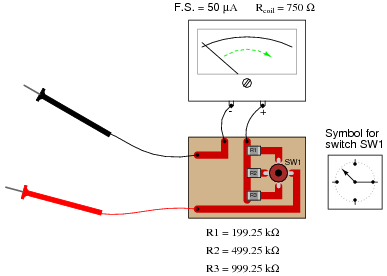
All components on the printed circuit board are “surface-mount,” soldered onto the top surfaces of the copper traces. The switch (SW1) schematic diagram is shown to the immediate right of the circuit board, with resistor values shown below the circuit board.
Reveal answerRanges = 10 V, 25 V, and 50 V.
Notes:Determining the voltage ranges for this voltmeter is simply an exercise in Ohm’s Law. The arithmetic is simple enough to permit solution without the use of calculators, so challenge your students during discussion time to work through the math “the old-fashioned way”.





The equations in the answer to question 3 are incorrect. The first two equations are missing Vt on the right side. Also, all of the equations are missing plus signs in the denominators.