Facebook
 Google
 GitHub
 Linkedin
Adding Vision to Supervision: Enhancing Workplace Efficiency
Placing cameras in a workplace can be tricky because it requires balancing workplace efficiency with employee security and privacy. Learn how to leverage sensing technology properly to maximize production.
When companies wish to succeed in business, a few priorities share the spot of top importance, namely maximizing the productive output of resources while minimizing overhead costs. This process of maximizing output is called “optimization,” and many technologies are leveraged to ensure that equipment and people can perform at top capacity, limiting downtime events.
Managing people is a process of balancing data collection to optimize the workflow and minimize the number of mistakes. These data-collection techniques can pose risks to employee privacy and, in some cases, safety, but modern vision systems have taken careful steps to reduce both of those concerns.

Figure 1. Positional data of workers in production environments can help identify bottlenecks in production. Image used courtesy of Omron
Vision Systems for Workplace Human Detection
It is important to note that human detection is not equivalent to facial recognition. When setting up a human detection camera system, the ideal location is a top-down field of view, allowing the camera to detect the tops of heads and body profiles in many standing and seated positions. These top-down profiles often do not exhibit distinguishing details, because many employees dress in similar gear, such as a safety hard hat or clean suit.
In contrast, facial-detection systems must be installed horizontally and close to eye level in order to better recognize features unique to each individual, allowing a system to track the location of each person.
When using human detection software, each top-down profile is assigned a unique ID, and as many as 10 individuals can be tracked inside the camera’s field of view at any given time. When an individual leaves the field of view and re-enters, that person is assigned a new ID. For each ID, the X and Y position of the person is relayed to the controller, and only the position information is stored.
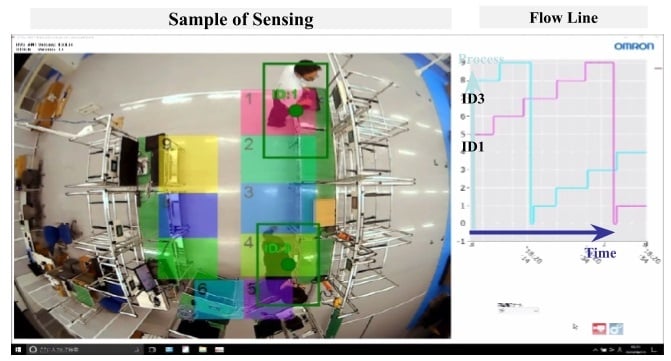
Figure 2. Detection scenario: ID2 and ID3 are tracked with positional XY data only. Image used courtesy of Omron
Human Detection Application Examples
When information is collected and stored, the next logical question is posed: How and why is this information used to make process decisions? Here are a few specific examples of when human detection software can be used to increase productivity.
Working Time Optimization
In many manufacturing processes, there is a specific set of steps to perform at a sequence of workstations. Assembling screws, applying adhesive, soldering connectors, testing contacts, and the list goes on. To maintain scheduled output, none of these steps should take an exceptionally long time. If the time at each station is tracked over time, management can identify critical bottlenecks and opportunities for training the workforce to speed up certain steps.
The traditional alternative is to rely on another supervisory layer with a subjective and limited human perspective. Vision systems are impartial and can more comprehensively connect bottlenecks to unseen upstream or downstream contributing factors that may be out of sight for human supervisors.
Industrial Equipment/Human Interaction
In any modern manufacturing facility, humans must inevitably work alongside automation. Perhaps this is most obviously demonstrated through one of the industry’s newest product categories: collaborative robots, or “cobots,” which operate without safety barriers.
When robots and humans come in close proximity, the robot must slow down or stop. While the location of the robots is fixed, it can be useful to track the position of each human worker to identify momentary stops of the robot. Can the process be optimized simply by adjusting a workstation position, or by reducing time spent at each workstation? Collecting data through human detection must be the first step.
Warehouse Traffic Path Planning
In the business of logistics, it’s important to reduce the steps between each pick or place action. This reduces the time spent on each order and worker fatigue. Tracking the location of each person through a workday can help identify long routes and help management optimize walking paths. Additionally, it can prevent collisions by locating trouble spots and blind corners around shelves and other obstacles.
Configuring a Human Detection Vision System
Setting up the vision system requires matching hardware and software, but, fortunately, the process relies mainly on configurable, flexible software packages.
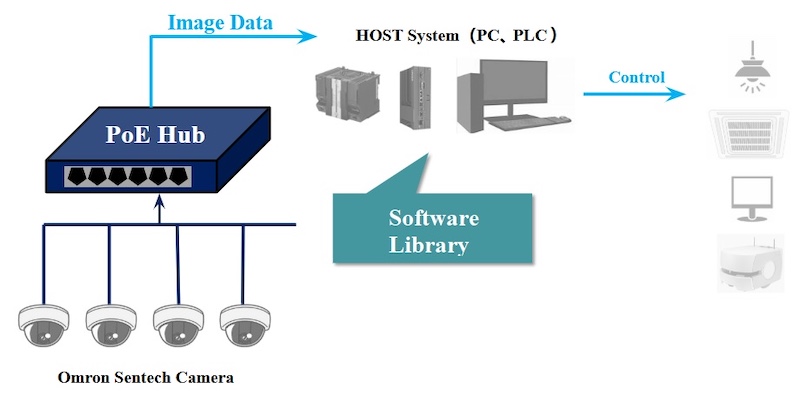
Figure 3. Hardware for a vision system, including cameras, network devices, controllers, and output devices. Image used courtesy of Omron
Vision systems are often designed to leverage cameras that use network protocols for ease of installation, such as the Omron Sentech GigE Vision series with a fish-eye lens that captures a wide view of the surroundings. Power over Ethernet (PoE) is a common method of supplying energy and relaying images from a camera over the same cable. A PoE hub transfers the images to the controller, usually a PC or a compatible PLC. Because the objective is tracking positional data rather than on-the-fly process changes, it’s more likely to be connected to a PC.
The software package, such as Omron’s AM1 top-down human body detection software, provides actionable outputs. If a logistics system provides path planning to mobile robots, the human location metrics might provide insights for the robots. The prevalence of AI algorithms creates many opportunities for processing data and identifying new insights from the ingested position data points.
Leveraging Vision in a Human-Centric Workforce
In any business, staff must be careful to balance productivity and privacy of data, all while attempting to increase the output of high-quality products. Effective managers can leverage technology and mitigate risks, and using tools like Omron cameras and the AM1 software can provide resources to incorporate inherent safety into the development process.
Related Content