Facebook
 Google
 GitHub
 Linkedin
Acopian Unwraps 900 W Low Profile AC-DC Power Supply
The LP2 series delivers programmable control, compact form factor, and high configurability.
Acopian Power Supplies has introduced its latest LP2 series of low-profile AC-DC switching power supplies rated up to 900 W. Designed for industrial and research applications, the series includes programmable voltage and current control along with protection and monitoring features standard across the lineup.
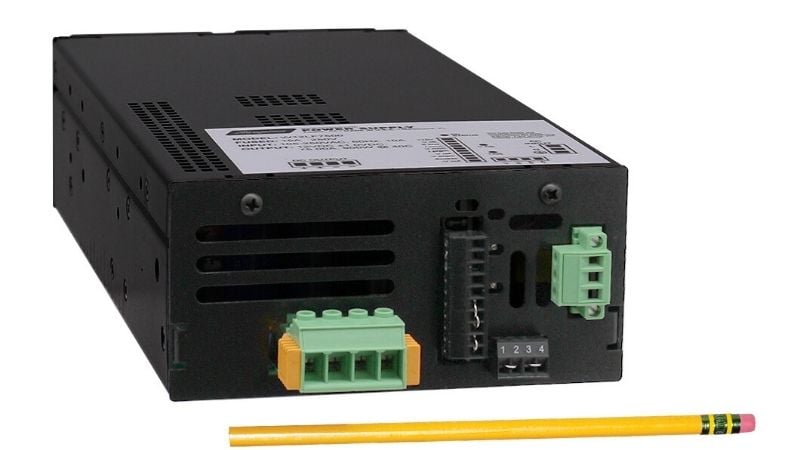
The LP2 PSU. Image used courtesy of Acopian
The LP2 Series
Available in both single and wide-adjustment output models, the LP2 family supports DC outputs ranging from fixed 5 V to 125 V, as well as adjustable versions spanning 0-5 V to 0-125 V. Meanwhile, universal input support ranges from 90-265 VAC at 49-420 Hz or 110-350 VDC, with active power factor correction maintaining 0.99 at full load. Input inrush current is controlled by thermistor limiting, with measured peaks of 33 A at 115 VAC and 65 A at 230 VAC.
Notably, the series provides both constant voltage and constant current operating modes. Line regulation holds at ±0.05% in voltage mode, with load regulation at the same level. In constant current mode, line regulation measures ±0.2% or 30 mA, and load regulation ±0.5% or 100 mA. Voltage and current outputs can be programmed from 0 to the model’s rated capacity using 0-10 VDC (or optional 0-5 VDC) external control signals, with voltage programming accuracy at 0.5%.
For dynamic loads, transient response times return to within ±1% of output in 3 ms after a load step from 50% to 100%, with excursion limited to ±3%. Efficiency reaches 85% for models at 24 V, 28 V, 36 V, and higher output voltages, while lower-voltage models operate around 80%.
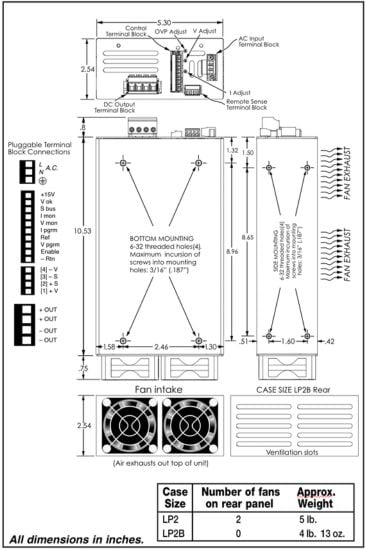
Diagram and dimensions. Image used courtesy of Acopian
Thermal design differentiates the two case types: the LP2B series uses passive convection cooling, while the higher-power LP2 series employs thermostatically controlled fans. Both designs maintain full operation from -20 °C to +71 °C, derating at 1% per °C above 40 °C. Models reach a maximum rating of 900 W when forced-air cooled and 600 W under convection cooling.
Integrated protection includes output short-circuit handling, overload recovery, overvoltage shutdown at 15% above rating, and thermal protection with automatic reset. Optional features add N+1 redundancy for up to four parallel units with internal isolation circuitry, alarm relay contacts for fault signaling, and conformal coating for moisture and fungus resistance.
Voltage and Current Programmability in PSUs
Programmability in power supplies is becoming important for laboratory and automated test environments. Traditional fixed-output supplies require manual adjustment or switching between discrete models. In contrast, programmable architectures allow a single supply to be configured dynamically through control voltages or digital interfaces.
Voltage programmability permits fine-grained tuning of supply levels to match test requirements so that devices are compatible operating at nonstandard voltages. Current programmability is often needed for stress testing, battery simulation, and current-limited device powering.
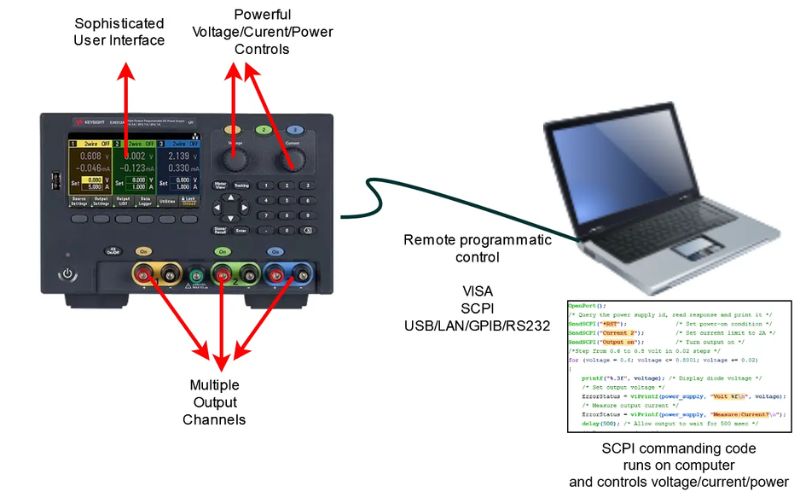
Programming a PSU with SCPI commanding code. Image used courtesy of Keysight
Fast transient response is also a factor when loads change abruptly. Without precise regulation, devices under test may experience overshoot or voltage sag, potentially leading to incorrect measurements or component damage. By combining programmable adjustment with tight regulation and protection, power supplies like the LP2 series provide engineers with both safety and versatility.
Finally, monitoring is a notable consideration for an engineer considering a PSU. Voltage and current monitor terminals allow external measurement without loading the circuit and improve accuracy in automated systems.
Broader Impact and Availability
In environments such as aerospace and medical testing, the balance between programmability and protection becomes particularly relevant. Supplies that can adapt to new requirements without replacing hardware reduce lifecycle costs while improving system flexibility. This switch toward multipurpose, configurable power sources is a significant part of the broader industry push favoring modular, software-driven instrumentation.
Acopian’s LP2 models include a five-year warranty and are designed and manufactured in the United States.