Facebook
 Google
 GitHub
 Linkedin
AONDevices Shows Off Sensor Fusion IC Targeting Always-On Designs
Announced at CES, the sensor fusion chip detected over a dozen sound classes while performing wake-word recognition, all within the chip’s ultra-low power envelope.
Among the slew of announcements at CES 2025, AONDevices stood out with the introduction of the AON1120 sensor fusion IC. Combining sophisticated sensor fusion capabilities with high energy efficiency, the AON1120 allows devices to perform complex tasks such as voice command recognition, sound classification, and biometric authentication—all within a power envelope that supports extended device lifespans.
_and_Jake_Hertz_(right)_holding_an_AON1120_evaluation_kit.jpg)
AONDevices' co-founder and CEO Mouna Elkhatib (left) and All About Circuits writer Jake Hertz (right) holding an AON1120 evaluation kit at CES 2025.
All About Circuits met with AONDevices' co-founder and CEO, Mouna Elkhatib, at CES 2025 to learn more about the new chip firsthand.
Meeting Edge AI Challenges
Edge AI presents many unique challenges, particularly in achieving high accuracy and functionality under stringent power constraints.
“The biggest challenge is to maintain high accuracy without impacting power,” Elkhatib said. “That’s why we don’t see many always-on solutions today. The trend is to bring more capabilities to low-power states, from sensor fusion to privacy-centric edge processing.”
The AON1120’s architecture is a direct response to these challenges. To this end, the new chip integrates a dual neural processing unit (NPU) architecture with a RISC-V core and a hardware digital signal processor (DSP) encapsulated in a compact, 40QFN package. AONDevices designed its architecture for always-on applications that must efficiently execute AI models without compromising battery life. Its micro-neural network technology deploys compact models that traditionally require much larger architectures. With models sized less than 50 KB, the AON1120 is said to rival larger networks in both capability and accuracy.
The AON1120 stands out for its power efficiency. In full processing mode, it operates at less than 260 µW, even when managing simultaneous AI tasks such as sound detection and voice command recognition. In listening mode, the power consumption drops to 80 µW. According to AONDevices, the device achieves this efficiency without sacrificing accuracy, with the chip having a reported detection hit rate exceeding 90% in noisy environments with signal-to-noise ratios (SNR) below 0 dB.
Expanding Possibilities With Multi-Sensor Fusion
The AON1120’s multi-sensor fusion capabilities expand its potential applications beyond conventional AI chips. It supports a range of input types, including microphones, accelerometers, and other sensors, allowing it to detect voice commands, gestures, and environmental sounds simultaneously.
“Our chip runs in the always-on state, fully processing sound detection and voice commands within 260 µW,” Elkhatib said. “That’s a key differentiator—we handle multiple tasks simultaneously without exceeding this power envelope.”
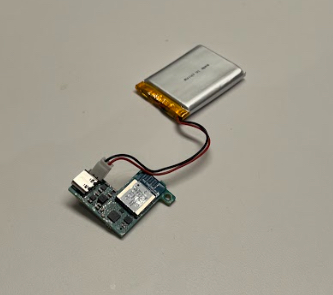
An AON1120 evaluation test setup at CES 2025.
In one CES demonstration, the AON1120 detected over a dozen sound classes while performing wake-word recognition, all within the chip’s power envelope. For instance, it can analyze sleep patterns by combining audio cues with motion data to offer a comprehensive solution for wearable health devices.
Tools and Ecosystem Support
AONDevices focuses on providing end-to-end solutions, integrating hardware, software, and neural network development under a single cohesive framework.
“From the day I started, it was a no-brainer that we needed an end-to-end solution,” Elkhatib said. “We design the hardware, algorithms, and software together, ensuring everything is optimized for super low-power applications.”
To complement its hardware, AONDevices provides the AONx360 online tool suite. This platform simplifies the deployment of AI models by enabling data collection, augmentation, training, and performance testing within a cohesive interface. One of the suite’s most innovative features is its support for tiny datasets. While traditional AI training often requires extensive data collection, the AONx360 platform can generate accurate models with as few as 100 samples. This efficiency is further enhanced by synthetic data augmentation and generative AI techniques that reduce the dependency on large, manually curated datasets.
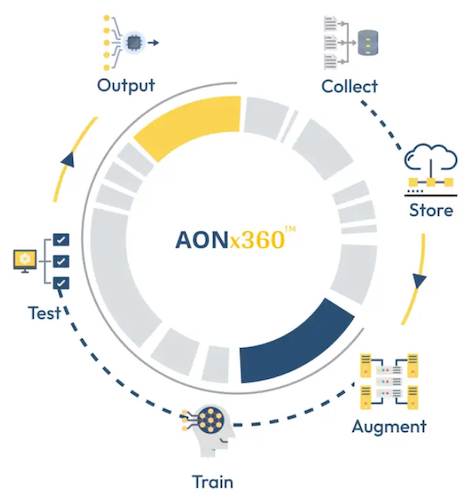
The AONx360 online tool suite. Image used courtesy of AONDevices
This platform is part of AONDevices’ vision for democratizing AI development, allowing developers to tailor device functionalities without extensive technical expertise. For example, users can train the AON1120 to recognize a specific wake word or sound pattern via the cloud-based platform. Once trained, the model is deployed over Bluetooth for real-time updates and customization.
Is 2025 the Year of Edge AI?
AONDevices' release of the AON1120 is its decisive response to the growing demand for efficient, always-on-edge AI solutions. With its ability to handle complex AI tasks within an ultra-low power envelope, this technology aligns with emerging trends prioritizing energy efficiency, privacy, and device autonomy.
“I see the inflection point for Edge AI really being 2025,” Elkhatib said. “There’s been a lot of hype and development over the last few years, but true ROI and scalable adoption are only starting to take shape now."