Facebook
 Google
 GitHub
 Linkedin
One Month Into 2025, Business Deals Fire Up the Semiconductor Industry
From Cadence taking over Secure-IC to Quantum Brilliance pocketing $20 million in funding, the semiconductor is already making big moves this year.
One month into 2025, semiconductor companies have hit the headlines following a series of high-profile acquisitions, collaborations, and, for diamond-based quantum device manufacturer Quantum Brilliance, a $20 million series A funding round.

Onsemi's Solutions Engineering Center in Scottsdale, Arizona. Image used courtesy of Onsemi
Here are a few announcements that have caught our eye on the high-level business side of the semiconductor industry.
1. Cadence to Acquire Secure-IC
Cadence has agreed to acquire Secure-IC, a provider of embedded security IP, to strengthen its portfolio of silicon-proven IP solutions. This move may enhance Cadence’s security capabilities across industries like automotive, aerospace, data centers, and IoT.

The Securyzr iSE IP module, an example of Secure-IC's embedded security IP. Image used courtesy of Secure-IC
Secure-IC’s expertise in cybersecurity will integrate with Cadence’s existing offerings, addressing growing security needs in AI-enabled SoCs and chiplet-based designs. The acquisition will expand Cadence’s market reach and provide stronger end-to-end security solutions. The deal is set to close in the first half of 2025, pending regulatory approvals, and is not expected to impact revenue or earnings this year.
Cadence's acquisition of Secure-IC will substantially expand its footprint in the embedded security IP market. This will enable Cadence to offer new solutions combining its existing IP portfolio with Secure-IC's specialized security offerings—and unlock a multi-hundred-million dollar incremental Total Addressable Market (TAM) opportunity for the company.
2. Weebit Nano Licenses ReRAM Tech to Onsemi
Weebit Nano has licensed its Resistive Random Access Memory (ReRAM) technology to Onsemi. This agreement brings Weebit's low-power, cost-effective embedded non-volatile memory (NVM) to Onsemi's Treo platform.
Weebit ReRAM operates by switching between high and low resistance states in an oxide layer between two electrodes, encoding binary data. The resistance state can be changed by applying positive or negative voltages, creating or breaking a conductive filament. This allows data to be written, erased, and retained without power.

Weebit ReRAM operates by switching between high and low resistance states in an oxide layer between two electrodes, encoding binary data. Image used courtesy of Weebit Nano
ReRAM technology provides strong data retention at high temperatures and integrates well into bipolar CMOS DMOS (BCD) processes. Weebit believes this technology could replace traditional Flash storage in many electronic products, improving performance in IoT devices, smartphones, robotics, and autonomous vehicles and making it easier for engineers to integrate ReRAM into existing fabrication processes.
3. Onsemi Acquires Qorvo’s SiC JFET Portfolio
Onsemi has officially acquired Qorvo’s silicon-carbide junction field-effect transistor (SiC JFET) technology business for $115 million in cash. This acquisition includes United Silicon Carbide and expands Onsemi’s EliteSiC power portfolio.
The deal strengthens Onsemi’s position in AI data centers, electric vehicles, and industrial applications. The acquisition is expected to increase market opportunities by $1.3 billion by 2030. It also improves efficiency and safety in electric vehicle battery disconnect units and supports energy storage and solid-state circuit breaker advancements.
SiC JFETs offer the lowest on-resistance per chip area, using less than half of any comparable technology. This will inevitably lead to the design of more compact and efficient power systems and streamline the design process for engineers by reducing development time and costs.
4. Siemens Launches ‘Siemens for Startups’ Program
Siemens has launched a new program to support early-stage engineering and manufacturing startups. Announced at CES 2025 in Las Vegas, the Siemens for Startups program will enable new companies to accelerate innovation, streamline development processes, and scale faster by providing venture-related services while reducing the cost of access to Siemens software and hardware.

Siemens is linking its "Siemens for Startups" program with AWS’ Startup program to further connect innovators. Image (modified) used courtesy of Siemens
The initiative aligns with the company’s focus on industry, infrastructure, mobility, and healthcare. It gives start-ups access to Siemens' technology and expertise, allowing engineers to work on new projects and contribute to digital and sustainability advancements across industries.
Engineering teams in the program will benefit from Siemens’ sophisticated software suite, including NX CAD for powerful CAD, Simcenter for 3D structural simulation, and Teamcenter for product lifecycle management.
5. Quantum Brilliance Receives $20 Million Series A Funding
Quantum Brilliance has raised $20 million in series A funding led by global deep tech and semiconductor firms Main Sequence, In-Q-Tel, and Intervalley Ventures. The company specializes in room-temperature diamond quantum technology. With the funding, Quantum Brilliance plans to build a quantum diamond foundry, develop prototypes for quantum sensing, and further advance proprietary IP in partnership with semiconductor companies.
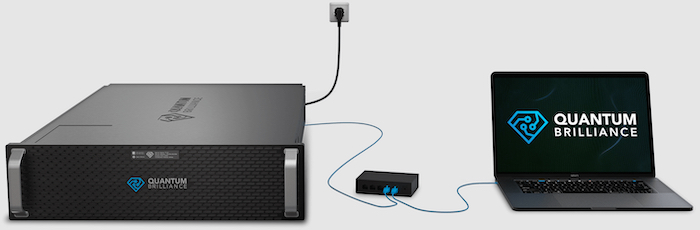
The company's quantum computer hardware, Quantum Brilliance Gen1 Model, is now commercially available. Image used courtesy of Quantum Brilliance
Quantum diamonds offer versatile applications in quantum computing, sensing, and networking. Their compact size, lightweight design, room-temperature operation, and scalability provide key advantages over other quantum technologies. These attributes make them an appealing candidate for large-scale deployment, provide consistent performance in challenging environments, and simplify integration into existing infrastructure.