Facebook
 Google
 GitHub
 Linkedin
Electronica 2024 Was Jammed Packed With Exciting Technologies and Products
Enjoy this selection of fascinating technology news from the recent Electronica 2024 trade show in Munich, Germany.
Our All About Circuits and EETech team had an amazing and productive time at the Electronica 2024 show! With a mix of scheduled meetings and impromptu drop-bys, we saw an impressive mix of technologies and products all across the electronics industry. For a taste of who we talked to and what we saw, in this article, we’ve rounded up the highlights from a handful of the many companies that had news to share at the show.
Thank you so much to every company and every person we interacted with, whether it was talking with us, letting us take cool pics, or just making a connection on the show floor or at dinner events. Can’t wait until the Electronica 2026 event two years from now!
TI Integrates Edge AI and Real-Time Control in New Mission-Critical MCUs
At Electronica 2024, Texas Instruments (TI) announced its new TMS320F28P55x series of C2000 MCUs. TI calls the series the industry’s first real-time microcontrollers with an integrated neural processing unit (NPU). Along with that announcement, TI also revealed the new 64-bit F29H85x series of MCUs built around its C29 digital signal processing (DSP) core. The C29 MCUs target automotive applications that require fault-tolerant, low-latency operations and predictive decision-making. Both sets of new MCUs can serve mission-critical applications that require low-latency, real-time detection, calculation, and response.
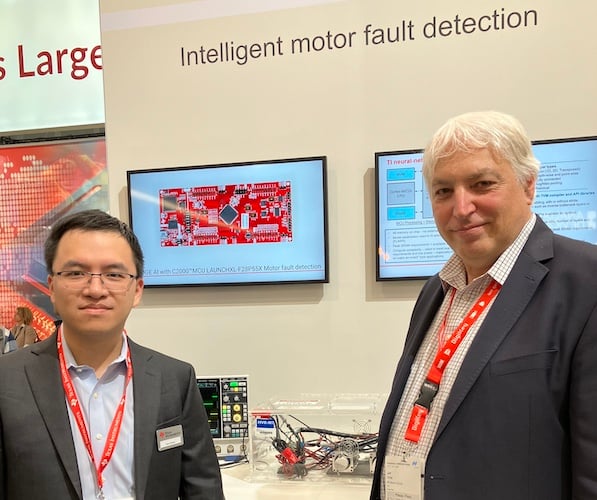
Han Zhang (left), Applications Manager at Texas Instruments, showed Jeff the demo for the TMS320F28P55x MCU at TI's Electronica booth.
The 40+ variants of the TMS320F28P55x series come with an integrated hardware NPU and on-chip Flash memory of up to 1.1 MB. This series also features 24 pulse width modulation (PWM) channels and 39 analog-to-digital (ADC) channels.
The second series of MCUs in this announcement, the F29H85x, provides motor and power control with two to three times the signal chain performance of its predecessors. TI also claims these devices have a five times faster fast Fourier transform (FFT) performance in diagnostics, tuning, and arc detection. Real-time interrupts run four times faster, and the MCUs are reportedly two to three times higher performing for general-purpose code execution. It includes an isolated hardware security module as well.
The newest additions to the family, the TMS320F28P55x series, integrate an NPU as an edge AI hardware accelerator. The NPU enables the MCU to offload AI processing from the primary core to dramatically increase real-time performance. The NPU offers advanced AI-based decision-making without loading down the primary processing core.
Lake Shore Cryotronics Introduces First SMU With Both DC and AC Sourcing
At Electronica, Lake Shore Cryotronics, a company that provides measurement and control solutions for scientific research, released a new source measurement unit (SMU). The company designed the SMU-10, an extremely low-noise, high-sensitivity measurement system, to operate in the ultra-low voltage regimes of sub-nanoscale and 2D nanomaterial semiconductors.
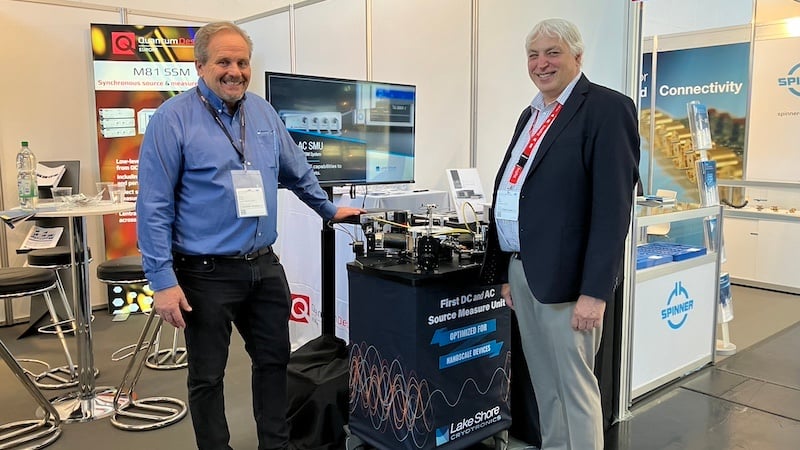
Lake Shore Cryotronics' Chuck Cimino (left) with All About Circuits editor-in-chief Jeff Child (right) at Electronica 2024.
An SMU is a test and measurement instrument that combines the signal source and measurement function on a single pin. While conventional instruments inject signals on one line and measure with another line, an SMU will perform both functions on the same line. The SMU-10 is an add-in module for Lake Shore Cryotronics’ MeasureReady M81-SSM synchronous source measure (SSM) system.
All About Circuits spoke to Chuck Cimino (see image above), senior product manager at Lake Shore, to learn more about the new SMU. “There's a lot of test equipment out there that does a good job keeping up with the Moore's law curve,” Cimino said. “But if things accelerate—let's say, because of the atomic nano-scale evolution—then we feel that Lakeshore has got a lot of technologies and background to help bring some new tools to the challenge.”
The Lake Shore Cryotronics SMU-10 operates with extremely low noise parameters and high sensitivities of below 10 nV/√Hz (AC) and below 100 fA (DC) with maximum voltage/current levels of ±10 V and ±100 mA DC/peak. The SMU-10 is a modular add-on to the company’s MeasureReady M81-SSM synchronous source measure (SSM) system. The SMU-10 is the first SMU with both DC and AC sourcing and measurement capabilities.
Onsemi Rolls Out Modular Analog and Mixed-Signal SoC Platform
At the show, Onsemi announced its Treo platform, an advanced and modular analog and mixed-signal system. Integrating diverse functionalities—power management, sensor interfaces, and communication subsystems—within a single modular architecture, the new platform addresses high-performance demands across automotive, medical, industrial, and AI data center applications.
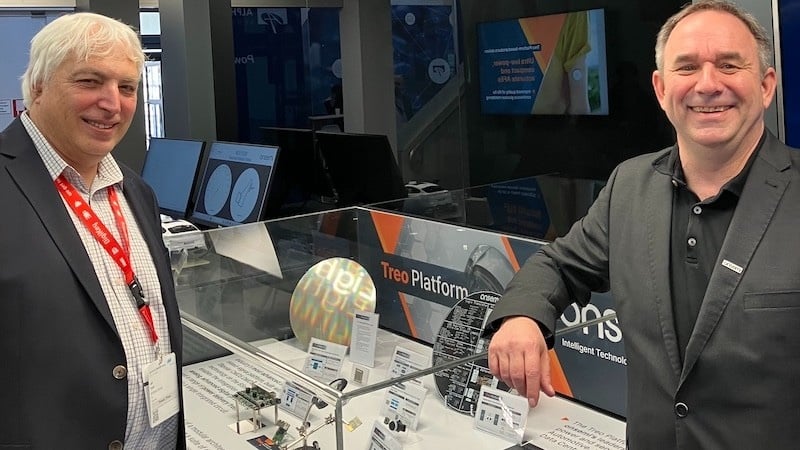
Martin Embacher (right), Sr. Technical Director - EMEA Applications at Onsemi showed Jeff the Treo platform display at the company's Electronica booth.
One of the key features of Treo's architecture is its 65-nm bipolar-CMOS-DMOS (BCD), which integrates the advantages of bipolar transistors, CMOS, and DMOS within a single chip. Each element provides distinct benefits: the bipolar transistors offer high analog precision for sensitive signal processing requirements; the CMOS component enables efficient digital processing and complex control logic directly on-chip; and the DMOS transistors address high-voltage and power demands.
Operating at 65 nm gives Treo a unique position among analog and mixed-signal platforms. While previous BCD technologies have often been constrained to 90 nm and beyond, this reduction to 65 nm increases integration density and reduces footprint. According to Rentala, this process density consolidates multiple functionalities into a single die and minimizes silicon area without compromising performance or reliability.
All About Circuits interviewed Vijay Rentala, vice president and CTO of Onsemi’s analog and mixed signals group, to learn more about the platform firsthand. “65 nanometers allows high-density digital, high-performance analog, and high-voltage power all in a single modular technology,” he explained.
Along with a compute subsystem that provides digital control for various functionalities, the power management subsystem includes features like DC-DC converters and low-dropout regulators (LDOs). Meanwhile, the sensing subsystem includes analog front ends (AFEs), and the communication subsystem offers support for technologies like single-pair Ethernet.
Renesas’ New R-Car SoC Supports Centralized Car Compute
Renesas has released its fifth generation of R-Car SoCs for automotive applications. All About Circuits attended Renesas' press conference at Electronica presented by Vivek Bhan (see below), senior vice president and general manager of high-performance computing. There, we learned details of how the new R-Car SoCs may meet the evolving demands of centralized compute architectures and software-defined vehicles (SDVs).

Vivek Bhan discussing the 5th-gen R-Car SoCs at Renesas' Electronica press conference.
Renesas has released its fifth generation of R-Car SoCs for automotive applications. All About Circuits attended Renesas' press conference at Electronica presented by Vivek Bhan (see above), senior vice president and general manager of high-performance computing. There, we learned details of how the new R-Car SoCs may meet the evolving demands of centralized compute architectures and software-defined vehicles (SDVs).
The new lineup, led by the R-Car X5H, is built around 32 Arm Cortex-A720AE cores, collectively delivering performance up to 1000k DMIPS for high-level ADAS and autonomous driving features. To address real-time processing requirements, the R-Car X5H also includes six Arm Cortex-R52 cores operating in dual-lockstep, delivering over 60k DMIPS and supporting Automotive Safety Integrity Level D (ASIL D).
Altogether, the SoC achieves up to 400 TOPS of AI processing, facilitated by an optimized neural processing unit (NPU) and digital signal processor (DSP).
The R-Car Gen 5 SoCs offer high-end graphics processing via a high-performance GPU. With up to 4 TFLOP graphics processing, the graphics subsystem supports multi-4k media processing, multi-megapixel camera inputs, and multi-display outputs.
From an efficiency standpoint, the fifth-generation solution leverages a 3-nm process technology to achieve a 30–35% power improvement over its 5-nm predecessors. Energy efficiency is further enhanced through an integrated system control processor (SCP), which manages various low-power modes for specific applications like parking or sentry mode.
AMD First to Release FPGA Devices With CXL 3.1 and PCIe Gen6
At Electronica, AMD introduced the Versal Premium Series Gen 2, the industry’s first FPGA platform to support CXL 3.1 and PCIe Gen6. AMD designed the Versal Premium Series Gen 2 for data centers, aerospace, communications, and T&M markets.
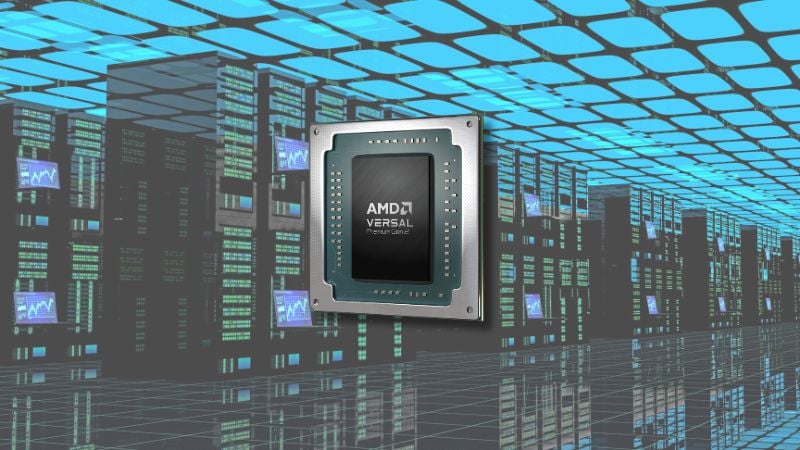
AMD designed the Versal Premium Series Gen 2 for data centers, aerospace, communications, and T&M markets.
All About Circuits spoke with Mike Rather, AMD's senior product line manager, to learn about the new FPGAs firsthand. Rather described the Versal Premium Series Gen 2 as a "traffic copy" instead of a primary AI accelerator. “We’re enabling AI, even though the GPU is the workhorse in this scenario,” he said. “Our role is to manage data movement quickly and efficiently so that GPUs can perform at peak levels.”
To this end, the Versal Premium Series Gen 2 embraces advanced interconnect technology to meet the high-speed, low-latency data movement between processors and accelerators in AI systems. The solution supports CXL 3.1 and PCIe Gen6, making it the first FPGA to integrate these latest industry standards.
PCIe Gen6 provides a bandwidth of 64 gigabits per second (Gbps) per lane, equating to 2-4x the speed of previous PCIe generations. CXL 3.1, on the other hand, enhances host-to-accelerator connectivity by offering memory coherency and pooling capabilities. CXL allows connected accelerators to share memory directly with the CPU, reducing redundant data movement and latency. By combining PCIe Gen6 and CXL 3.1 support, AMD’s Versal Premium Gen 2 devices achieve a dual eight-lane interface that can support up to 256 Gbps of aggregate bandwidth.
Tektronix Introduces Isolated Current Probes and 3-Channel Power Supply
In January, Tektronix acquired EA Elektro Automatik to strengthen its stronghold in the electronics test and measurement market. At Electronica 2024, nearly a year later, the duo made waves with two new power devices for the engineer’s benchtop: a high-performance current probe series and an advanced power supply solution.
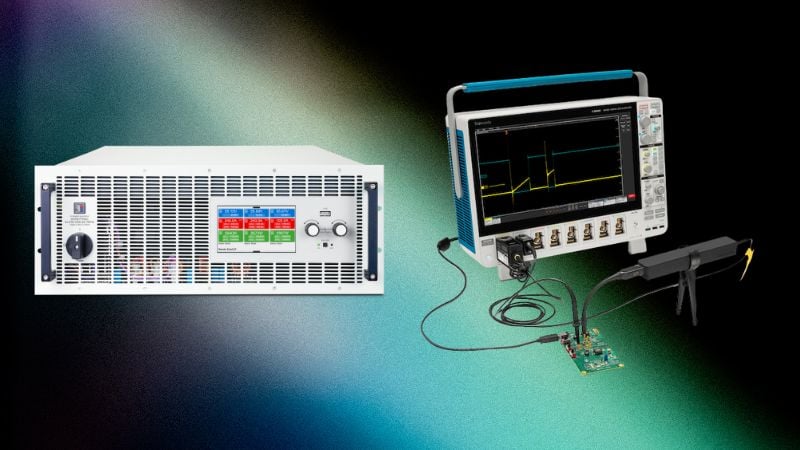
The EA-PSB 20000 Triple (left). TICP series IsoVu Isolated Current Shunt Probes (right).
All About Circuits spoke to Tektronix’s Daryl Ellis (general manager of mainstream and entry power portfolio) and EA Elektro-Automatik's James Hitchcock (VP and general manager) to learn about the new releases firsthand.
The EA-PSB 20000 Triple is a high-performance, bidirectional DC power supply designed to enhance testing efficiency and flexibility for advanced applications. It operates through three independent channels, each capable of delivering up to 10 kW in 3U models and up to 30 kW in 4U models. This provides 96.5% energy recovery in regenerative mode.
“Instead of buying three 1U power supplies with three different certifications and calibrations, you get a single high-quality, trusted power supply that can do the job of all three of those products,” Hitchcock said.
Meanwhile, Tektronix calls the TICP series IsoVu Isolated Current Shunt Probes a breakthrough in isolated current measurement.
“With TICP, we want to not only serve the demands of what we see today in the power space, but also start navigating toward the future of that space,” Ellis said.
Designed for high-bandwidth, low-noise applications across both high- and low-voltage environments, these probes implement a proprietary RF galvanic isolation.
Electronica 2024—Quick Briefs
Siemens has announced upgrades and AI enhancements to its flagship electronics design suite, including Xpedition, Hyperlynx, and PADS Professional. While PCB design is at the core of the toolset, the new suite covers the full gamut of the design process and leverages cloud computing and AI functionality.
TDK unveiled its second-generation 6-axis IMUs for advanced driver assistance and safety applications with the IAM-20685HP and IAM-20689. The company says that doth devices deliver reliable motion data for decision-making algorithms and accurately detect vehicle dynamics in real-time to enhance advanced driver assistance (ADAS) and safety applications,
NXP launched two products at Electronica. First is its new i.MX 94 family of applications processors for the industrial and automotive edge. Second, is an “industry-first” wireless battery management system (BMS) solution with Ultra-Wideband (UWB) capabilities.
Keysight Technologies expanded the frequency range of its FieldFox handheld signal analyzers, offering up to 170 GHz support for mmWave signal analysis. Through a collaboration with VDI, Keysight’s A- and B-Series FieldFox handheld analyzers with 18 GHz or higher, can be paired with VDI PSAX frequency extenders to cover sub-THz frequency range.
Attend announced its USB4 Gen 3 Type-C receptacle connectors, designed for high-performance applications. This series supports data transfer speeds of up to 40Gbps, a rated current of 5A, and input voltages of up to 48VDC, ensuring stable power delivery and high-speed data transmission to meet the demands of modern electronic devices.
Unless otherwise specified, all images are All About Circuits images taken at the show.
Related Content