Facebook
 Google
 GitHub
 Linkedin
Here Comes the First Industrial Edge AI Computer Built on Raspberry Pi
Sixfab’s ALPON X5 AI aims to make real-world edge AI deployment faster, cheaper, and far less frustrating.
Power and practicality rarely go hand-in-hand in edge computing. Engineers often face a frustrating tradeoff between spending weeks integrating dev kits into a production-grade setup or splurging on a proprietary industrial computer with a four-figure price tag and vendor lock-in.
A new platform from Sixfab, called ALPON X5 AI, might offer an off-ramp from that dilemma. Recently launched on Kickstarter, ALPON X5 is positioned as the first-ever industrial-grade edge AI computer based on Raspberry Pi. More than just another Pi-in-a-box, this device combines AI acceleration, cellular connectivity, and rugged industrial design in a single, deployment-ready unit.
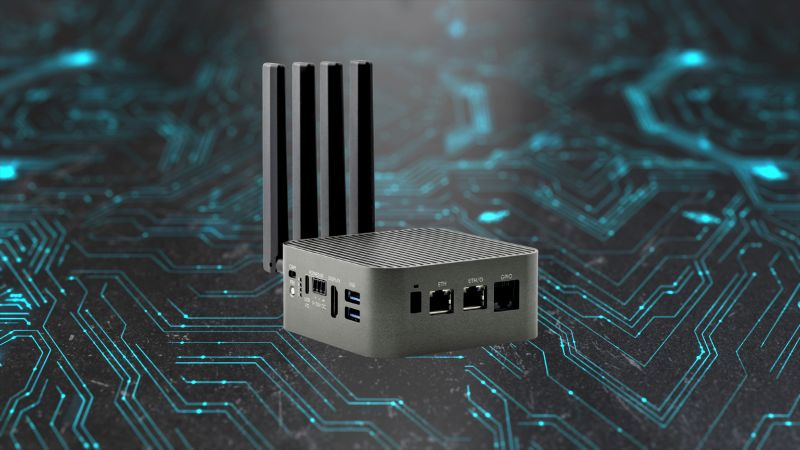
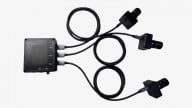
ALPON X5 edge AI computer.
Where AI Computers Fall Short
The Sixfab team has spent years building connectivity hardware for Raspberry Pi. Along the way, they’ve learned where DIY systems break down: inconsistent power delivery, thermal issues, flaky cellular modules, and a general lack of industrial readiness. Even with high-performance single-board computers, engineers often find themselves cobbling together solutions from cables, HATs, and breakout boards.
Enter the ALPON X5 AI: a fanless, LTE-connected, 25-TOPS AI inference engine with Raspberry Pi at its heart and industrial deployment in its bones. At the core of ALPON X5 is the Raspberry Pi Compute Module 5 (CM5), the latest in Pi’s lineup of embeddable Linux compute brains. But where the CM5 stops, Sixfab layers on the kind of muscle and ruggedization needed for real-world applications. Key specs include:
- DEEPX DX-M1 AI accelerator (25 TOPS)
- Built-in LTE/eSIM, Wi-Fi, and Bluetooth
- Industrial-grade aluminum chassis, fanless design
- Modular NVMe SSD and eMMC storage
- I/O for industrial environments
- Preloaded with Sixfab’s ALPON Cloud for fleet management
In short, it includes most of what developers build from scratch, already built and shipping in a box.
True Edge Computing in Any Environment
Traditional AI workflows often route sensor data back to centralized cloud services for inference. But for many use cases, that model breaks down. “Decisions need to be made in milliseconds, even if the internet goes down,” the Kickstarter campaign notes.
ALPON X5 processes AI models locally, on-device—cutting latency and eliminating the need for constant connectivity. Whether it’s YOLOv7 object detection in a warehouse or lane-line segmentation on an autonomous drone, inference happens at the edge, where the action is.

ALPON X5 is compatible will all major AI frameworks.
In initial demos, ALPON X5 has successfully run workloads including YOLOPose for human pose estimation, SCRFD for lightweight face detection, and VGG16 for semantic segmentation. Because the system runs standard AI frameworks—TensorFlow Lite, ONNX, PyTorch, and OpenVINO—developers don’t need to retool their pipeline to fit a proprietary SDK.
So, Who’s It For?
The obvious candidates are industrial automation teams, robotics developers, and AI startups that need something more rugged than a dev board, but not as complex (or expensive) as a full-on industrial PC. Think real-time quality control, fleet-based sensor processing, or agricultural automation.
But because the price point is accessible ($549 for early backers, $750 MSRP), Sixfab is also targeting educators, research labs, and small startups. It’s a platform designed to scale from prototype to pilot deployment.
While the “world’s first industrial-grade edge AI computer powered by Raspberry Pi” claim may sound superfluous, it reflects a real convergence. Until now, Raspberry Pi-based systems have struggled to meet industrial requirements for thermal stability, security, and integrated connectivity. ALPON X5 attempts to bridge that gap by treating the Pi as a compute layer while building an infrastructure around it that aligns with industrial standards.
All images used courtesy of Sixfab.