Facebook
 Google
 GitHub
 Linkedin
MIT Researchers Craft Mouthpiece With Sensors and Hands-Free Interface
The dental brace uses sensors and feedback components to help motor-impaired individuals interact with a phone, computer, or fitness tracker using their mouths.
Aarhus University researchers, in collaboration with MIT, have developed MouthIO, the first customizable intraoral interface that integrates sensors and actuators for hands-free interaction and health monitoring.
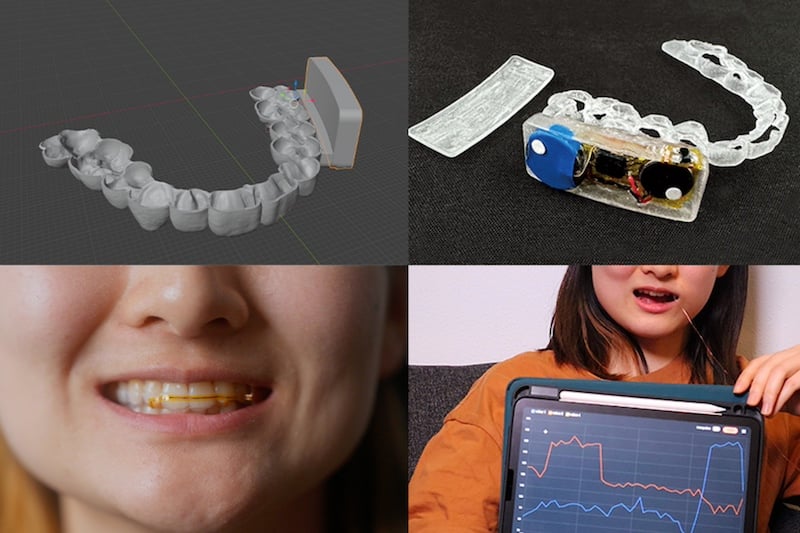
MouthIO can provide a wealth of health data to dentists and doctors. Image used courtesy of Sebastian Krog Knudsen and MIT
While most wearable interfaces are confined to skin or textile applications, the intraoral MouthIO fills a longstanding gap in accessible wearables. Oral interfaces offer unique benefits for individuals who require unobtrusive, hands-free interaction. The MouthIO system represents an important step toward more accessible, adaptable wearables.
An Interactive, Wearable Mouth Brace
MouthIO is a customizable intraoral interface that supports various applications such as health monitoring, assistive technology, and beverage safety.
Resembling a dental retainer, MouthIO is a transparent brace that fits the specifications of a user's teeth from a scan. The team leveraged a plugin for the modeling software Blender to tailor MouthIO to fit a dental scan, which they then 3D printed in dental resin. The researchers then digitally customized PCB housing on the side to integrate electronic components like batteries, sensors, and actuators. The sensors capture temperature, acceleration, and tongue-touch data, while the actuators include vibration motors and LEDs for feedback.
The device comprised three key elements: a biocompatible SLA-printed brace, a bite-resistant PCB housing, and an integrated, flexible PCB. These components were fabricated for under $15 using commercially accessible tools like resin printers, vinyl cutters, and dental-grade materials. The flexible PCB included copper traces created with a vinyl cutter, which adhered to Kapton tape for durability. The researchers claim this method achieved high trace resolution with copper conductivity exceeding that of traditional conductive inks.
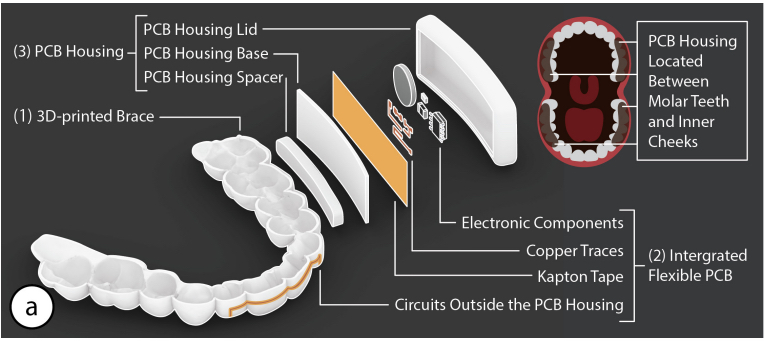
MouthIO schematic. Image used courtesy of MIT
MouthIO addresses challenges in oral interface design, implementing an open-bite brace configuration to enhance user comfort and speech clarity by leaving the tips of the front teeth exposed. To mechanically test the device’s structural integrity, the MIT and Aarhus researchers used a Zwickroell Z005 three-point bend test. Empty PCB housings demonstrated an initial bending phase at forces of 52–73N before deforming under additional compression, breaking at forces between 87–143N. In contrast, fully resin-filled housings resisted forces from 662N up to 2,173N before fracture, significantly above the average human bite force of 285N.
Testing MouthIO
The researchers then evaluated MouthIO’s functionality across several applications. For instance, a temperature sensor (MCP9700) integrated into the PCB housing activated a vibration motor at 65°C, alerting users with oral hypoesthesia about hot beverages. In testing, the device activated the motor when exposed to 75°C water. For teeth-grinding monitoring, an ADXL345 accelerometer within a closed-design brace effectively tracked jaw movement patterns. The team also conducted tests under biting, grinding, and idle states, revealing distinguishable acceleration patterns that could help automatically detect grinding behavior.
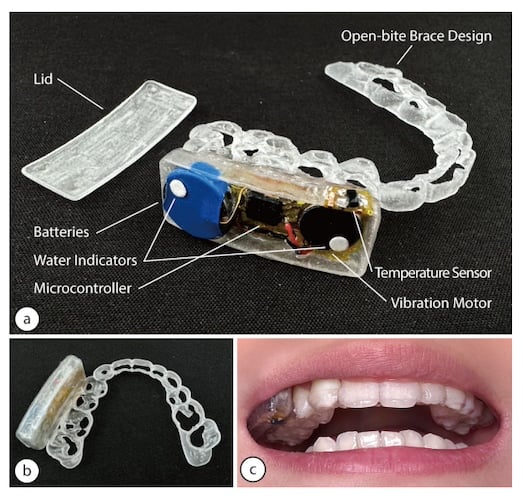
a) MouthIO interface. b) MouthIO with lid on. c) MouthIO in practice. Images used courtesy of MIT
The researchers further validated MouthIO’s performance and comfort in a user study with ten participants (eight male, two female) aged 22–35. Participants wore personalized open-bite and closed designs, with the open-bite design favored by 80% due to improved tactile sensation and speech comfort. Extended wear sessions averaged 6.9 hours, with users rating comfort on a 7-point Likert scale, yielding a mean score of 5.3 for “getting used to the brace.” Participants assessed social acceptance using the WEAR scale, reporting minimal negative reactions and a “coolness” rating with a median of 6.
A New Option in Future Wearables
The researchers behind MouthIO envision a future where intraoral devices are commonplace tools for personal health, assistive technology, and hands-free interaction. Looking ahead, they aim to refine MouthIO with features like wireless communication and rechargeable batteries, making it even more practical for daily, long-term use. By enabling flexible customization, they anticipate that MouthIO could support applications ranging from precise health diagnostics to discreet control interfaces for people with mobility challenges.
Related Content