
 Facebook
 Google
 GitHub
 Linkedin
Mycelium Memory: Researchers Grow Sustainable Computing From Mushrooms
A new memristor architecture trades silicon for shiitake, advancing low-power neuromorphic hardware with biodegradable substrates.
In a new study that crosses the frontier between sustainability and neuromorphic computing, researchers at Ohio State University engineered functioning memristors from shiitake mushroom mycelium. These "living" memristors, capable of learning-like behavior, point toward a future where computing substrates could be biodegradable, self-growing, and environmentally benign.
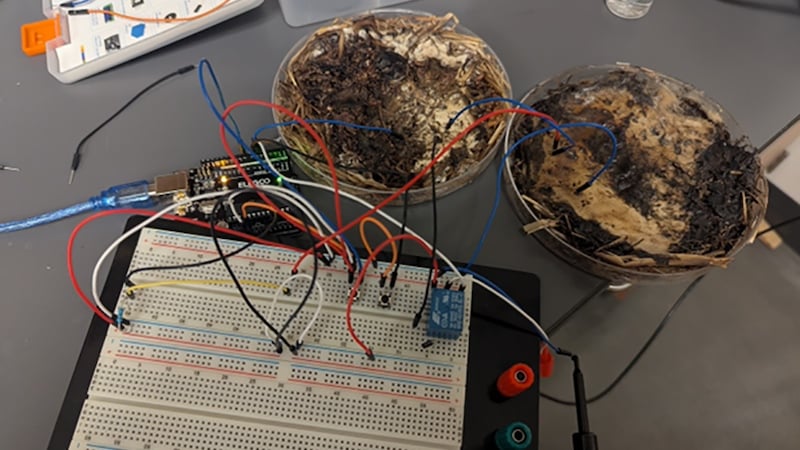
The researchers believe the fungal memristors could be useful interfaces for high-frequency bioelectronics.
The team’s research paper outlines a repeatable and low-cost method to grow and test fungal-based memory components. With potential applications ranging from artificial intelligence hardware to aerospace electronics, the work could mark a significant milestone in the evolution of living computers.
Building With Fungal Networks
Central to the research was the exploitation of the mushroom's branching, filamentous network of hyphae called mycelium, known for both structural integrity and biological intelligence. In a series of controlled experiments, shiitake spores were cultivated in nutrient-rich media until the mycelium colonized entire petri dishes. Once fully developed, the mycelial networks were dehydrated to create stable, disc-shaped structures, which were then rehydrated to reactivate their conductivity.
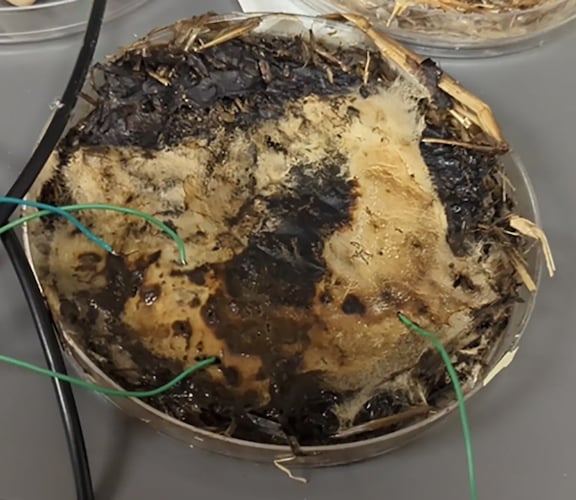
Each sample grew a mycelial network that was connected to conventional electronics.
These reconstituted fungal samples were connected to conventional electronics and evaluated for memristive behavior. The researchers subjected the samples to a series of voltage inputs while capturing I–V characteristics across a range of frequencies. True to memristor theory, the fungal substrates displayed pinched hysteresis loops, especially at low frequencies and higher voltages, indicating variable resistance states akin to synaptic plasticity in biological brains.
One standout result was achieved with a 5-V, peak-to-peak sine wave at 10 Hz, where the samples reached a memristive accuracy of 95%. Even at high frequencies of up to 5.85 kHz, the devices retained 90% accuracy, making them promising candidates for real-time computing applications.
Beyond static memory tests, the team engineered a custom Arduino-based testbed to evaluate the potential of the fungal memristors as volatile memory. By applying controlled pulses and measuring voltage thresholds, they confirmed the devices' ability to transiently store and recall data, which is a key requirement for integration into neuromorphic circuits.
Fungal Memristors
At the heart of this research is the memristor fungal memristor. While conventional memristors rely on inorganic materials like titanium dioxide or rare-earth metals, the fungal variant taps into the natural conductive properties of biological structures.
Shiitake mycelium, in particular, exhibits a hierarchically porous carbon structure when processed, which enhances its electrochemical activity. The internal architecture of the mycelium provides dynamic conductive pathways that form and dissolve in response to electrical input. These features closely mimic the ion-based mechanisms in neurons, making fungal memristors ideal for analog computing tasks.

Plot of a noisy 1-Vpp sine wave at 10 Hz during measurement.
Additionally, because the devices are fully biodegradable and derived from renewable biomass, they circumvent many of the environmental costs associated with semiconductor fabrication. No cleanrooms, etching chemicals, or mining of critical materials are required—just a controlled growth chamber, some agricultural substrate, and time.
That simplicity belies their potential complexity. These fungal circuits could serve in edge computing, intelligent sensors, and even autonomous robotics, anywhere a lightweight, low-power, and adaptive processor is needed. They also open up speculative applications in distributed environmental sensing, where devices could be left to decompose harmlessly after use.
A Mycelial Future?
Alongside their electrical properties, the biological resilience of shiitake mushrooms positions them as contenders for more extreme applications. The species is known to survive ionizing radiation, which could make fungal electronics suitable for aerospace applications, where cosmic radiation typically degrades semiconductor reliability.
In addition, shiitake mycelium’s ability to be dehydrated and rehydrated without losing function further enhances its deployability. In the Ohio State experiments, dehydrated samples stored their programmed resistance states and resumed functionality when rehydrated, suggesting a practical path toward shipping, storing, and even transmitting bio-electronic components.
While still in its early days, this research marks a pivotal step toward integrating biological organisms into functional computing systems. By cultivating memristive behavior in edible fungi, the Ohio State team has demonstrated that computing components don’t need to be etched in silicon, but that they can be grown, dried, and wired into circuits.
All images used courtesy of Ohio State University.












Looks like someone got inspired by Star Trek Discovery 😉
What about Slime Molds? They have shown some odd “learning” abilities.