Facebook
 Google
 GitHub
 Linkedin
New Automotive ICs Cover Signal Integrity, Power Density, & Integration
Recent automotive IC releases highlight ongoing efforts to improve signal integrity in ADAS, increase power density in compact inductors, and integrate sensing and logic functions for next-gen electric drive platforms.
Automotive electronics are pushing toward higher data rates, greater power density, and tighter system integration. ADAS platforms, electric drive systems, and in-vehicle networking are adding layers of complexity at both the signal and power levels. As that complexity increases, semiconductor vendors are being forced to address signal integrity, thermal limits, and board-level component reduction in more deliberate ways.
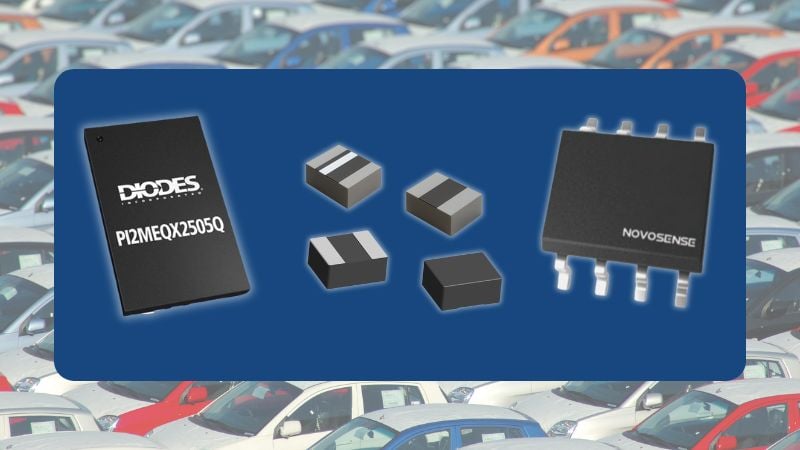
Recent releases from Diodes Incorporated, Vishay Intertechnology, and Novosense show how those design pressures are influencing IC development across different parts of the automotive stack.
Diodes Incorporated Targets 2.5-Gbps Signal Integrity for ADAS Cameras
Diodes Incorporated has introduced the automotive-compliant PI2MEQX2505Q, a 2.5-Gbps MIPI D-PHY 1.2 ReDriver designed for camera monitoring systems and ADAS applications. The device supports four differential data lanes and one clock lane, regenerating D-PHY signals across PCB traces, connectors, and cable assemblies.
The 2.5-Gbps data rate is significant in automotive camera systems where higher pixel counts and increased resolution demand greater bandwidth between CSI-2 source and sink devices. By compensating for frequency loss and reducing inter-symbol interference, the ReDriver helps maintain signal integrity across longer trace lengths and interconnects. Running at 2.5 Gbps across four lanes also gives designers room to support higher-resolution image sensors without resorting to more complex retimer architectures, which can otherwise add latency and increase overall design complexity in ADAS camera modules.
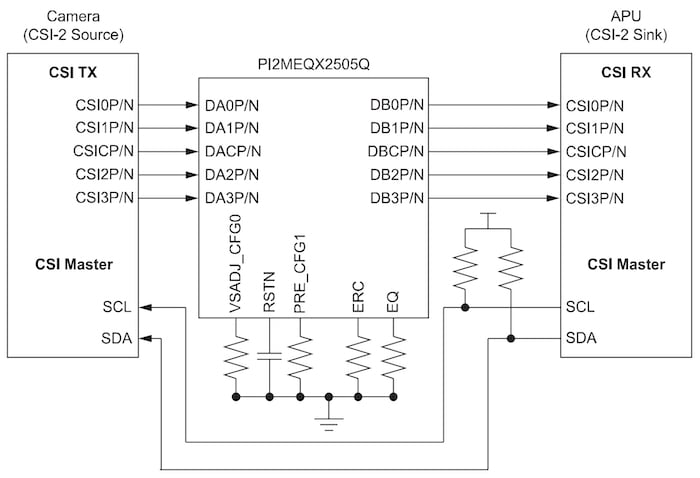
Application schematic for the PI2MEQX2505Q. Image used courtesy of Diodes Incorporated
The device provides programmable receiver equalization (3 dB, 6 dB, or 9 dB at 1250 MHz), selectable pre-emphasis levels, and adjustable output swing up to 275 mV. With those settings, engineers can tune performance based on the board layout and channel conditions, rather than defaulting to a more complex retimer solution that adds latency and design overhead.
The device also addresses power efficiency. Operating from a 1.8-V supply, the device supports ultra-low-power (ULPS) and low-power states, with integrated activity detection to reduce consumption when idle. With a maximum active power of 200 mW and sub-milliwatt standby levels, the part is positioned for battery electric vehicle (BEV) platforms where every watt matters.
The AEC-Q100 Grade 2-qualified device comes in a compact 3.5 mm x 5.5 mm W-QFN package, enabling high-density routing in space-constrained camera modules.
Vishay Reduces Footprint While Increasing Temperature Tolerance
Vishay Intertechnology has introduced four new commercial and automotive-grade power inductors in 0806 and 1210 case sizes. The new IHLL and IHLP series achieve the same performance as the next-smallest competing inductors in footprints up to 64% smaller (0806) and 11% smaller (1210).
Shrinking inductor footprint without sacrificing performance directly impacts power density in DC-DC converters and automotive control modules. The devices offer inductance values from 0.24 µH to 4.70 µH and a typical DCR as low as 6.6 mΩ, supporting improved efficiency in space-limited designs. Automotive-grade versions are AEC-Q200 qualified and rated for operation up to +165°C, which is 10°C higher than comparable composite inductors. This increase in temperature tolerance can be important in under-hood and inverter-adjacent environments where thermal margins are tight.
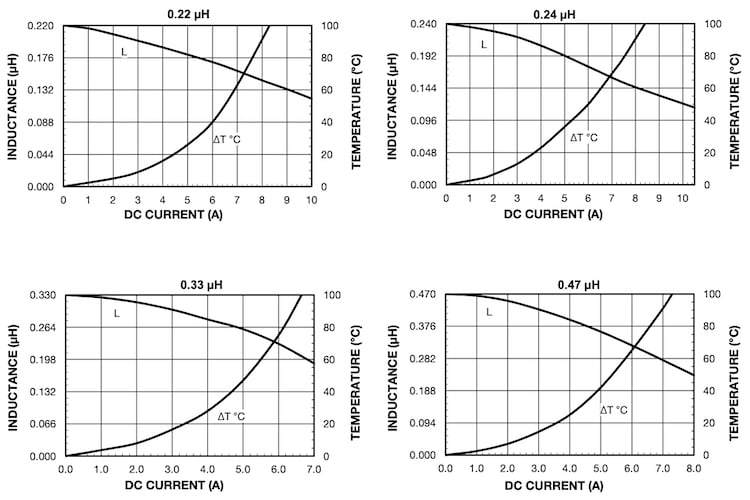
Inductance and temperature rise vs. DC current for the IHLP-0806AB-5A automotive-grade power inductor. Image used courtesy of Vishay
All four inductors use a powdered iron body that encapsulates the windings. This process eliminates air gaps and provides magnetic shielding against crosstalk. A soft saturation curve helps maintain stability across operating temperature and current ranges. The composite construction also reduces acoustic noise and improves resistance to mechanical and thermal shock. The powdered iron construction and full encapsulation allow tighter winding density while improving thermal handling, enabling the smaller footprint without sacrificing high-temperature performance up to +165°C.
By combining smaller land patterns, lower DCR, and higher temperature capability, the new inductors address ongoing demands for higher current density and compact PCB layouts in automotive and industrial systems.
Novosense and Inovance Integrate Sensing and Logic for E-Drive Platforms
Novosense announced that two co-developed ICs, an isolated sensing IC and a logic ASC IC, have entered mass production on Inovance Automotive’s next-generation electric drive platform. Conventional electric drive systems often rely on discrete components distributed across the PCB, increasing wiring complexity and system size. As EV architectures shift toward multi-in-one integration, reducing external components becomes increasingly important.
The isolated sensing IC integrates a high-voltage LDO, isolated sensing amplifier, and isolated comparator into a single device. This reduces the need for external components while enabling high-precision voltage sensing and fast overvoltage/undervoltage protection. The companion logic ASC IC consolidates multiple logic functions and supports frequency detection. This allows centralized handling of interface logic, simplifies inverter interface design, reduces overall BOM cost, and supports functional safety architectures.
Together, the two companies designed these solutions to reduce potential failure points, lower PCB area requirements, and shorten development cycles.