Facebook
 Google
 GitHub
 Linkedin
New Rohde & Schwarz Spectrum Analyzer Pushes Past Old Limits
The device's multipath architecture—a first of its kind—accelerates signal analysis using multiple inputs and cross-correlation.
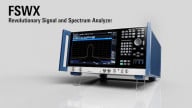
Rohde & Schwarz has introduced the first multichannel signal and spectrum analyzer with multiple input ports, the FSWX. The new signal and spectrum analyzer employs a multiple-port input path to increase measurement bandwidth.
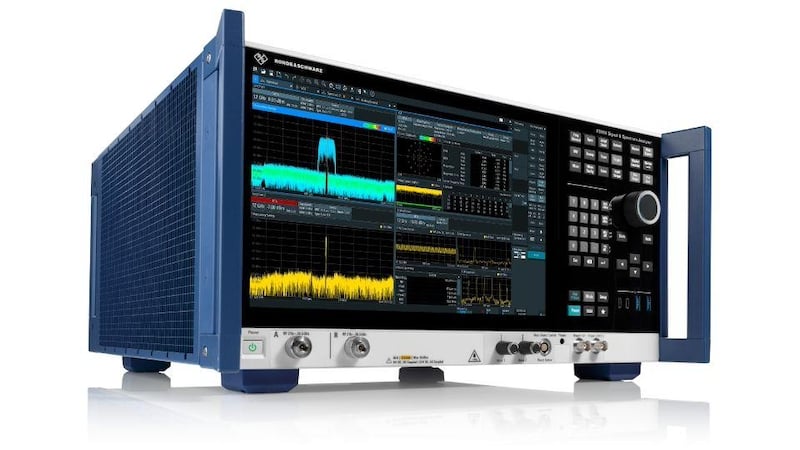
FSWX signal and spectrum analyzer.
Signals from multiple input ports can be utilized independently, combined, or cross-correlated to expand RF bandwidth and measurement capabilities. The dual paths deliver greater accuracy, higher bandwidth, and signal interactions not possible with traditional single-path measurement systems.
Many Inputs, One Device
The unit delivers low phase noise for high signal purity and spurious-free dynamic range for RF applications, including active RF component testing, automotive radar development, and airborne radar and satellite testing.
The synchronous multiple inputs each feature a 4-GHz analysis bandwidth. Two paths can be combined for an 8-GHz internal frequency bandwidth. Alternatively, the paths can operate independently to measure multiple signals with different frequencies or characteristics.
Such flexibility simplifies several previously challenging measurement scenarios, such as phase-coherent measurements of antenna arrays used in beamforming for wireless communications. The FSWX can replace multiple pieces of equipment that would have been required for such measurements. Combining these functions into a single device on a single screen enables better visualization and more accurate analysis.
Cross-Correlation and Testing Beyond YIG Filters
In the FSWX's cross-correlation mode, a single signal will be split into two signal paths. These paths, each with independent oscillators and ADCs, are subjected to advanced algorithms to remove inherent in-instrument noise. This capability detects spurs and other difficult-to-detect signals, such as error vector magnitude (EVM) in mobile equipment.
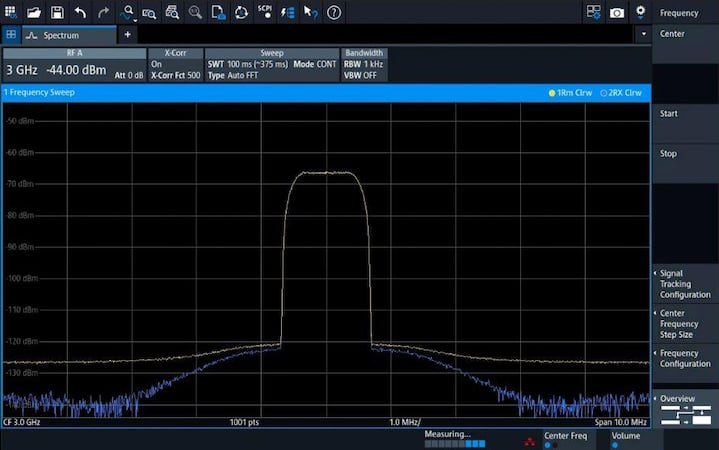
Cross-correlation reduces noise and displays signals that are not visible with previous-generation equipment.
Broadband ADCs in the FSWX allow the unit to overcome the limitations of yttrium-iron-garnet (YIG) filters by bypassing them. YIG filters are typically used in high RF test equipment to pre-select specific frequencies in microwave and millimeter-wave analysis. The filters are tunable using large electromagnets, which presents several challenges, including limitations on frequency response.
The FSWX's advanced broadband ADCs, in conjunction with filter banks that span the entire operating frequency range, enable high bandwidth without the need for YIG filters. However, for cases where YIG filters are the best option, the FSWX can use optional YIG filters.
Multiple independent inputs and signal paths also enable radar and multiple-phase signals testing. In the example below, both phase and amplitude can be visualized on the same screen rather than through multiple pieces of test equipment.
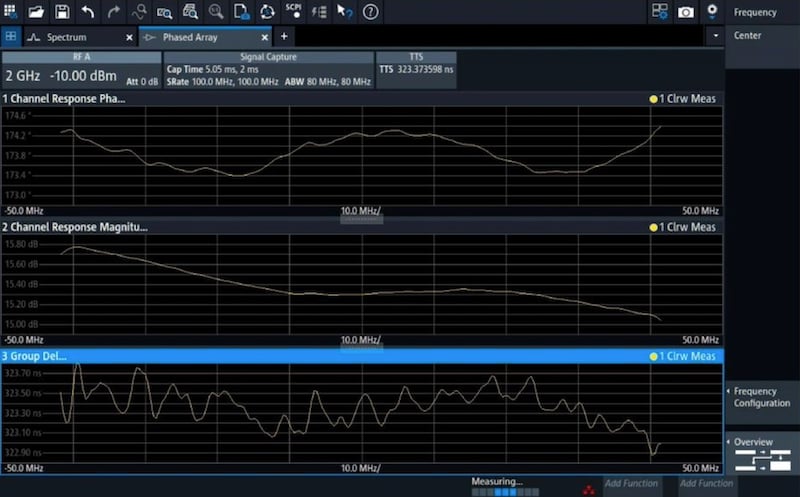
Simultaneous measurement of amplitude and phase of two-phase array antenna ports.
Advanced Firmware and Secure Operating Systems
The FSWX operates on a Linux-based operating system to ensure security and flexible functionality. With an open operating system at the base, support and expansion are built into the product from the outset.
The equipment comes with multiple firmware options. The Cross Application Control and Triggering (CrossACT) firmware option synchronizes measurements across multiple input channels. Such an operation enables simultaneous analysis with multiple tools, simplifying comparisons. For example, a user might examine the higher harmonics of a radar signal to gauge their impact on EVM at high frequencies. This capability is part of a common 5G wireless test scenario.
Four Model Options
Rohde & Schwarz will offer four models with a maximum frequency of up to 44 GHz. The top-end model delivers 8-GHz signal analysis bandwidth from two RF input channels. The first public showing took place at the IEEE MTT-S International Microwave Symposium (IMS) in San Francisco’s Moscone Center in June 2025.
All images used courtesy of Rohde & Schwarz.