Facebook
 Google
 GitHub
 Linkedin
New T&M Solutions a Boon for High-Frequency, Multi-Domain Testing
New releases from Siglent, Rohde & Schwarz, and Liquid Instruments bring new features to the T&M marketplace.
Shrinking device margins and rising signal complexity are changing expectations for test and measurement (T&M) equipment in the laboratory. For example, high-speed digital protocols and synchronized multi-rail systems require instruments that can capture fast transients across many inputs with minimal latency and noise.
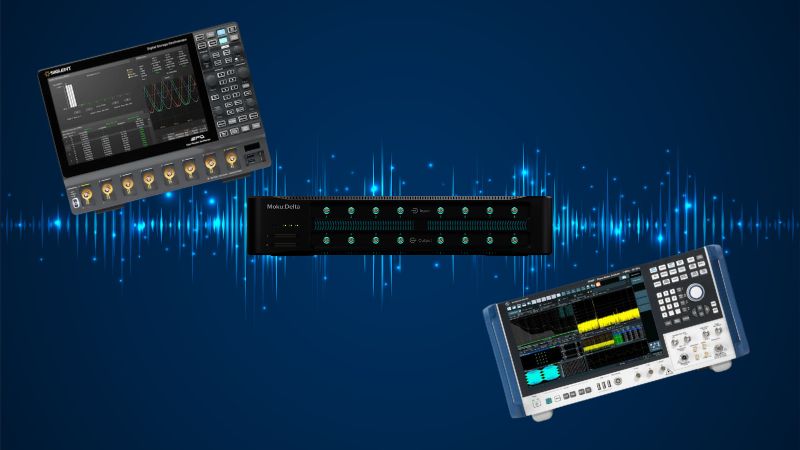
Recently, Siglent, Rohde & Schwarz, and Liquid Instruments have each launched high-performance T&M tools for engineers working in high-frequency, multi-domain environments. Let’s take a look at the new products from each.
Siglent Reveals 1-GHz, Eight-Channel Oscilloscopes
Siglent has introduced a pair of eight-channel oscilloscopes—the SDS5000X HD and the rack-friendly SDS5000L—for engineers working with fast-switching power electronics, embedded systems, and multi-rail designs.
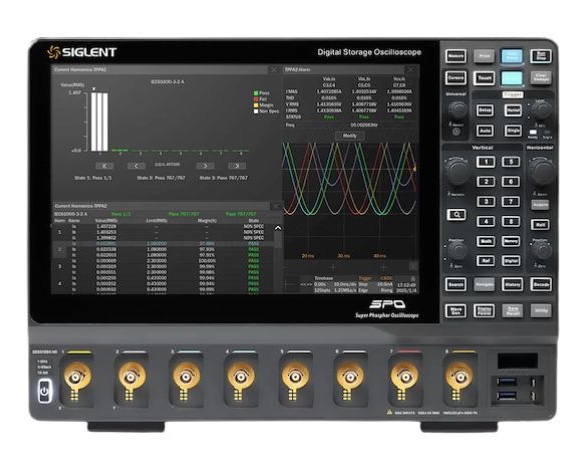
The SDS5000X HD scope from Siglent. Image used courtesy of Siglent
Siglent built the SDS5000X HD for interactive debugging with a touchscreen interface, while the SDS5000L trims the form factor for rack-mounted, automated test environments. On the analysis front, both models support synchronized multi-channel acquisition for three-phase power systems and time-aligned startup verification. Both models support bandwidths up to 1 GHz and sampling rates of 5 GSa/s across all channels. They are backed by a deep memory architecture that stores up to 2.5 Gpts per channel in quarter-channel mode.
The scopes offer 12-bit vertical resolution with an effective number of bits reaching 8.2 at full bandwidth and maintain a low 140 µVrms noise floor. According to Siglent, such features are suitable for analyzing wide-bandgap semiconductor (GaN and SiC) switching behavior. These capabilities are even further improved when paired with Siglent’s new optically isolated ODP6000B probes, which provide up to 1-GHz bandwidth and 160-dB CMRR at low frequencies.
Rohde & Schwarz Expands FSWP Phase Noise Analyzer to 56 GHz
Rohde & Schwarz has recently released a major upgrade to its FSWP phase noise analyzer and VCO tester by extending its capabilities to 56 GHz with the new FSWP-B56G option. According to the company, this enhancement (datasheet linked) enables direct, absolute phase noise measurements at frequencies that are increasingly common in high-speed digital links and emerging satellite communication systems without the need for external converters. The update also introduces support for external high-end local oscillators for much faster measurements through reduced cross-correlation cycles.
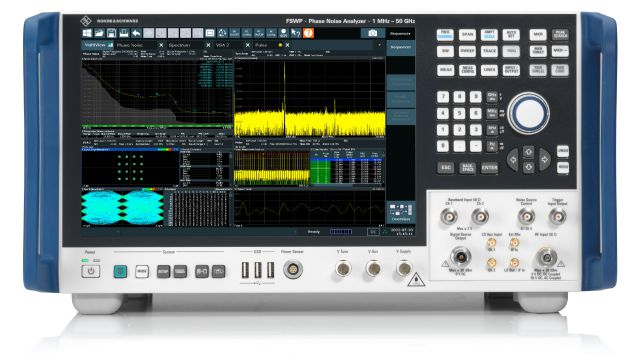
The FSWP phase noise analyzer and VCO tester. Image used courtesy of Rohde & Schwarz
For applications like radar and high-frequency synthesizer design, the analyzer’s expanded internal source now reaches 54 GHz, while external configurations push that ceiling to 56 GHz. Engineers working on additive and residual phase noise tests in amplifiers can now operate across this extended spectrum with a 40-MHz offset range.
A new measurement function also simplifies small-signal noise figure characterization by using the same phase demodulation technique that powers phase noise analysis. This eliminates traditional setup complexity while maintaining precision. For workflows involving dual DUT comparisons or cross-correlation using multiple sources, the FSWP offers flexible tuning outputs and a 3-dB correction mode.
Liquid Instruments Unveils Reconfigurable T&M Platform
Liquid Instruments recently launched Moku:Delta, a reconfigurable, software-defined test and measurement platform built around the Xilinx UltraScale+ RFSoC. Built for researchers and engineers working at the intersection of quantum control, optics, and high-speed analog systems, Moku:Delta (datasheet linked) combines eight 14/20-bit analog inputs at 5 GSa/s and eight 14-bit outputs at 10 GSa/s, all with 2-GHz bandwidth. The platform supports sub-10 nV/√Hz input noise and includes a ±1 ppb stability onboard clock.
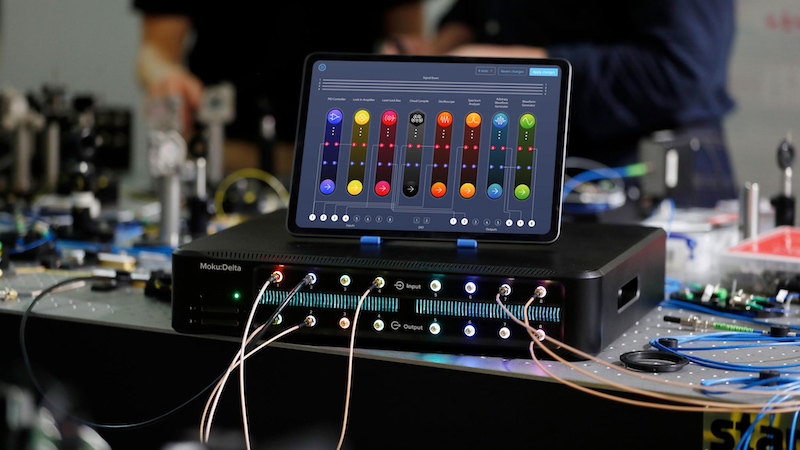
The Moku:Delta. Image used courtesy of Liquid Instruments
MokuOS 4 runs on the embedded FPGA for real-time operation of up to eight instruments simultaneously, with a 30 Gb/s internal signal path linking them in low-latency workflows. Onboard tools include lock-in amplifiers, arbitrary waveform generators, PID controllers, spectrum analyzers, and custom digital filters. Developers can swap instruments on the fly or deploy VHDL/Verilog-compiled custom algorithms via the Moku Cloud Compile toolchain.
With 32 DIOs, 100 GbE support, and an internal 1-TB SSD for deep captures, Moku:Delta can replace racks of instruments with a single high-throughput platform.
Converged Workflows in Test and Measurement
As test environments grow more complex, engineers are gravitating toward systems that consolidate precision, speed, and configurability. The latest releases from Siglent, Rohde & Schwarz, and Liquid Instruments offer this unique convergence, where flexibility in signal domain coverage and software integration is just as important as headline specs. All three products are now available through their respective vendors.