
 Facebook
 Google
 GitHub
 Linkedin
RCA CD4000: The CMOS Logic That Wouldn’t Die
For over 55 years, this logic family has bridged analog and digital design with noise immunity, rail flexibility, and unmatched staying power.
By the late 1960s, TTL was taking over digital logic, offering speed, fanout, and a growing catalog of gates, latches, and counters. But it came at a cost of power consumption, fixed 5-V rails, and limited tolerance for the analog world. RCA had other ideas.
In 1968, it introduced the CD4000 COS/MOS series, the first commercial logic family built entirely in CMOS. With supply voltages ranging from 3 V to 18 V, input thresholds tied to VDD, and static power consumption in the nanoamp range, CD4000 represented a new category of logic optimized for longevity, low power, and noise immunity.
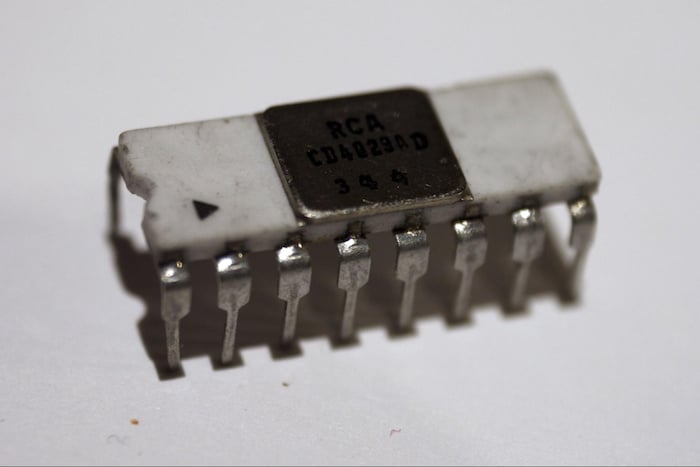
An early CD4029A counter IC manufactured by RCA, in a 16-pin ceramic dual-in-line package. Image used courtesy of Teravolt via Wikimedia Commons (CC BY 3.0)
More than half a century later, CD4000 parts are still in production and still solving problems. While they’ll never win a race on switching speed, they remain unmatched for flexibility, robustness, and compatibility with real-world, analog-adjacent signals. They’ve outlasted the company that created them and the process node they were born on.
From COS/MOS to Universal Logic
The CD4000 family, which debuted under RCA’s “COS/MOS” (Complementary Symmetry MOS) banner, was initially met with skepticism. CMOS logic was known in theory but had rarely been commercialized. RCA’s decision to go to market with an entire logic family built on this low-power technology was a gamble. Yet, it paid off.
While early CD4000 parts had long propagation delays in the hundreds of nanoseconds, they offered designers something TTL couldn’t in the form of trivial static power draw, huge noise margins, and freedom from a fixed 5-V rail. The buffered “B-series” soon followed, tightening voltage thresholds and increasing output drive, while maintaining full CMOS compatibility.
These parts supported supply voltages from 3 V to 15 V or 18 V, depending on the variant. Logic thresholds tracked VDD, meaning that input high/low margins scaled proportionally with supply. This gave CD4000 devices a crucial edge in noisy environments, battery-powered gear, and systems with poor regulation.
Engineers designing analog-digital hybrids quickly adopted CD4000 logic as their go-to. Its parts ran cleanly at ±15 V, interfaced easily with op-amps, and didn’t care about slow or sloping logic transitions that would baffle TTL. The family was broad, and it grew over time to include standard gates, flip-flops, counters, analog switches, phase-locked loops, and multiplexers. Many of these parts, like the CD4046 PLL and CD4066 analog switch, remain design staples today, still sold by multiple vendors.
Analog-Compatible by Nature
What made CD4000 logic so beloved by analog engineers wasn’t just that it tolerated abuse, but rather that some parts were designed to invite it. Nowhere is this clearer than in the Schmitt trigger and unbuffered subfamilies.
Take the CD40106B, a six-inverter Schmitt trigger. Its defined input hysteresis allowed it to accept slow, noisy, or RC-filtered edges without oscillation—a boon for debouncing mechanical contacts or building wave oscillators. Its thresholds scaled with VDD, so hysteresis increased naturally at higher supplies, improving resilience in industrial settings.
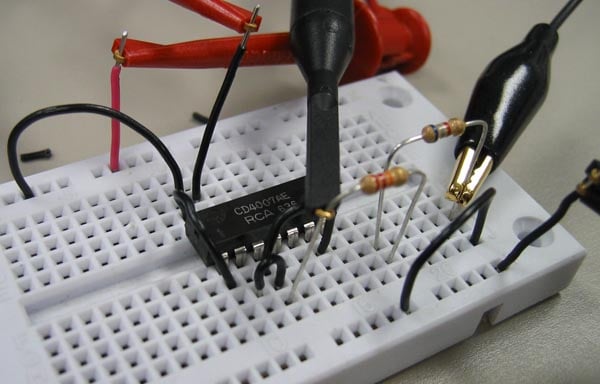
A CD4007A on a solderless breadboard. Image used courtesy of Skydivingdutch via Wikimedia Commons (CC BY-SA 3.0)
Then there’s the CD4069UB, the unbuffered inverter. Unlike its buffered cousin, this version exposed the internal inverter stage directly. This makes it a logic gate that can operate in the linear region, functioning as a crude but handy voltage amplifier. RCA’s own app notes and countless hobbyist circuits showed how to bias these gates into small-signal amplifiers, waveform shapers, and oscillators. Designers would exploit the high input impedance and VDD-scaled transfer function to create gain stages, VCOs, and monostables using nothing but logic chips and a handful of passives.
Most famous of all was the CD4007, a trio of CMOS pairs that could be configured into amplifiers, switches, current sources, or logic gates. It was a DIY analog/digital workhorse, often used in classrooms to demonstrate both disciplines. Analog Devices still maintains a lab module around it to teach circuit design fundamentals.
Durability Across Domains
More than a few logic families have come and gone, but CD4000 has stayed in production because its features map so well to real-world engineering constraints.
Consider power supplies. CD4000 parts can run off unregulated 12-V rails, ±15-V analog supplies, or battery stacks. You don’t need regulators or level shifters just to use logic gates in a control loop or signal chain.
Then there’s noise. In automotive and industrial environments, where edge rates are slow and wire lengths are long, CD4000’s input thresholds and rail-to-rail swing make it far more forgiving than newer logic families like 74HC or LVC. Its immunity to “analog-looking” logic inputs is a strength, not a weakness.
Perhaps most impressively, radiation‑tolerant RCA COS/MOS devices—the same technology underlying the CD4000 family—were qualified for and used in deep‑space missions of the late 1970s, including the Voyager program, to implement timing and control logic.
Today, CD4000 devices are still sold by Texas Instruments, Onsemi, Nexperia, and others. The datasheets may be newer, but the pinouts haven’t changed. And engineers working on low-power instrumentation, analog front-ends, or rugged systems still drop them into schematics confident in the knowledge that they’ll just work.
Do you still use CD4000 devices? Tell us about your design experiences with this logic family in the comments below.







I have been told that CD4000 in space grade is
real tough to find, but can’t seem to get to the
folks who need it, to discuss solving that. Getting
obsoleted HiRel parts “rehomed” is a thing I do.
still remember CD4050