Facebook
 Google
 GitHub
 Linkedin
Remembering Charles Sporck, the Johnny Appleseed of Fabs
It takes more than physicists and electrical engineers to advance the semiconductor industry. Charles Sporck, ME, helped drive the early days of the tech industry with production, operations, and management expertise.
Charles Edward Sporck, former CEO of National Semiconductor and key founding father of Silicon Valley, passed away at 96 on October 12. Sporck was at the helm of National Semiconductor as president and CEO from 1967 to 1991, but his journey to the heart of the tech industry started long before that.
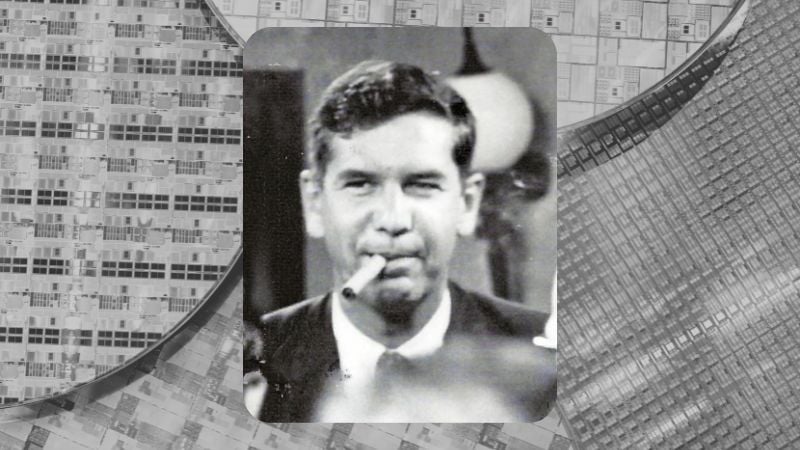
Charles Edward Sporck, Silicon Valley pioneer. Image used courtesy of Adirondack Daily Enterprise
From New York Auto Mechanic to Silicon Valley Founder
Sporck was born in 1927 in Saranac Lake, New York. His father was a cab driver, and his mother operated the family gas station business. He grew up playing sports, working as a lifeguard, enjoying the outdoors, and learning to be an auto mechanic from his father and a neighbor. He later attributed much of his success to the qualities of small-town life and the work ethic he developed during these early years.
He joined the U.S. Army in 1945 as a young adult and enrolled in the mechanical engineering program at Cornell University after his discharge. General Electric gave him his start in the industry with a work-study program at Cornell, which led him to join GE manufacturing operations full-time after graduation. In his nine years at GE, Sporck learned management and manufacturing, preparing him for a pivotal role in the emerging semiconductor industry. He had a variety of assignments during his tenure, including a nine-month apprenticeship as a machinist. In a biographical video interview with the Computer History Museum, he explained that while machinist training is not something he would generally recommend to engineers, it did help him to better empathize and respond to his employees later in his career.
His last GE assignment, running production for a division manufacturing power factor capacitors, particularly informed his later career. In that division, the management “never left their offices.” Discord between disconnected management and uncooperative union labor led to the cancelation of his manufacturing-method improvement project. The cancelation rendered much of his work meaningless and drove him to apply for and get hired as a production manager at the newly formed Fairchild Semiconductor.
A Fruitful Manager at Fairchild Semiconductor
In 1959, Sporck joined the semiconductor division of Fairchild Camera and Instruments as production manager. The move to Mountain View, California, from upstate New York was a long distance in both mileage and culture. In 1959, the northern California tech hub as we know it was not yet called Silicon Valley. Shockley Semiconductor, arguably the first semiconductor company in the valley, had only been in Mountain View for three years, and Fairchild Semiconductor, its first spinoff, was but two years in.
Sporck admired that Fairchild's management team was incredibly hands-on and accessible.
“If you wanted to speak to a vice president, you just went into their office,” he recalled.
This open environment, so different from his prior work experience, allowed him to learn about semiconductors despite having no experience in the industry. As a Fairchild production manager, Sporck helped to actualize the dreams of pioneers such as Jean Hoerni, inventor of the planar transistor process, and Robert Noyce, inventor of the monolithic silicon planar integrated circuit.
Sporck Heralds In the Heyday of National Semiconductor
In 1967, National Semiconductor, heavily funded by Peter J. Sprague, was nearly bankrupt. National had recently acquired Molectro, a five-year-old startup founded by two Fairchild veterans. Sprague aimed to turn the company around by expanding into linear semiconductors and new monolithic integrated circuits. To do so, he hired Charles Sporck and four other executives from Fairchild.
Stock options as compensation were not as common in the 1960s as they are today, but Sporck’s compensation package for his new role as CEO included a substantial options package to make up for a 50% base salary cut in the company. With his new position as CEO and a team of brilliant engineers and scientists, Sporck set about turning National Semiconductor into what, for a time, would be the world’s largest semiconductor manufacturer.

National Semiconductor's 8250 UART chip became one of the most prolific UART chips because of its use in the first IBM personal computer. Image used courtesy of Nixdorf via Wikimedia Commons (CC BY-SA 3.0)
While other industries suffered from inflation during the 1960s and 70s, the early days of the integrated circuit industry were marked by dramatic increases in performance and reliability coupled with constant price reductions. Charles Sporck was a major driver for this phenomenon. With his expertise in production, he brought focus to National Semiconductor on cost control and overhead reduction. Doing so enabled National to start a semiconductor price war and thrive while others did not.
Charging Into the 1980s
As a part of his cost cutting efforts, Sporck pioneered the practice of offshoring semiconductor manufacturing to Hong Kong and Singapore. He emphasized process standardization and improvement to increase volume while decreasing costs. Both pushes allowed National to grow dramatically in revenue and profit while decreasing component prices. National transitioned into a multinational world-class semiconductor company. In 1981, National became the first semiconductor company to reach one billion dollars in annual sales.
The world economy was changing, however, and not all was rosy for National. The very methods Sporck used to conquer the industry eventually made it difficult for National to keep up with innovation from smaller, more nimble competitors. While National Semiconductor was the lowest-cost U.S. semiconductor manufacturer, it was still not cost-competitive with pure offshore manufacturing. In 1991, Charles Sporck retired from National Semiconductor and entered a new phase of his life.
A Legacy as Big as Silicon Valley Itself
After retirement, Sporck spent many summers at Saranac Lake, vacations in Hawaii, and ski trips to Utah. He continued supporting the tech industry with contributions to STEM and donations to Cornell University's engineering school. He also remembered his roots and set up an annual scholarship in the name of the superintendent of Saranac Lake schools for engineering and science students.

Charles Edward Sporck during his oral history interview with the Computer History Museum. Screenshot used courtesy of the Computer History Museum
When asked in his Computer History Museum interview, “What was the most fun thing you did in your career”, Sporck answered, “Buying Fairchild.” Charles Sporck left Fairchild for National Semiconductor in 1967. In a remarkable role reversal twenty years later, he was instrumental in National Semiconductor's purchase of Fairchild.
When Sporck arrived in California in 1959, the valley was more orange groves than technology. When he retired 32 years later, the valley was the heart of technology in the U.S. At Sporck's retirement dinner, his dear friend and former colleague Gordon Moore—founder of Moore's Law—compared Sporck to Johnny Appleseed: instead of planting trees, though, Sporck sprouted up fabs and managed them better than anyone else.