Facebook
 Google
 GitHub
 Linkedin
Sensors for LiDAR, Phones, and Even the Brain Push the Limits of Size
Sony, Omnivision, and Georgia Tech have each developed compact sensors that deliver high-end performance in tight spaces.
Miniaturization in sensor design is hitting new benchmarks, not just in form factor but in performance and integration. Recent developments from Sony, Omnivision, and Georgia Tech show how small-scale hardware is solving long-standing engineering problems, from autonomous robot navigation to brain-computer interfaces. These sensors are making it easier to embed advanced capabilities into tight spaces, whether that’s inside a drone, under a phone lens, or beneath your skin.
Sony Shrinks High-Precision LiDAR Into 50g Package
Sony’s AS-DT1 LiDAR sensor aims straight at the trade-off between size and precision in 3D sensing. At 29 mm x 29 mm x 31 mm and just 50 grams, it’s the smallest and lightest in its class, according to Sony. That compact frame doesn’t cut corners. Sony has applied its miniaturization and optics know-how from its machine vision cameras to get high-resolution depth sensing into a package that fits into drones and mobile robots without draining battery or taking up space.
The AS-DT1 is built around a direct Time-of-Flight (dToF) architecture using Sony’s proprietary ranging module. It uses a single photon avalanche diode (SPAD) sensor that amplifies signals from single photons to achieve accurate reads even from low-reflectivity or low-contrast objects. While SPAD tech isn’t new, Sony’s version draws on its experience with automotive-grade imaging and distance sensors to push performance further than typical commercial-grade LiDAR.
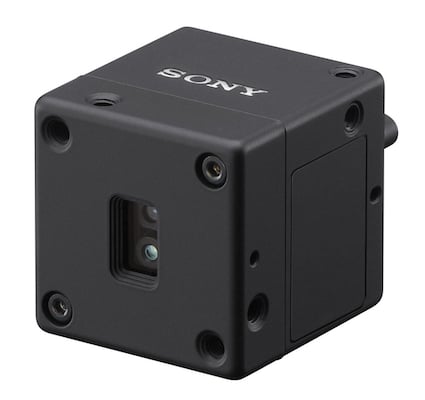
The AS-DT1 is the world’s smallest and lightest LiDAR depth sensor structure. Image used courtesy of Sony Electronics
It supports multiple ranging points to capture 3D measurements: length, width, and depth. That adds up to reliable data capture in cluttered or variable environments, like stores or warehouses. The sensor is rated for a range of 40 meters indoors and 20 meters outdoors in full sunlight (100,000 lux), with a resolution of ±5 centimeters at 10 meters. That's a good range for a unit this size, particularly outdoors where small sensors often fall short.
Sony is positioning this sensor for robots, drones, and fixed installations. The device may also help autonomous mobile robots navigate indoor logistics or retail spaces, where it can help avoid obstacles and interact with dynamic environments.
Omnivision OV50X Pushes Smartphone Imaging Toward Pro-Grade Video and HDR
Omnivision’s OV50X brings smartphone sensors closer to pro-level imaging with a 1-inch, 50-MP design that supports 110-dB, single-exposure HDR and 8K video. The sensor uses TheiaCel, a stacked-die architecture combining a lateral overflow integration capacitor (LOFIC) and dual conversion gain (DCG) to capture high-contrast scenes without needing multi-frame stitching. This architecture avoids motion artifacts and simplifies HDR processing in real time.
The 1.6-µm native pixel size—up from the 1.0 µm in Omnivision’s previous OV50H—boosts light sensitivity. In low-light or high-speed scenarios, the sensor can switch to four-cell binning for 3.2-µm effective pixels. This mode supports full-resolution readouts at 12.5 MP and 180 fps, or 60 fps with HDR. That flexibility helps with slow-motion video and low-light stills without pushing ISO too far.
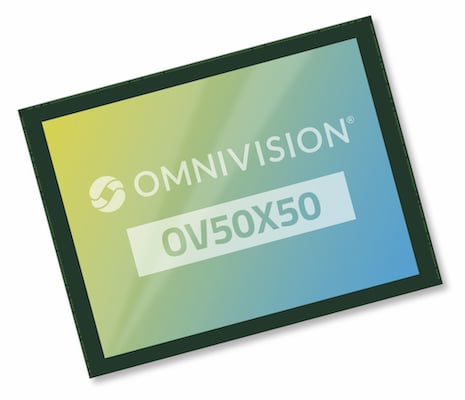
The Omnivision OV50X50. Image used courtesy of Omnivision
For autofocus, the OV50X uses 100% quad phase detection (QPD), which maps depth across the full sensor without leaving gaps. Every pixel contributes to phase detection, so focus is faster and more reliable across scenes. The sensor architecture uses Omnivision’s PureCel Plus-S stacked-die layout, separating pixel and logic layers. This cuts noise, improves thermal control, and supports high readout speeds. It also helps shrink the package to a 13.1 mm × 9.8 mm footprint despite the large optical format.
Sampling is underway, with mass production planned for Q3 2025. OEM interest is expected to align with phones using Qualcomm’s next-gen ISP. Thermal performance under 8K 30 fps loads could require larger chassis or active cooling, so early use will likely appear in premium-tier flagships. Still, the OV50X shows how smartphone imaging is evolving to support compact cinema camera capabilities.
Georgia Tech’s Microneedle Brain Sensor for Everyday BCI
Georgia Tech’s microstructure brain sensor rethinks how you interface with digital systems using brain signals. This microneedle-based device is designed to slip between hair follicles and rest just beneath the skin. The result is a nearly invisible sensor that picks up high-fidelity neural data while letting you move freely with no drop in signal quality.
The sensor works by embedding ultra-thin conductive polymer microneedles into the skin’s upper layers, right where neural signals are strongest. These microneedles connect to polyimide/copper traces housed in a sub-millimeter package. The design sidesteps traditional scalp-mounted electrodes and their reliance on conductive gel, which typically degrade in performance with movement. It also avoids the invasiveness of surgical implants.
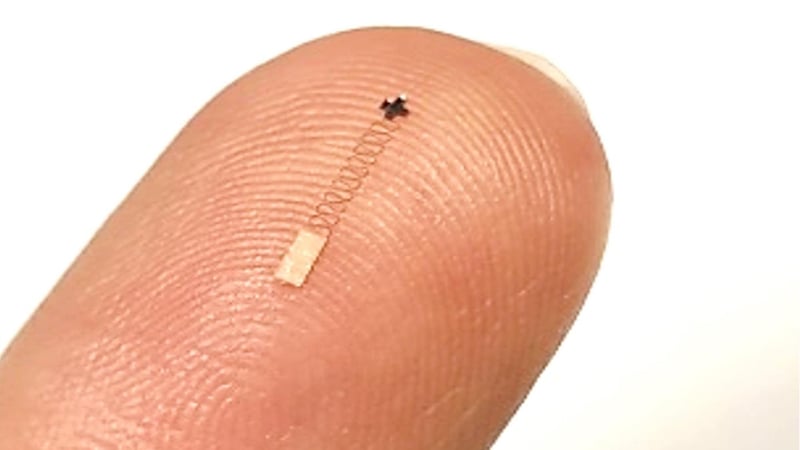
A micro-scale brain sensor on a finger. Image used courtesy of W. Hong Yeo, Georgia Tech
In testing, the sensor maintained contact resistance as low as 0.03 kΩ·cm², the lowest ever reported in wearable brain-computer interfaces (BCIs). Neural classification accuracy hit 99.2% while standing, 97.5% while walking, and 92.5% while running. Signal integrity held steady for up to 12 hours, allowing for extended, untethered use. This performance means subjects can use a BCI without being locked in place or wired up to bulky equipment.
Georgia Tech tested the system on six participants who controlled an augmented reality video call interface using brain activity alone. The research, led by Professor Hong Yeo and published in PNAS, is supported by the NSF, the WISH Center, and South Korean science agencies. The sensor marks a step toward everyday brain-computer interfaces that integrate with how you already move and live.
Related Content