
 Facebook
 Google
 GitHub
 Linkedin
SiTime Enters Resonator Market With Tiny MEMS-Based Devices
Announced today, SiTime is expanding into a $4 billion resonator market with its Titan platform.
Today, SiTime announced a new family of MEMS resonators designed to displace quartz solutions in Bluetooth-enabled microcontrollers, wearables, and IoT applications. Until now, the company’s MEMS technology had been integrated exclusively within oscillators and clock ICs. The new family, dubbed the Titan Platform, is SiTime’s entry into standalone resonators, with devices offering frequencies from 32 MHz to 76.8 MHz.
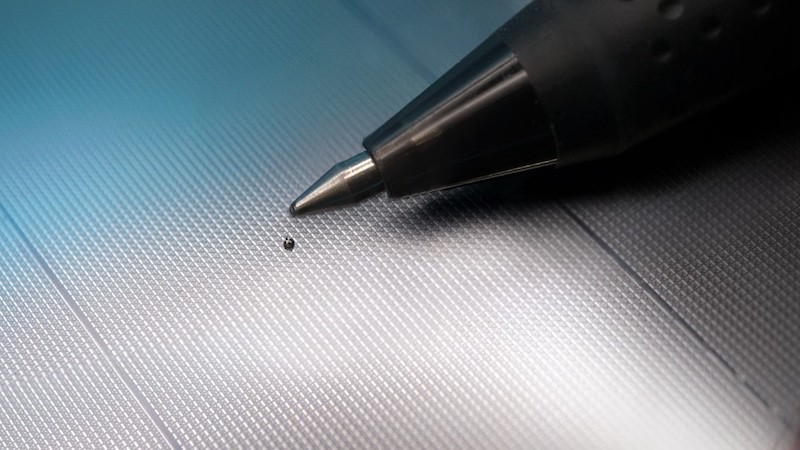
SiTime’s new Titan resonators
All About Circuits had the chance to speak with Piyush Sevalia, Executive Vice President, Marketing at SiTime, to learn about the new platform.
Significance of Size Reduction
The most heavily marketed attribute of Titan is its scale. Fabricated in a 0.46 x 0.46 mm chip-scale package, Titan is up to seven times smaller in PCB footprint than 1210 quartz devices and four times smaller than 1008 quartz equivalents.
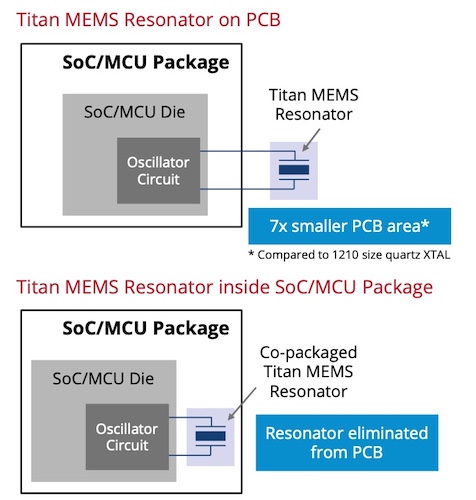
Titan can be integrated as a PCB-level solution or co-packaged within an SoC/MCU.
This degree of miniaturization has noteworthy implications for space-constrained electronics such as wearables. By removing the need for a discrete quartz package, Titan allows designers to either reduce board size or to repurpose freed-up area for additional features. As Sevalia explains, “Since Titan is much smaller than a quartz device, it frees up area on the PCB for engineers to implement something else… like putting some AI/ML predictive processing functionality in their system.”
MEMS Versus Quartz Performance
According to SiTime, Titan builds on the company’s sixth-generation FujiMEMS technology and seventh-generation analog circuits. Compared to quartz, Titan is said to deliver up to 5x better aging stability, specified for five years at maximum rated temperature, and offer tighter stability across the -40°C to +125°C operating range. Mechanical resilience is also improved, as Titan is said to exhibit up to 50x better shock resistance and 30x better vibration resilience than quartz.
Power efficiency is another advantage, which manifests in both direct and indirect means. Directly, Titan resonators are said to achieve up to 50% lower oscillator circuit power consumption and reduce startup energy by a factor of three as compared to quartz solutions. Indirectly, MEMS oscillators offer faster startup times than quartz equivalents, up to 3x in the case of Titan.
As a result, system energy is saved through more accurate duty-cycling of RF subsystems. As Sevalia explains, “ Titan has up to 3x faster startup speeds, which gives you benefits in terms of power savings because you can turn the RF on and off much more accurately.”
Compatibility with Existing Interfaces
Perhaps the most strategic aspect of Titan is its electrical compatibility with oscillator circuits already embedded in SoCs and MCUs. Historically, SiTime’s MEMS oscillators paired proprietary resonators with internal circuits optimized for MEMS performance. Titan, by contrast, is designed to operate with the same oscillator interfaces that semiconductor vendors originally designed for quartz. As Sevalia puts it, “Getting that right, making sure that our resonators are compatible electrically with the oscillator circuit that's already in there, that's the big learning that we came through with this Titan family.”
Such compatibility allows engineers to use Titan as a drop-in replacement for quartz without redesigning the oscillator stage, which would likely require years of validation and new silicon tape-outs.
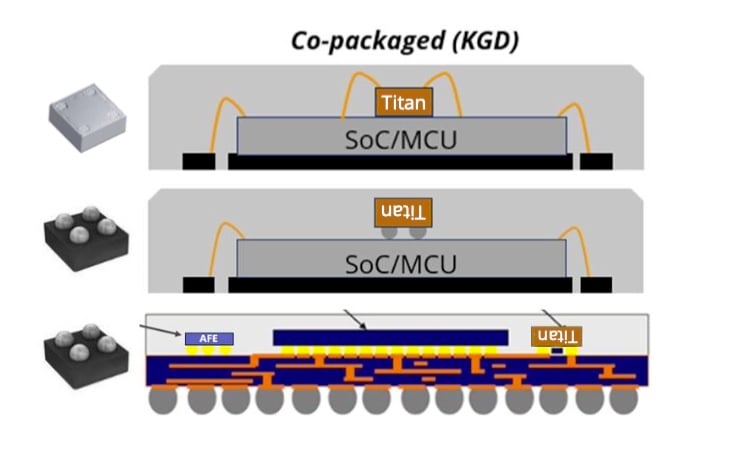
Co-packaging Titan as a known good die (KGD)
Engineers can also reap the integration benefits of co-packaging Titan as a known good die with SoCs or MCUs. When embedded within a plastic package alongside a host device, Titan eliminates the external resonator entirely, the result being a simplified board layout and minimized parasitic effects from long traces. This packaging approach also frees up general-purpose I/O pins that would otherwise be reserved for resonator connections to create additional value for microcontrollers with pin count constraints.
Roadmap and Availability
The Titan family debuts with the SiT11100 at 32 MHz, and production samples are already available. Additional variants (including SiT11101 at 76.8 MHz, SiT11102 at 38.4 MHz, SiT11103 at 48 MHz, and SiT11104 at 40 MHz) will begin sampling in December 2025
To speed up the design-in process, SiTime is also releasing the SiT6400EB evaluation board, which lets customers substitute Titan resonators onto footprints originally designed for 1210 or 1612 quartz devices.
“We think it’s a game changer because it changes how the customer uses these devices, what features they can add, and how the industry itself approaches resonators,” says Sevalia.
All images used courtesy of SiTime.











For what its worth I would say that “co-packaged” is the way to go here, completely eliminating layout issues.
Obviously there are also applications for a PCB mounted version but it seems as if even the compatibility between existing silicon and existing quartz products isn’t guaranteed such that if you have a working product you do not change parts without a very good reason so selling into that marketplace is going to be challenging.