Facebook
 Google
 GitHub
 Linkedin
Skywater Unwraps CMOS Platform Aimed at Thermal Imaging Designs
The new ThermaView suite supports hybridized focal plane arrays (FPAs) and monolithically fabricated microbolometer FPAs for uncooled imaging.
Skywater Technology recently introduced Thermaview Solutions, a suite of read-out ICs (ROICs) and microbolometer solutions for thermal imaging applications. Skywater says this suite incorporates innovations that will support the development of thermal imaging systems using large-format focal plane arrays.
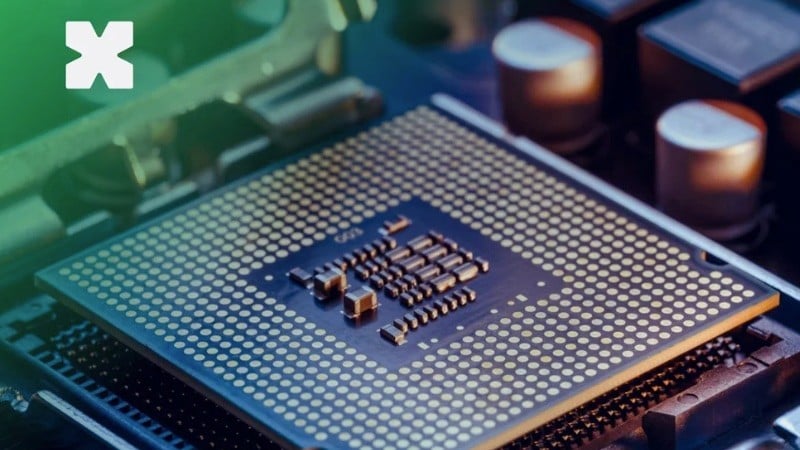
Skywater says ThermaView ROICs are scalable and reliable in advanced manufacturing and automation. Image used courtesy of Skywater Technology
Skywater based the suite on its new 90-nm CMOS process. Unlike traditional ASICs, which require custom design and long development cycles, the S90LN platform provides a specialized, high-density routing architecture that reportedly enhances pixel density and read-out performance.
New ROIC Based on 90-nm CMOS
The new ROICs in the Thermaview Solutions suite are based on Skywater's S90LN CMOS technology. The S90LN platform uses two local interconnect layers to maximize pixel density on each IC, providing a 15% area improvement in chip density as a result.
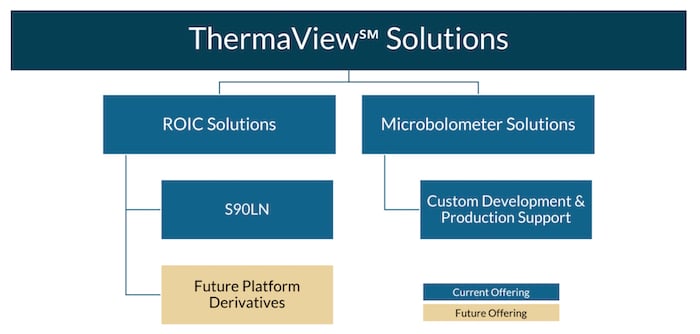
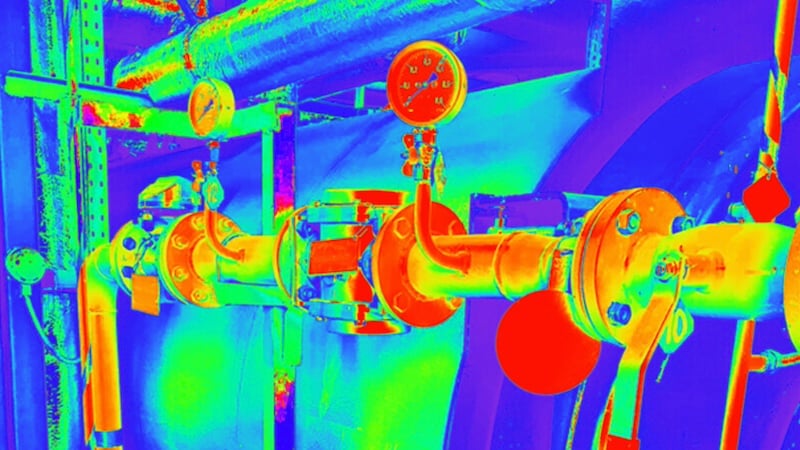
Skywater created ThermaView Solutions for thermal imaging designs supporting both read-out IC solutions and microbolometer development. Image used courtesy of Skywater Technology
ROICs in uncooled thermal imaging systems work by measuring small changes in resistance output from a microbolometer, a sensor that can detect changes in temperature. The ROIC converts that change in resistance to a voltage. This voltage is then driven through an analog-to-digital converter (ADC) and outputs digital information to the rest of the thermal imaging system.
Microbolometers are the basic building block of the thermal imaging system, with many microbolometers comprising a focal plane array. They are primarily used in uncooled thermal imaging systems, which do not require artificial cooling to reduce thermal noise.
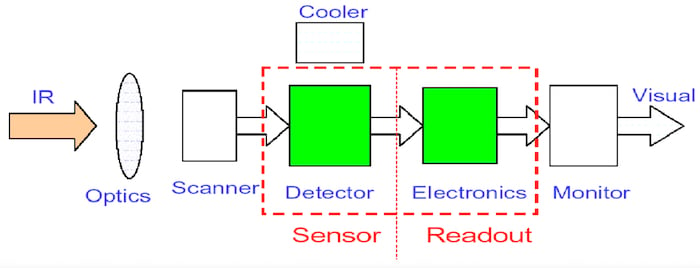
High-level block diagram of generic thermal imaging components. Image used courtesy of Semantic Scholar
By maximizing chip density, more features can be packed onto one chip. These features allow thermal imaging systems to capture sharper images and transmit them to the end-user. This is highly desirable for precision applications such as UAVs and aerial warfare systems that often rely on thermal imaging to make important, real-time decisions.
The S90LN process uses 200-mm wafers with seven metal layers and two local interconnects. While details on the specifics of this local interconnect technology are sparse, Skywater says it allows the new ROICs to maximize chip density by eliminating the need for vias.
Additionally, Skywater says the SL90LN is radiation tolerant. This makes it suitable for defense applications such as reconnaissance systems, which operate at a very high altitude and must be tolerant to the harsh effects of radiation. Additionally, the ROICs operate reliably in extreme temperatures from -55°C to 125°C, with cryogenic models supporting 77K to 150K, making them useful for high-altitude, space, and other harsh environments.
Alternative ROICs and Thermal Imaging Options
SkyWater isn’t alone in advancing thermal imaging technology. Companies like Teledyne FLIR have long dominated the space, offering custom ROICs and sensor solutions for military, industrial, and commercial applications. FLIR, furthermore, has integrated AI-driven thermal imaging into defense systems. Teledyne FLIR has a full suite of software support called Prism AI, which enables classification and object detection capabilities for thermal imaging hardware.