Facebook
 Google
 GitHub
 Linkedin
TDK Serves Up DC 1500 V Contactor for High-Voltage Systems
The series is designed for lithium-ion battery systems used in electric vehicles and energy storage systems
TDK Corporation has launched the HVC50, a high-voltage DC contactor that can handle up to 750 A at 1500 V in traction battery systems and megawatt charging systems (MCS).
As demand for high-capacity electric vehicle charging and large-scale energy storage continues to surge, traditional contactors have started to struggle with the extreme voltage and current demands posed. The HVC50 could address these engineering needs.
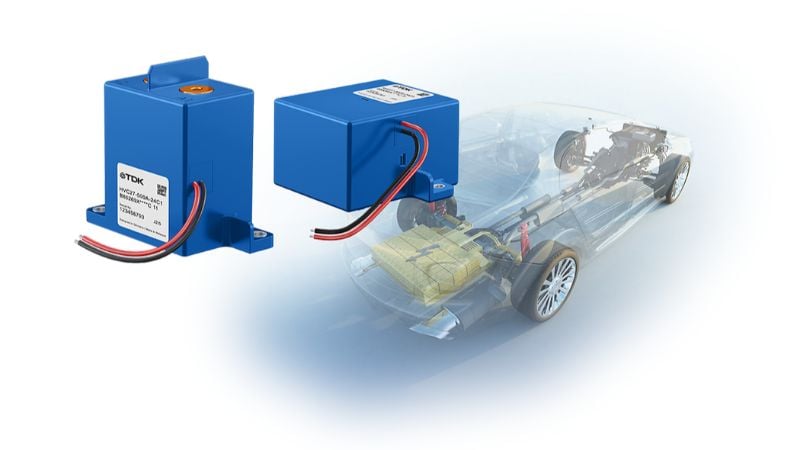
Gas-filled contactors for high-voltage safety disconnection of lithium-ion batteries. Image used courtesy of TDK
TDK’s Contactors for High-Power Systems
The TDK HVC50 is a series of gas-filled contactors meant to connect or disconnect lithium-ion batteries operating at up to 1500 V. Specifically, the system can interrupt DC voltages up to 1,500 V and peak DC currents up to 1,000 A within 30 milliseconds. Under continuous operation, it supports currents up to 750 A.
The HVC50 architecture includes a ceramic arc chamber with a gas-filled design to allow for rapid and reliable current disconnection. It features bidirectional contacts that allow current to flow in both directions without polarity restrictions, which simplifies system design and supports applications that require reversible current flow. The product also provides a reliable, mechanically linked feedback signal via an IEC 60947-4-1 compliant mirror contact. The contact confirms the true open or closed state of the main contacts and helps detect contact welding or failure.
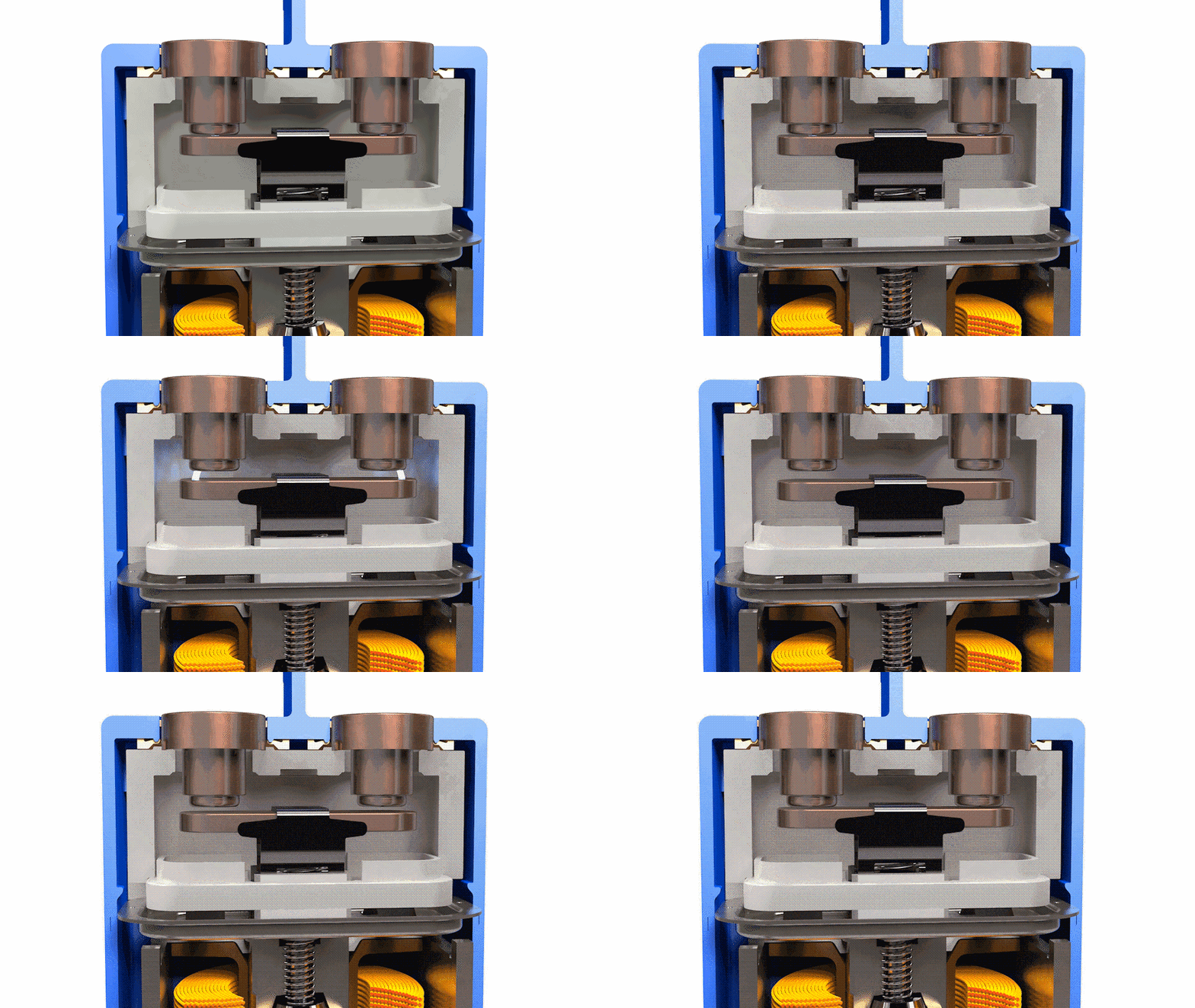
The movable armature in HVC50. Image courtesy of TDK Electronics
Overall, TDK offers several versions of the HVC50 with varying continuous current ratings, from 400 A to 750 A, and temporary overcurrent ratings up to 1000 A.
The Dynamics of High-Voltage DC Switching
Modern high-voltage lithium-ion batteries offer energy capacities equal to traditional internal combustion engines. To operate safely, these batteries rely on a battery management system (BMS), which includes a battery disconnect unit (BDU). The BDU, equipped with a fuse and high-voltage DC contactors, is responsible for isolating the battery from the load during faults. When a malfunction occurs, the BMS signals the contactor to disconnect the circuit more quickly than the fuse, allowing for multiple safe disconnections under load.
In energy storage and EV charging setups, the same contactor must carry current both into the battery (charging) and out of it (discharging or feeding the grid). A bidirectional contactor uses symmetric contact geometry and equal gap distances so its interruption and conduction ratings are identical in both directions. This design eliminates the need for separate “charge” and “discharge” switches.
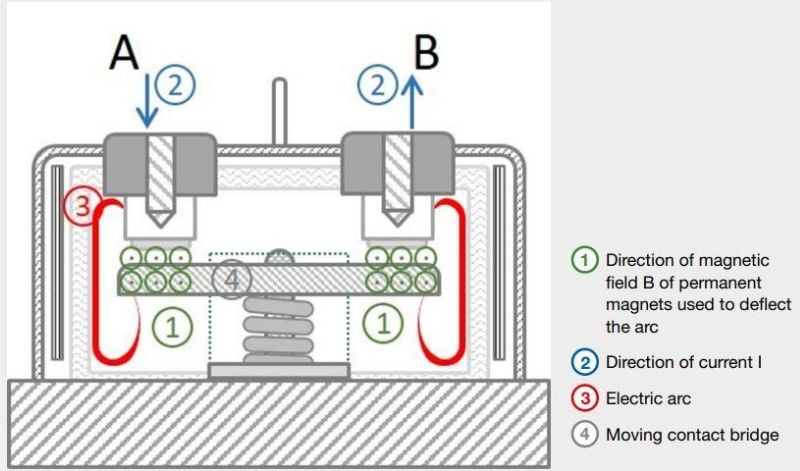
Working of a gas-filled contactor. Image courtesy of TDK Electronics
During high-power DC switching, transitioning a contactor from closed to open generates an electrical arc with significant energy, capable of damaging or melting the contact surfaces. This arc must be suppressed as quickly as possible; otherwise, prolonged arcing imposes severe stress on the contactor.
One effective arc-quenching method uses gas-filled contactors with two fixed contacts and a movable bridge. The bridge increases arc length, while magnetic deflection, assisted by permanent magnets, helps separate and cool the arc. High-pressure hydrogen gas mixtures further accelerate arc cooling and extinguishment.
Future Integration
High-voltage DC contactors’ enhanced reliability and efficiency will be central to the future of energy storage and charging infrastructures. As renewable deployments scale, system integrators can leverage these advancements to design higher-density energy storage system arrays and faster MCS installations, thereby reducing footprint and costs. Ongoing work to improve material resilience and control algorithms will hopefully further refine switching performance.
Related Content