Facebook
 Google
 GitHub
 Linkedin
TrustinSoft’s New Tools Analyze a Hybrid C/C++ and Rust Code Base
Using a mathematically sound method, TrustinSoft's new service shows designers how many (or how few) errors are in their hybrid Rust/C/C++ code bases.
At Embedded World 2025, TrustinSoft revealed its Rust Code Analysis Service for hybrid C/C++ and Rust software evaluation. This new tool complements TrustinSoft’s Software Analyzer portfolio and allows designers to outsource compliance verification of their code.

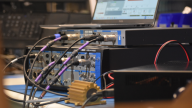
TrustInSoft CEO Caroline Guillaume (left) with All About Circuits' editor-in-chief Jeff Child at Embedded World 2025.
To learn more about the Rust Code Analysis Service, All About Circuits' editor-in-chief Jeff Child met with Caroline Guillaume, CEO at TrustinSoft at Embedded World 2025. Through our conversation, we learned some details of how this new tool can improve code safety and reduce time to market.
Rust Is Safe—Until It Isn’t
Since its release in 2015, the Rust programming language has gained a considerable amount of attention in the software community. This attention is well-deserved; Rust includes several features that build upon older languages such as C or C++.

While the Rust programming language includes several built-in features to improve program safety without external applications, it is still subject to unsafe programming in embedded or hybrid environments. Image used courtesy of CodeZeros
Within the Rust language, designers find built-in memory safety features that can be solved in the compiling stage, creating a much safer development environment with minimal impact on the code’s final speed.
In spite of these integrated safety features, Rust is still subject to misuse. In embedded environments, where users cannot access the Rust “std” library, designers can quickly find themselves succumbing to memory errors that were once thought to be long gone. In addition, hybrid codebases using Rust in combination with C or C++ can also create memory or security weak points, mandating third-party analysis tools to prove the code’s infallibility.
Guillaume discussed these types of complex errors and how TrustinSoft designed its analysis tools to solve them.
“We know that traditional testing—either static analysis, traditional testing through execution of the code, dynamic testing—may oversee types of errors that are subtle and difficult to identify,” Guillaume said. “Our mission is identifying those difficult errors, which have heavy consequences. We want to find them.”
Enter the Rust Code Analysis Service
TrustinSoft’s Rust Code Analysis Service is not its first foray into the world of software compliance testing. In fact, TrustinSoft has a long history of designing software analyzers specifically to point out the presence (or absence) of critical complex software bugs that could drastically impact the functionality of C or C++ code.

The Rust Code Analysis Service provides designers with a simpler method of finding critical errors and proving that their code is error-free. Image used courtesy of TrustinSoft
With its Rust Code Analysis Service, however, TrustinSoft has expanded its support to include both Rust-only code bases and hybrid Rust/C/C++ code bases. With the Rust Code Analysis Service, designers can identify and eliminate security or memory issues before deployment, with root cause analysis to determine exactly where the errors originated. Furthermore, the service comes with target-aware emulation capabilities, enabling error identification in the specific environment the code is executed.
The Rust Code Analysis Service can also mathematically prove when no errors exist.
“We are what you call sound,” Guillaume said. “Sound is equivalent to no false negative. We’re not allowed to miss a bug, and our tool is qualified to actually do that.”
Improving Security, Even for AI-Made Code
TrustinSoft designed Rust Code Analysis Service to accelerate time to market by quickly and accurately pinpointing software errors. AI-generated code is a particularly interesting use case that may greatly benefit from TrustinSoft’s verification tools.
“Whether it’s code generated by humans or whether it’s code generated by AI, to us, it’s very similar,” Guillaume noted.
Now, instead of manually hunting for code-breaking bugs, designers can leverage this mathematically sound software analysis suite to do the job.