Facebook
 Google
 GitHub
 Linkedin
USC Revolutionizes Electron Paramagnetic Resonance in One-Chip Solution
USC researchers have developed the first fully integrated chip-based sensor that performs pulse-mode electron paramagnetic resonance spectroscopy.
University of Southern California (USC) electrical engineering Ph.D. student Ray Sun and his professor, Constantine Sideris, have developed and demonstrated a new sensor combining continuous wave (CW) and pulse electron paramagnetic resonance (EPR) onto a single 1.5-mm x 2-mm chip.
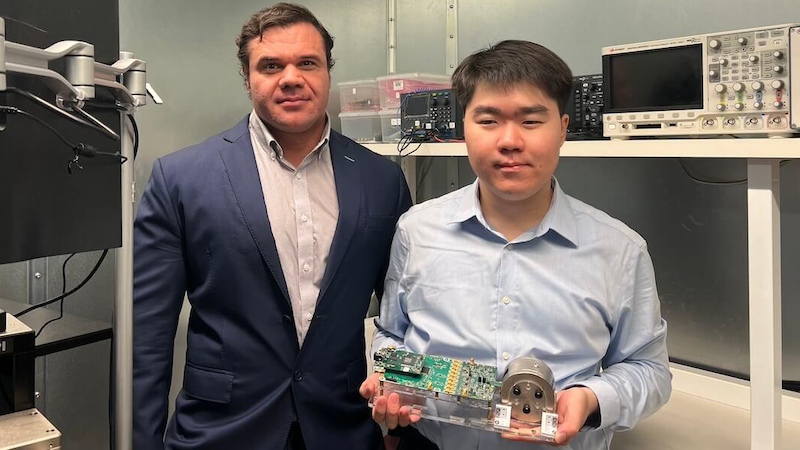
Ray Sun (right) and Constantine Sideris (left) with portable EPR proof of concept. Image used courtesy of USC
The chip enables, for the first time, pulse-mode EPR spectroscopy on a portable, highly integrated platform.
What Is EPR Spectroscopy?
Electron paramagnetic resonance (EPR) spectroscopy, sometimes called electron spin resonance (ESR) spectroscopy, directly detects radicals—atoms or molecules with unpaired electrons. When radicals are placed in a magnetic field, the electrons absorb energy from microwave radiation at specific frequencies. Scientists study this absorption to determine the properties of the radicals.
EPR is most often used as an analytical method to study radicals, including organic radicals and transition metal-containing complexes. In bioscience, EPR-sensitive molecules called spin labels are used to study the structure and dynamics of proteins, cell membranes, DNA, and more. EPR can also be used for defect detection and material characterization in semiconductors and organic materials. It has also gained attention in quantum computing as a method to control and manipulate qubits that use electron spins.
Continuous-Wave and Pulse EPR
The most straightforward method of performing EPR is continuous-wave (CW) EPR, where low-power microwaves are used to excite the sample continuously. The magnetic field strength or the frequency of the microwaves is varied to measure a spectrum. EPR may also be performed by pulsing the microwave signal.
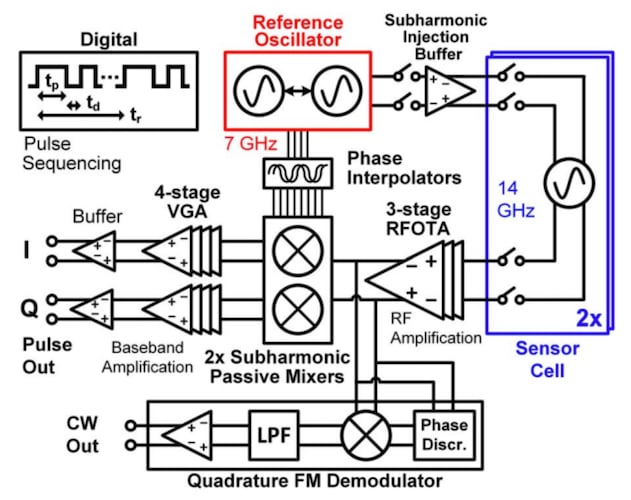
System architecture of the proposed EPR spectrometer IC. Image used courtesy of Ray Sun
The pulses rotate the magnetization of the unpaired electrons, like a magnet deflecting the needle of a compass, which is analyzed to determine spectroscopic information. While CW EPR is easier to perform and typically offers more sensitivity than pulse EPR, pulsed operation can provide much more detail about the properties of the electron spins and their molecular surroundings compared to CW.
EPR on a Chip
Conventional EPR spectrometer instruments are large, bulky machines that rely on power-hungry superconducting electromagnets. In contrast, researchers are developing EPR sensors that use integrated circuit chips and are compatible with miniaturized permanent magnets. Miniaturized, portable systems using such chips can dramatically reduce the size and cost associated with EPR spectroscopy to enable new EPR applications, such as health monitoring.
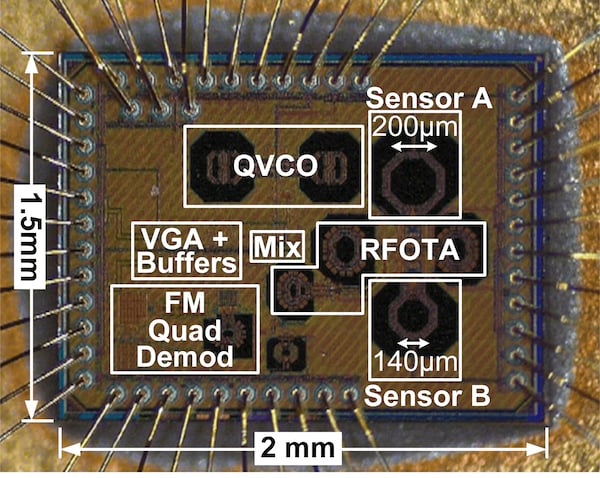
Dual-mode EPR sensor chip. Image used courtesy of USC
Chip-based EPR sensors use on-chip inductor coils to generate excitation microwaves and detect the response from a sample radical. The sample is then directly deposited onto the chip surface.
While EPR chips already existed prior to the USC researchers’ work, none have incorporated the pulse generation and detection capabilities for pulse-mode EPR—until now. In the USC researchers’ study, the sensor inductor was incorporated into an on-chip inductor-capacitor (LC) voltage-controlled oscillator (VCO) to generate a 14-GHz microwave signal. Such oscillators often used in CW EPR chips may face the challenge of rapidly turning the VCO on and off during pulse operation. The USC researchers introduced circuit innovations to accomplish this and generate nanoseconds-long pulses.
The Promise of Portable Dual-Mode EPR
USC’s dual-mode sensor stands to revolutionize EPR by simultaneously supporting both modes of EPR and significantly reducing the device size and cost. The portable EPR system combines the chip with a small 0.5 Tesla permanent magnet, enabling EPR measurements with only the system and a laptop. The whole system fits inside a shoebox, and the researchers estimate that the system’s compact form factor, combined with the mass-producibility of semiconductor chips, reduces the overall cost by three orders of magnitude compared to traditional EPR equipment.
While traditional EPR spectrometers use a single sensing cell, USC's chip uniquely houses two independent sensing cells, each capable of both EPR modes. This allows the chip to run multiple experiments simultaneously on different samples. To switch modes on conventional EPR machines, users must reconfigure the instrument hardware or use different spectrometers altogether. EPR sensor cells, on the other hand, can be configured for either mode simply by reprogramming the chip.
The miniaturized EPR spectrometer holds exciting promise in medical applications that use EPR to detect and characterize radicals. The single-chip solution may even open the path to low-cost, portable analysis equipment in patient homes or outpatient clinics.
Sun and Sideris originally presented this chip at the International Solid-State Circuits Conference (ISSCC) in February 2024. They recently published their work in IEEE Transactions on Biomedical Circuits and Systems.
Special thanks to Ray Sun for providing access to his research for this article's development.