Facebook
 Google
 GitHub
 Linkedin
Introduction to RMS Measurements
Charles Steinmetz: The Fascinating Father of RMS
Root-mean-square (RMS) calculation was introduced over a hundred years ago by Charles Steinmetz, who grew up in Breslau, Germany (now Poland). Shortly before he got his Ph.D. in mathematics and physics, he had to flee to Switzerland because of his socialist activities. In 1889, he emigrated to the U.S. and found a job as an assistant draftsman in Yonkers. The company he worked for fabricated hat-making machinery but soon expanded into electrical motors.
Steinmetz was a small man with a hunchback and one leg shorter than the other, a deformity he inherited from his father. Though he made the proverbial bad first impression, the people around him soon were in awe of his razor-sharp mind. No surprise, then, that the overqualified draftsman was at the forefront of AC engineering within four years. Through mergers and acquisitions, Steinmetz found himself working for General Electric as head of the calculating department in Schenectady and teaching at Union College.
He led a bohemian life: afraid to marry because of his inherited deformity, he shared his house with an entire family and kept several crows, raccoons, eagles, owls, squirrels, dogs, and alligators. He resumed his socialist activities, expounding his ideas in a book—he was against competition and advocated an industrial reorganization by the government. Remarkably, he got along very well with his bosses at GE.
In all respects, Steinmetz was a delightful man who seemed to have a very happy life. Almost singlehandedly, he moved electrical engineering from a craft to a profession.
The Problematic Averages of Alternating Currents
Steinmetz found that few electricians used mathematics, his specialty. The first curriculum in electrical engineering started at MIT in 1882, and very few people understood AC. George Prescott lamented in 1888 that "it is a well-known fact that alternating currents do not follow Ohm's law, and nobody knows what law they follow."
For example, there were two things wrong with the average value that meters of the time displayed:
- The true average of an AC waveform should have been zero.
- The product of the average current and voltage gave the wrong answer for power.
The phase shift between voltage and current also left almost everyone perplexed.
The Root-Mean-Square Process
In 1893, Steinmetz presented his first paper on the use of complex numbers in electrical engineering. It was heavy going, delivered in a thick German accent. But he kept at it in paper after paper, and then in a massive, three-volume textbook. By 1901, he had it down pat, and he finally published a textbook that was easy to understand.
What he said was this: in order to calculate the average power correctly, you need to do the following:
- Square the voltage or current.
- Calculate its mean.
- Take the square root.
That’s where we get the name RMS—root-mean-square. In a bit more detail, the process is:
- Divide the waveform into equal segments over one period.
- Square each segment.
- Add up the squared values.
- Calculate the average.
- Take the square root of that.
This will give you the average power. Keep in mind that there’s no such thing as RMS power, only RMS voltage and RMS current.
For a pure sine wave, this works out as:
$$V_{RMS}~=~ \frac{V_{peak}}{\sqrt 2} ~=~ 0.707 ~\times~ V_{peak}$$
Example RMS Calculation
Let’s use Figure 7-1 to work through a simple example of an RMS calculation.
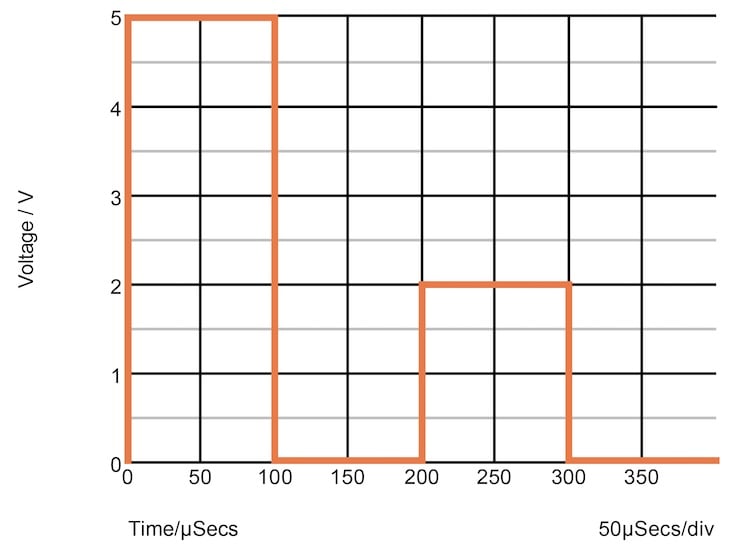
Figure 7-1. Arbitrary voltage waveform for RMS calculation.
The voltages in this figure are divided into four time segments of 100 μs each:
- 0 μs to 100 μs: 5 V.
- 100 μs to 200 μs: 0 V.
- 200 μs to 300 μs: 2 V.
- 300 μs to 400 μs: 0 V.
Plugging this into the RMS equation, we get:
$$V_{RMS} ~=~ \sqrt \frac{5^2~+~0^2~+~2^2~+~0^2}{4} ~=~ 2.69~\text{V}$$
Limitations of RMS Calculations
RMS calculation has some limitations—for example, it doesn’t work with nonlinear elements. In Steinmetz's time, there were no transistors, not even vacuum tubes. There were only linear elements (save perhaps for the occasionally saturating transformer), so he didn't consider what would happen if the impedance changes while you’re measuring RMS voltage and current.
Take the case of a transistor stage, either linear or switching. You want to determine its power dissipation, so you measure the current through it and the voltage across it. But the impedance of the transistor constantly changes, and Ohm's law doesn't hold.
The product of RMS voltage and RMS current gives an absurdly wrong result for power. The only way you can determine the power is to integrate the instantaneous values of voltage times current. In a simulation, SPICE does this very well, but measurements aren't nearly so easy.
Though "True RMS" instruments do indeed have a circuit element that measures RMS rather than average, the inputs to almost all of them are capacitively coupled. If the waveform you’re measuring has a DC component, it’s ignored, and the result reflects only its AC portion.