Facebook
 Google
 GitHub
 Linkedin
The Schmitt Trigger
Otto H. Schmitt was not a German electronics engineer as one would expect. He was born in St. Louis, Missouri in 1913 and studied biophysics and zoology. All through his life, he built the electronic equipment he needed for his research himself. As a result, he became an expert in electronics as well.
In 1934, Otto Schmitt was 21 years old. He was engaged in the study of the nervous system at the time, and came up with a bistable circuit that mimicked the behavior of a nerve (using vacuum tubes, of course). He never patented his design, which eventually became known as the Schmitt trigger.
The schematic in Figure 11-10 is a translation of his circuit into MOS devices.
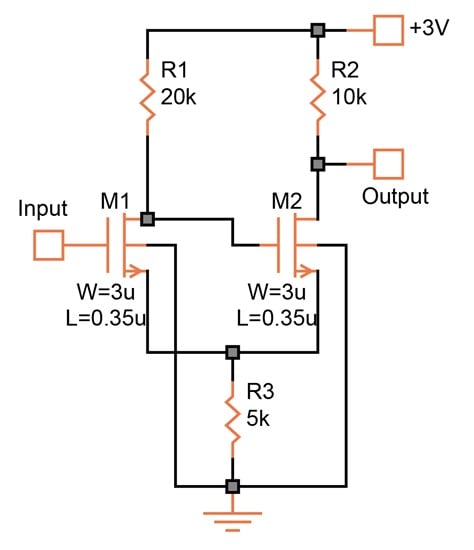
Figure 11-10. A MOSFET Schmitt trigger.
With the input low, the gate of M2 is biased high through R1. This turns M2 ON.
The ratio of R2 to R3 sets a bias point at the sources of the two transistors. When the input is greater than the sum of the bias point and the threshold voltage of M1, M1 turns ON, M2 turns OFF, and the bias voltage is set to a lower level by the ratio of R1 to R3. This is illustrated in Figure 11-11.

Figure 11-11. Voltage plot for the Schmitt trigger in Figure 11-10.
Otto Schmitt died in 1998 after a long and productive tenure at the University of Minnesota. Although he’s best known for the Schmitt trigger, it represents only a minute fraction of his contributions to science and engineering.