Facebook
 Google
 GitHub
 Linkedin
AC Electric Circuits
AC Power
47 questions By Tony R. Kuphaldt
-
Question 22 of 47
In this circuit, three common AC loads are represented as resistances, combined with reactive components in two out of the three cases. Calculate the amount of true power (P), apparent power (S), reactive power (Q), and power factor (PF) for each of the loads:
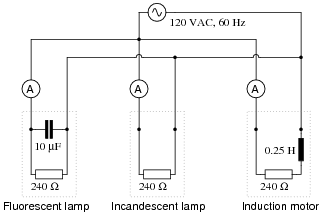
Also, draw power triangle diagrams for each circuit, showing how the true, apparent, and reactive powers trigonometrically relate.
Reveal answerFluorescent lamp: P = 60 W ; Q = 54.3 VAR ; S = 80.9 VA ; PF = 0.74, leading
Incandescent lamp: P = 60 W ; Q = 0 VAR ; S = 60 VA ; PF = 1.0
Induction motor: P = 52.0 W ; Q = 20.4 VAR ; S = 55.8 VA ; PF = 0.93, lagging
Notes:Your students should realize that the only dissipative element in each load is the resistor. Inductors and capacitors, being reactive components, do not actually dissipate power.
Ask your students how the “excess” current drawn by each load potentially influences the size of wire needed to carry power to that load. Suppose the impedance of each load were 100 times less, resulting in 100 times as much current for each load. Would the “extra” current be significant then?
Being that most heavy AC loads happen to be strongly inductive in nature (large electric motors, electromagnets, and the “leakage” inductance intrinsic to large transformers), what does this mean for AC power systems in general?
-
Question 23 of 47
Calculate the amount of phase shift between voltage and current in an AC circuit with a power factor of 0.97 (lagging), and an apparent power of 3.5 kVA. Also, write the equation solving for phase shift, in degrees.
Reveal answerΘ = arccos(PF) = 14.1o
Notes:Ask your students whether this circuit is predominantly capacitive or predominantly inductive, and also how they know it is such.
It is very important for students to be able to solve for angles in simple trigonometric equations, using “arcfunctions,” so be sure you discuss the method of solution for this question with your students.
-
Question 24 of 47
A common analogy used to describe the different types of power in AC circuits is a mug of beer that also contains foam:
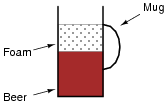
Explain this analogy, relating the quantities of beer and foam to the different types of power in an AC circuit, and also why this analogy is often employed to describe the “desirability” of each power type in a circuit.
Reveal answerThe beer itself is “true” power (P, measured in Watts). Good beer, good. Ideally, we’d like to have a full mug of beer (true power). Unfortunately, we also have foam in the mug, representing “reactive” power (Q, measured in Volt-Amps-Reactive), which does nothing but occupy space in the mug. Bad foam, bad. Together, their combined volume constitutes the “apparent” power in the system (S, measured in Volt-Amps).
Follow-up question: can you think of any potential safety hazards that low power factor may present in a high-power circuit? We’re talking AC power circuits here, not beer!
Notes:Ask your students to apply this analogy to the following AC circuits: how much beer versus foam exists in each one?