
 Facebook
 Google
 GitHub
 Linkedin
AC Electric Circuits
Advanced Electromagnetism and Electromagnetic Induction
11 questions By Tony R. Kuphaldt
-
Question 1 of 11
∫f(x) dx Calculus alert!
Electronic power conversion circuits known as inverters convert DC into AC by using transistor switching elements to periodically reverse the polarity of the DC voltage. Usually, inverters also increase the voltage level of the input power by applying the switched-DC voltage to the primary winding of a step-up transformer. You may think of an inverter’s switching electronics as akin to double-pole, double-throw switch being flipped back and forth many times per second:
The first commercially available inverters produced simple square-wave output:
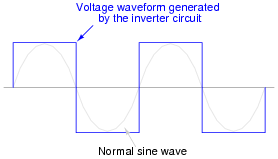
However, this caused problems for most power transformers designed to operate on sine-wave AC power. When powered by the square-wave output of such an inverter, most transformers would saturate due to excessive magnetic flux accumulating in the core at certain points of the waveform’s cycle. To describe this in the simplest terms, a square wave possesses a greater volt-second product than a sine wave with the same peak amplitude and fundamental frequency.
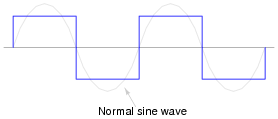
This problem could be avoided by decreasing the peak voltage of the square wave, but then some types of powered equipment would experience difficulty due to insufficient (maximum) voltage:
A workable solution to this dilemma turned out to be a modified duty cycle for the square wave:
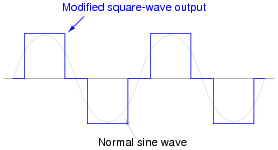
Calculate the fraction of the half-cycle for which this modified square wave is “on,” in order to have the same volt-second product as a sine wave for one-half cycle (from 0 to π radians):
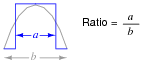
Hint: it is a matter of calculating the respective areas underneath each waveform in the half-cycle domain.
Reveal answer$$Fraction=\frac{2}{π}≈ 0.637$$
Challenge question: prove that the duty cycle fraction necessary for the square wave to have the same RMS value as the sine wave is exactly 1/2. Hint: the volts-squared-second product of the two waveforms must be equal for their RMS values to be equal!
Notes:This problem is a great example of how integration is used in a very practical sense. Even if your students are unfamiliar with calculus, they should at least be able to grasp the concept of equal volt-second products for the two waveforms, and be able to relate that to the amount of magnetic flux accumulating in the transformer core throughout a cycle.
-
Question 2 of 11
An electric arc welder is a power conversion device, used to step utility power voltage (usually 240 or 480 volts AC) down to a low voltage, and conversely step up the current (to 100 amps or more), to generate a very hot arc used to weld metal pieces together:
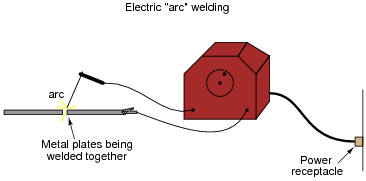
The simplest designs of arc welder are nothing more than a large step-down transformer. To achieve different power intensities for welding different thicknesses of metal, some of these arc welders are equipped with taps on the secondary winding:

Some arc welder designs achieve continuous variability by moving a magnetic ßhunt” in and out of the transformer core structure:
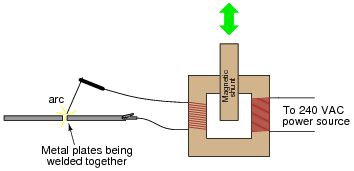
Explain how this shunt works. Which way does it need to be moved in order to increase the intensity of the welding arc? What advantages does this method of arc power control have over a “tapped” secondary winding?
Reveal answerAs the shunt is pulled further away from the core (up, in the illustration), the welding arc intensity increases.
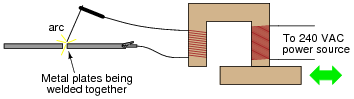
Challenge question: why would it not be a good idea to achieve the same continuously-variable arc control by varying the reluctance (ℜ) of the transformer’s magnetic circuit, like this?
Notes:This question illustrates an application of the coupling (k) factor between mutual inductors. There are a few advantages of controlling the arc welder’s output in this manner, as compared to using winding taps, so be sure to discuss this with your students.
As to the challenge question, controlling the transformer output in this manner would also affect the magnetizing inductance of the primary winding, which would have detrimental effects at low settings (what would happen to the “excitation” current of the primary winding as its inductance decreases?).
-
Question 3 of 11
The majority of the “humming” sound emitted by an unloaded transformer is due to an effect known as magnetostriction. What is this effect, exactly?
Reveal answer“Magnetostriction” is the physical strain (contraction or expansion) of a material when subjected to a magnetic field.
Notes:Ask your students if they discovered whether magnetostrictive materials normally contract or expand with the application of a magnetic field. The answer to this question is quite surprising!




Question 5 - If the source voltage polarity is reversed, would the decay of the field respond quicker than if the source voltage was simply turned off? In other words, would the slope of the flux decay/growth be steeper at voltage reversal, than what it is at its initial condition when the voltage is first applied?