
 Facebook
 Google
 GitHub
 Linkedin
AC Electric Circuits
Advanced Electromagnetism and Electromagnetic Induction
11 questions By Tony R. Kuphaldt
-
Question 4 of 11
∫f(x) dx Calculus alert!
What would happen to the magnetic flux inside an air-core inductor made of superconducting wire (no electrical resistance at all), if a constant DC voltage were applied to that coil? Remember, this is an ideal scenario, where the only mathematical function describing the resulting flux is that which relates magnetic flux to voltage and time!Reveal answerIdeally, the flux would increase from zero in a linear fashion over time.
Follow-up question: what would happen with an iron-cored inductor, with the same superconducting (zero-resistance) wire?
Notes:Discuss with your students why the flux increases linearly, as described by Faraday’s Law of electromagnetic induction. When discussing the iron-core scenario, be sure to mention magnetic saturation if your students have not considered it!
-
Question 5 of 11
∫f(x) dx Calculus alert!
Plot the magnetic flux (Φ) over time in the core of an ideal transformer, given a square-wave voltage applied to the primary winding:
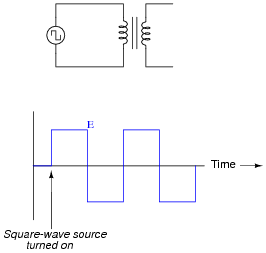
Hint: The output voltage (measured at the secondary winding) will also be a square wave, perfectly in-phase with the source (primary) voltage.
Reveal answer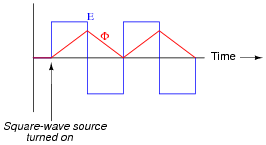
Notes:Have students relate the equation EL = N dφ/dt to this problem, discussing the flux wave-shape in terms of rate-of-change over time.
-
Question 6 of 11
∫f(x) dx Calculus alert!
Plot the magnetic flux (Φ) over time in the core of an ideal transformer, given a square-wave voltage applied to the primary winding:
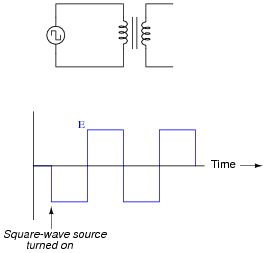
Hint: The output voltage (measured at the secondary winding) will also be a square wave, perfectly in-phase with the source (primary) voltage.
Reveal answer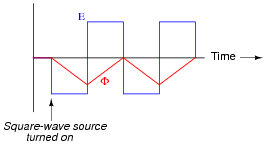
Notes:Have students relate the equation EL = N $$\frac{d φ}{dt}$$ to this problem, discussing the flux wave-shape in terms of rate-of-change over time.





Question 5 - If the source voltage polarity is reversed, would the decay of the field respond quicker than if the source voltage was simply turned off? In other words, would the slope of the flux decay/growth be steeper at voltage reversal, than what it is at its initial condition when the voltage is first applied?