
 Facebook
 Google
 GitHub
 Linkedin
AC Electric Circuits
Advanced Electromagnetism and Electromagnetic Induction
11 questions By Tony R. Kuphaldt
-
Question 7 of 11
∫f(x) dx Calculus alert!
Plot the magnetic flux (Φ) over time in the core of an ideal transformer, given a square-wave voltage applied to the primary winding:
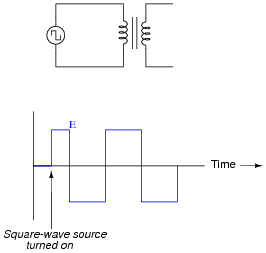
Important: note the point in time where the square-wave source is energized. The first pulse of applied voltage to the primary winding is not full-duration!
Reveal answer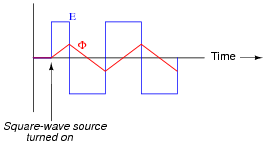
Follow-up question: explain why the flux waveform is symmetrical about the zero line (perfectly balanced between positive and negative half-cycles) in this particular scenario. How would this situation differ if the square-wave voltage source were energized at a slightly different point in time?
Notes:Have students relate the equation EL = N $$\frac{d φ}{dt}$$ to this problem, discussing the flux wave-shape in terms of rate-of-change over time.
-
Question 8 of 11
Power transformers may “surge” when initially connected to a source of AC voltage, drawing up to several times their rated primary current for a brief period of time. This inrush of current is usually audible, especially if the transformer is a large power distribution unit, and you happen to be standing next to it!
At first, this phenomenon may seem contradictory, based on your knowledge of how inductances respond to transient DC voltage (zero current at first, then the current builds asymptotically to its maximum value). Indeed, even with AC, it is the nature of inductance to oppose current by dropping voltage (producing a counter-EMF). So why would an unloaded transformer draw a large inrush current when initially connected to a source of AC voltage?
Hint: a transformer will not always surge when first connected to its voltage source. In fact, if you were to open and close the disconnect switch feeding a power transformer’s primary winding, you would find the surge phenomenon to be almost random: some times there would be no surge when you closed the switch, and other times there would be surge (to varying degrees) when the switch closed.
Reveal answerA transformer will surge the most if the switch closes at the exact moment the AC voltage waveform crosses zero volts. It will not surge at all if the switch closes exactly at one of the AC voltage peaks (either positive or negative).
Notes:This is a complex question to answer. A full explanation of the “surge” effect requires the use of calculus (integrating the voltage waveform over time) to explain the magnitude of magnetic flux in the transformer core, and how this approaches saturation during a surge.
Despite the highly mathematical nature of the question, it is a very practical one. If and when your students build AC-DC power supplies, they may find that the fuse in series with the primary winding of the transformer occasionally blows when powered up, even though the power supply is unloaded at the time, and despite the fact that the fuse does not blow when the power supply is fully loaded. What causes this random blowing of fuses? Transformer surge!
-
Question 9 of 11
Suppose you were testing this step-down transformer, moving the selector switch between its various positions and measuring the transformer’s output voltage at each switch position:

You notice something strange: when the switch is moved to the position producing the greatest output voltage, the transformer audibly “buzzes.” It produces no noticeable noise in any of the other switch positions. Why is this happening?
Hint: if the switch is left in the “buzzing” position for any substantial amount of time, the transformer temperature begins to increase.
Reveal answerThe transformer core is saturating when the switch is in that one position. This accounts for both the noise and the heating.
Notes:Discuss with your students why the transformer core saturates only in that one switch position. Why not in any of the other switch positions?
In a non-tapped transformer, what condition(s) lead to core saturation? How does this relate to the scenario shown here with a tapped transformer?
Ideally, power transformer circuits should be designed to avoid core saturation, but this is not always the case in cheap designs. I once encountered a tapped transformer, much like the one shown in the diagram, from an automotive battery charger which acted like this. It was an excellent example for my students to feel and hear magnetic saturation.





Question 5 - If the source voltage polarity is reversed, would the decay of the field respond quicker than if the source voltage was simply turned off? In other words, would the slope of the flux decay/growth be steeper at voltage reversal, than what it is at its initial condition when the voltage is first applied?