Facebook
 Google
 GitHub
 Linkedin
Discrete Semiconductor Devices and Circuits
Electrical Conduction in Semiconductors
17 questions By Tony R. Kuphaldt
-
Question 7 of 17
In perfectly pure (“intrinsic”) semiconductors, the only way charge carriers can exist is for valence electrons to “leap” into the conduction band with the application of sufficient energy, leaving a hole, or vacancy, behind in the valence band:
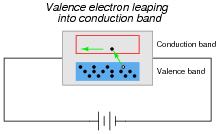
With sufficient thermal energy, these electron-hole pairs will form spontaneously. At room temperature, however, this activity is slight.
We may greatly enhance charge carrier formation by adding specific impurities to the semiconducting material. The energy states of atoms having different electron configurations do not precisely “blend” with the electron bands of the parent semiconductor crystal, causing additional energy levels to form.
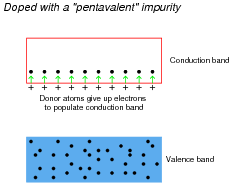
Some types of impurities will cause extra donor electrons to lurk just beneath the main conduction band of the crystal. These types of impurities are called pentavalent, because they have 5 valence electrons per atom rather than 4 as the parent substance typically possesses:
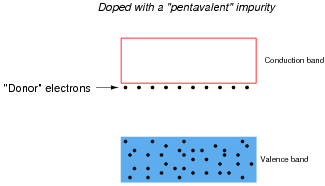
Other types of impurities will cause vacant electron levels (acceptor “holes”) to form just above the main valence band of the crystal. These types of impurities are called trivalent, because they have 3 valence electrons per atom instead of 4:

Compare the ease of forming free (conduction-band) electrons in a semiconductor material having lots of “donor” electrons, against that of an intrinsic (pure) semiconductor material. Which type of material will be more electrically conductive?
Likewise, compare the ease of forming valence-band holes in a semiconductor material having lots of “acceptor” holes, against that of an intrinsic (pure) semiconductor material. Which type of material will be more electrically conductive?
Reveal answerUnder the influence of thermal energy from ambient sources, pentavalent “donor” atoms contribute to free electrons in the conduction band:
Likewise, trivalent “acceptor” atoms contribute to holes in the valence band:

In either case, the addition of impurities to an otherwise pure semiconductor material increases the number of available charge carriers.
Notes:The most important concept for students to grasp here is that the addition of impurities increases the number of available charge carriers in a semiconducting substance. What was essentially an insulator in its pure state may be made conductive to varying degrees by adding impurities.
-
Question 8 of 17
Describe the difference between an intrinsic and an extrinsic semiconducting substance.
Reveal answerAn “intrinsic” semiconducting material is absolutely pure. An “extrinsic” semiconducting material has dopant(s) added for enhanced conductivity.
Notes:Just a simple definition here, nothing more. This is easily referenced in any introductory textbook.
-
Question 9 of 17
What type of substance(s) must be added to an intrinsic semiconductor in order to produce “donor” electrons? When this is done, how do we denote this type of “doped” semiconducting substance?
Likewise, what type of substance(s) must be added to an intrinsic semiconductor in order to produce “acceptor” holes? When this is done, how to we denote this type of “doped” semiconducting substance?
Reveal answerTo create donor electrons, you must add a substance with a greater number of valence electrons than the base semiconductor material. When this is done, it is called an N-type semiconductor.
To create acceptor holes, you must add a substance with a lesser number of valence electrons than the base semiconductor material. When this is done, it is called a P-type semiconductor.
Follow-up question: identify some common “donor” (N-type) and “acceptor” (P-type) dopants.
Notes:When doping silicon and germanium substrates, the materials used are classified as either pentavalent or trivalent substances. Ask your students which one of these terms refers to the greater valence number, and which refers to the lesser valence number.