Facebook
 Google
 GitHub
 Linkedin
Discrete Semiconductor Devices and Circuits
Insulated Gate Bipolar Transistors
5 questions By Tony R. Kuphaldt
-
Question 1 of 5
What is an Insulated Gate Bipolar Transistor (IGBT), and what advantages does the IGBT provide over both power MOSFET and traditional BJT devices?
Reveal answerThe IGBT is a hybrid device, combining the best attributes of MOSFET and BJT in a single component.
Follow-up question: describe some typical applications for the IGBT which make use of these advantages.
Notes:The given answer is accurate, yet not very specific. Ask your students to explain exactly what attributes of MOSFET and BJT are exhibited by the IGBT, and why.
-
Question 2 of 5
Complete the schematic diagram showing an equivalent circuit for an N-channel IGBT, using an N-channel E-type MOSFET and a PNP bipolar transistor:

Reveal answer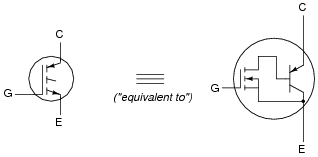
Notes:You should discuss with your students the fact that IGBT’s are not actually made of two discrete transistors connected as shown. Instead, they are fabricated as monolithic devices, all on the same semiconductor substrate. The “model” of an IGBT consisting of a MOSFET coupled to a BJT is similar to the model commonly used to emulate an SCR: a circuit whose sole purpose it is to show the operation of a special device in terms of other, well-understood devices.
-
Question 3 of 5
The equivalent circuit for an IGBT - comprised of a MOSFET coupled to a BJT - bears resemblance to a couple of other BJT circuits you may have seen before:

Which of these two paired-BJT circuits most resembles the IGBT equivalent circuit, in terms of what two terminals the control signal voltage must be applied between to turn the device on?
Reveal answerThe Sziklai pair most resembles the IGBT equivalent circuit.
Notes:It is important for students to realize what two terminals of the device the input (control) signal must be applied to in order to turn the device on. This is really the point of the question, not so much a review of Darlington versus Sziklai pairs.